Napier grass (Pennisetum purpureum, elephant grass / hybrid Napier) is a high-moisture tropical forage and biomass crop. Fresh stems are mostly water; without controlled drying they spoil fast, ship poorly, and resist stable pelleting. This page is a sizing brief—not a yield brochure. It helps plant engineers and procurement teams choose between cabinet CD / CDS and KH multi-trolley heat pump architectures for feed-grade or biomass / pellet-pathway duty, using honest wet-infeed language.
Airtek (ATK) builds heat pump food dryer chambers and open-loop multi-trolley solutions at airtekdehydrator.com. We do not invent hectare tonnage, TPH nameplates for Napier, dry-kg guarantees, hours, kWh figures, CE numbers, prices, ROI%, or client names. Start from product inquiry with your wet kg/day and end-use.
Soft note: moisture bands below are literature context / plant-trial conversation, not Airtek contractual limits. Variety, cut length, press step, and buyer / pellet mill specs change the answer.
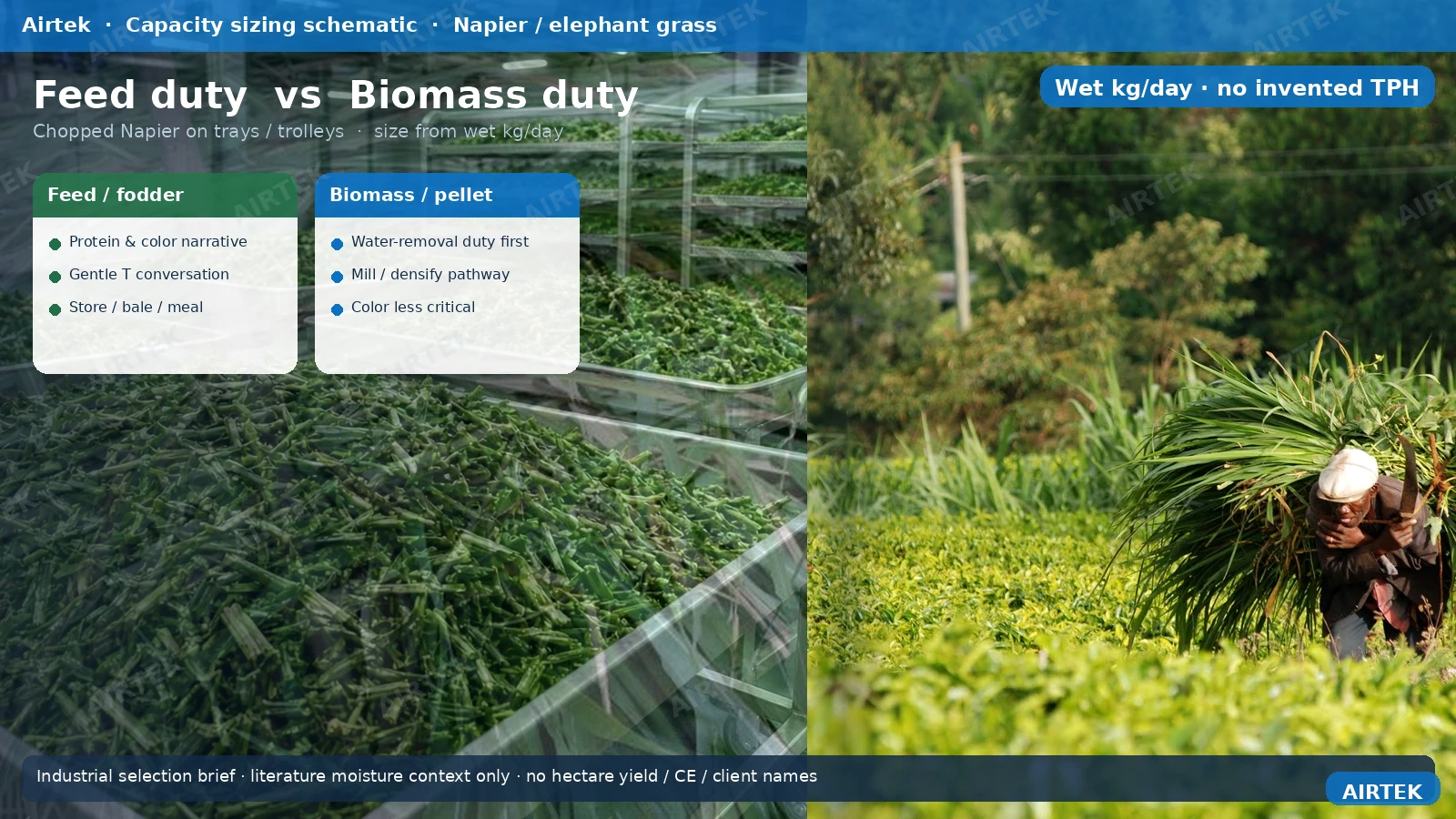
Duty definition: what “Napier drying” is for buyers
| End use | What “done” usually means (soft) | Buyer signals |
|---|---|---|
| Ruminant feed / fodder | Stable moisture for store / bale / meal; protein & color narratives matter more | Gentle heat conversation; avoid scorched leaf |
| Biomass / fuel pathway | Stable moisture for mill / densify / burn prep | Throughput & water-removal duty dominate; color less critical |
| Pellet pathway | Moisture class compatible with mill SOPs | Too wet → mold / soft pellets; over-dry → cracking conversations in literature |
A Napier grass heat pump dryer (also searched as elephant grass drying, Pennisetum dehydrator, forage grass dryer) uses a heat-pump loop to condense moisture from circulating air and return warmer, drier air to trays or trolleys. Capacity is sized from wet infeed + water removed + hours—see industrial heat pump dryer capacity sizing and the product inquiry / RFQ fields.
Related: Heat pump food dryer machine · Energy saving vs hot air · Batch vs continuous · Product inquiry
Soft moisture & process context (tables only—no invented tonnage)
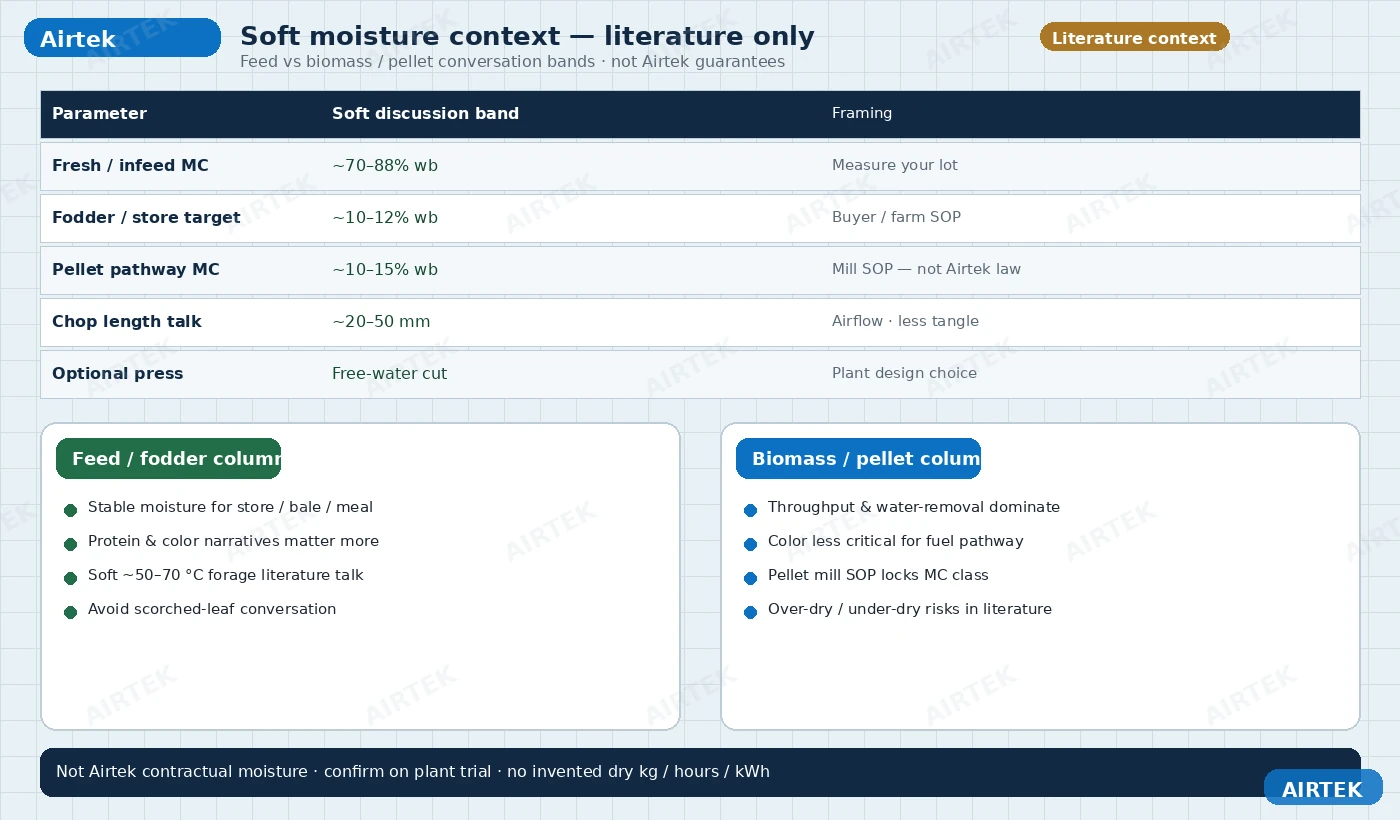
Literature-informed moisture classes
| Parameter | Soft discussion band | Framing |
|---|---|---|
| Fresh / infeed moisture class | Often discussed around roughly ~70–88% wb depending on maturity, rain, and variety | Literature context—measure your lot |
| Storage / fodder target class | Often discussed around roughly ~10–12% wb for stable fodder / bale talk | Lock to buyer / farm SOP |
| Pellet pathway moisture class | Often discussed around roughly ~10–15% wb; literature warns over-dry can crack pellets and under-dry risks mold | Confirm with mill SOP—not Airtek law |
| Chop length conversation | Field / stationary chop often discussed around roughly ~20–50 mm before dryer | Improves airflow; reduces tangle |
| Optional mechanical dewatering | Screw press / press before thermal dry reduces free water load | Plant design choice; not mandatory |
Soft temperature conversation by duty
| Duty | Soft discussion | Notes |
|---|---|---|
| Feed-quality narrative | Low-temperature belt / controlled-air talks in forage literature often cite roughly ~50–70 °C bands to protect protein narratives | Literature context—confirm on trial |
| Biomass / fuel narrative | Higher heat may be acceptable when color/protein are secondary—still avoid uncontrolled scorch of sticky sugars | Site trial; do not invent kWh |
| Heat pump advantage | Controllable T/RH, enclosed hall, weather independence, energy talk in kWh per kg water removed | No invented “X times” slogans—see energy saving vs hot air |
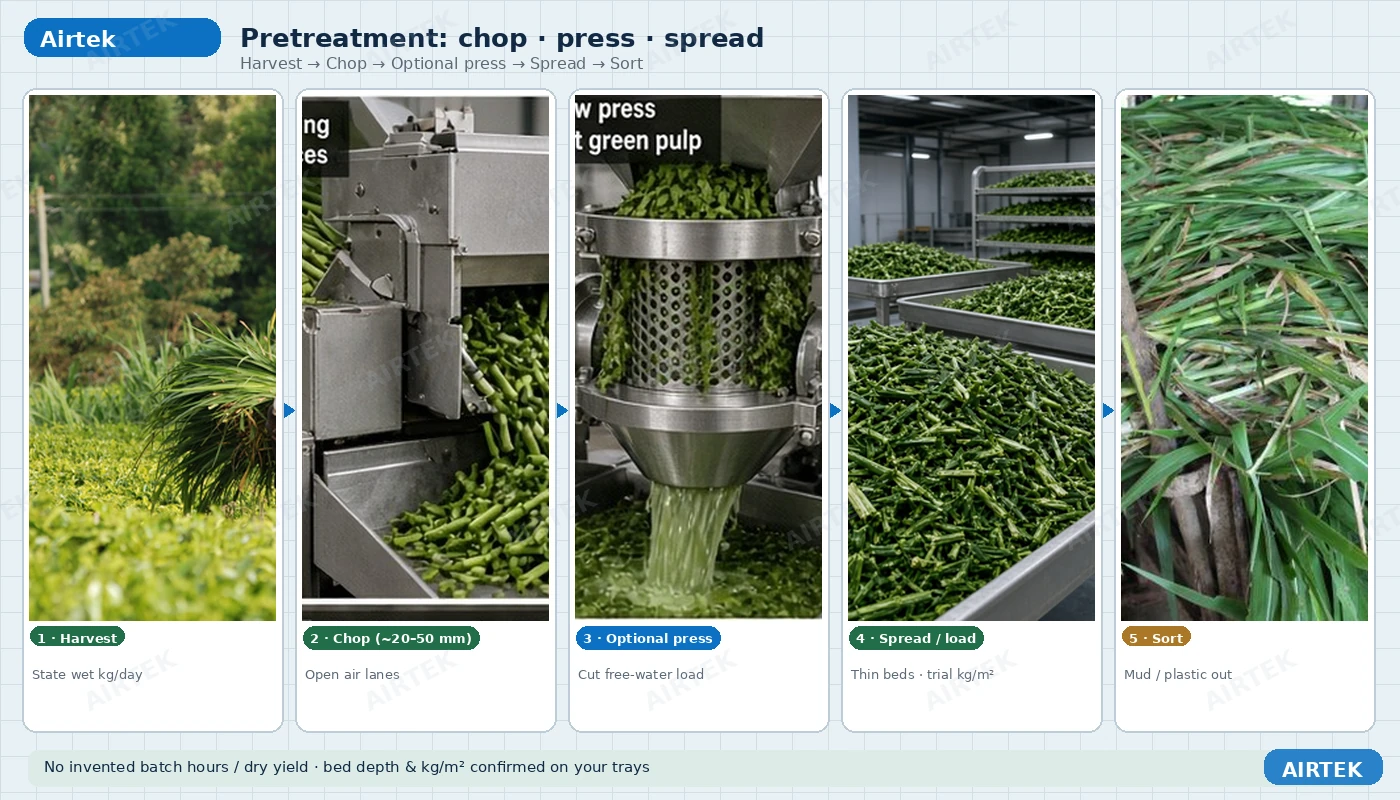
Pretreatment matrix (chop → optional press → load)
| Step | Why it matters for sizing | Soft rule |
|---|---|---|
| Harvest | Peak moisture = peak evaporation load | State wet kg/day honestly in RFQ |
| Chop | Long fiber tangles; stems dry slower than leaves | Uniform cut length; open air lanes |
| Optional press | Removes free water before thermal duty | Cuts dryer water load—do not invent % savings here |
| Spread / trolley load | Thick mats block airflow | Thin beds / controlled bed depth—trial kg/m² on your trays |
| Sort | Foreign matter, mud, plastic | Feed & biomass buyers both reject dirty lots |
Do not publish invented batch hours or dry yield from this blog.
Selection matrix: cabinet CD/CDS vs KH multi-trolley
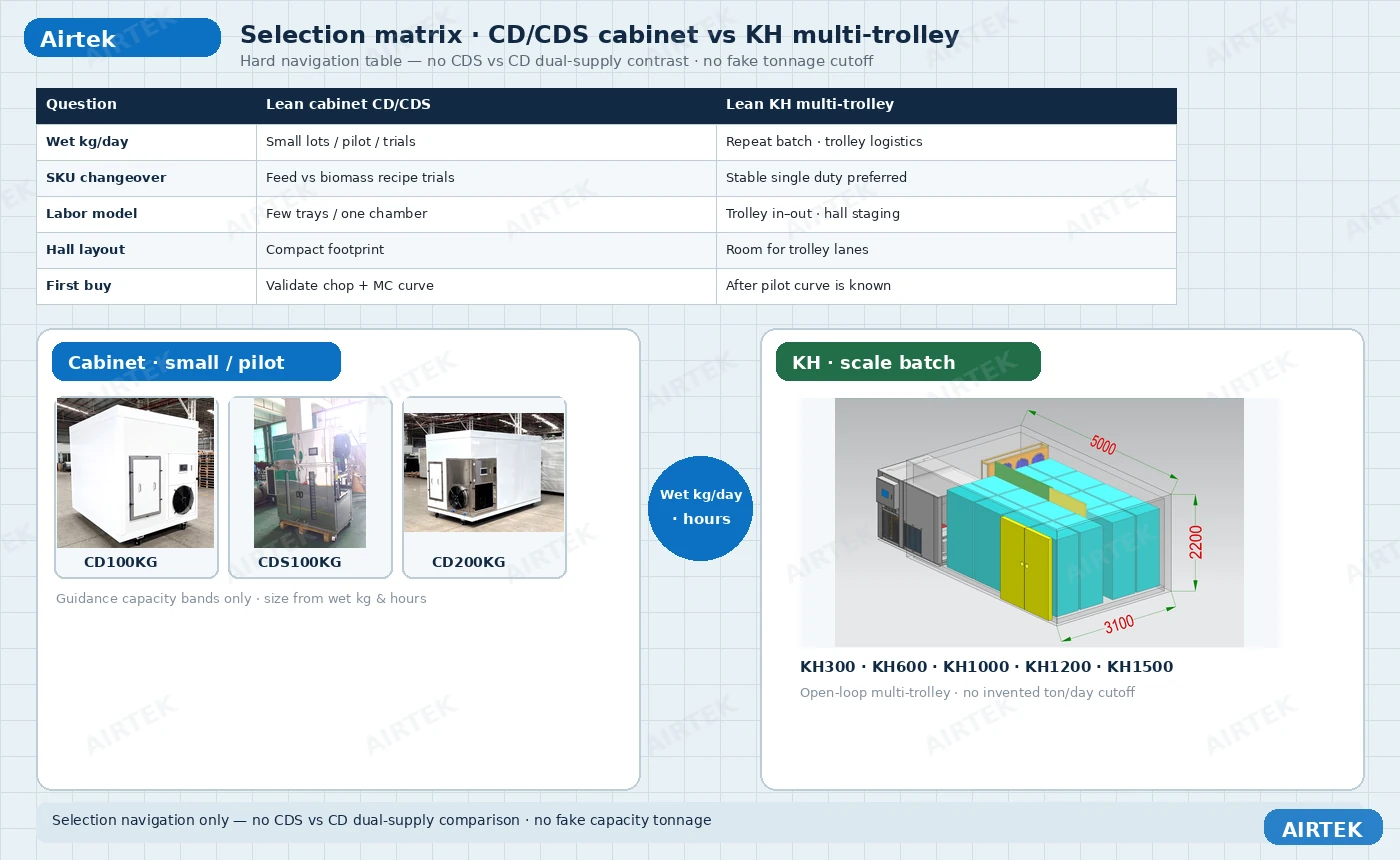
Pick architecture from lot size, labor, and hall layout—not marketing nicknames. No CDS vs CD dual-supply comparison copy—both cabinets are navigation options only.
Decision table
| Question | Lean cabinet (CD / CDS) | Lean KH multi-trolley |
|---|---|---|
| Wet kg/day | Small lots / pilot / recipe trials | Repeat batch scale when trolley logistics justify |
| SKU changeover | Frequent feed vs biomass trials | Stable single duty preferred |
| Labor model | Few trays / one chamber | Trolley in–out, hall staging |
| Hall layout | Compact footprint | Room for trolley lanes |
| First buy | Validate chop + moisture curve | After pilot curve is known |
Cabinet navigation (small / pilot)
| Model | Role | Link |
|---|---|---|
| CD100KG | Compact cabinet for chop-length & moisture trials | Product page |
| CDS100KG | Compact cabinet option for trial / small commercial lots | Product page |
| CD200KG | Larger cabinet when wet daily volume grows but single chamber preferred | Product page |
Published capacity bands on product pages are guidance only—not a contractual dry-kg promise for Napier. Confirm live page details and project sizing via inquiry.
KH open-loop multi-trolley (scale batch)
| Model | Navigation use | Link |
|---|---|---|
| KH300 | 6-trolley open-loop | Product page |
| KH600 | 12-trolley scale-up | Product page |
| KH1000 | 16-trolley | Product page |
| KH1200 | 20-trolley | Product page |
| KH1500 | 24-trolley | Product page |
Site temperature, hall RH, and power are confirmed per project—voltage and trade terms are never written as fixed public facts here. Architecture trade-offs: batch vs continuous heat pump dryer.
Method comparison (buyer framing—no invented %)
| Method | Feed narrative | Biomass narrative | Soft caveat |
|---|---|---|---|
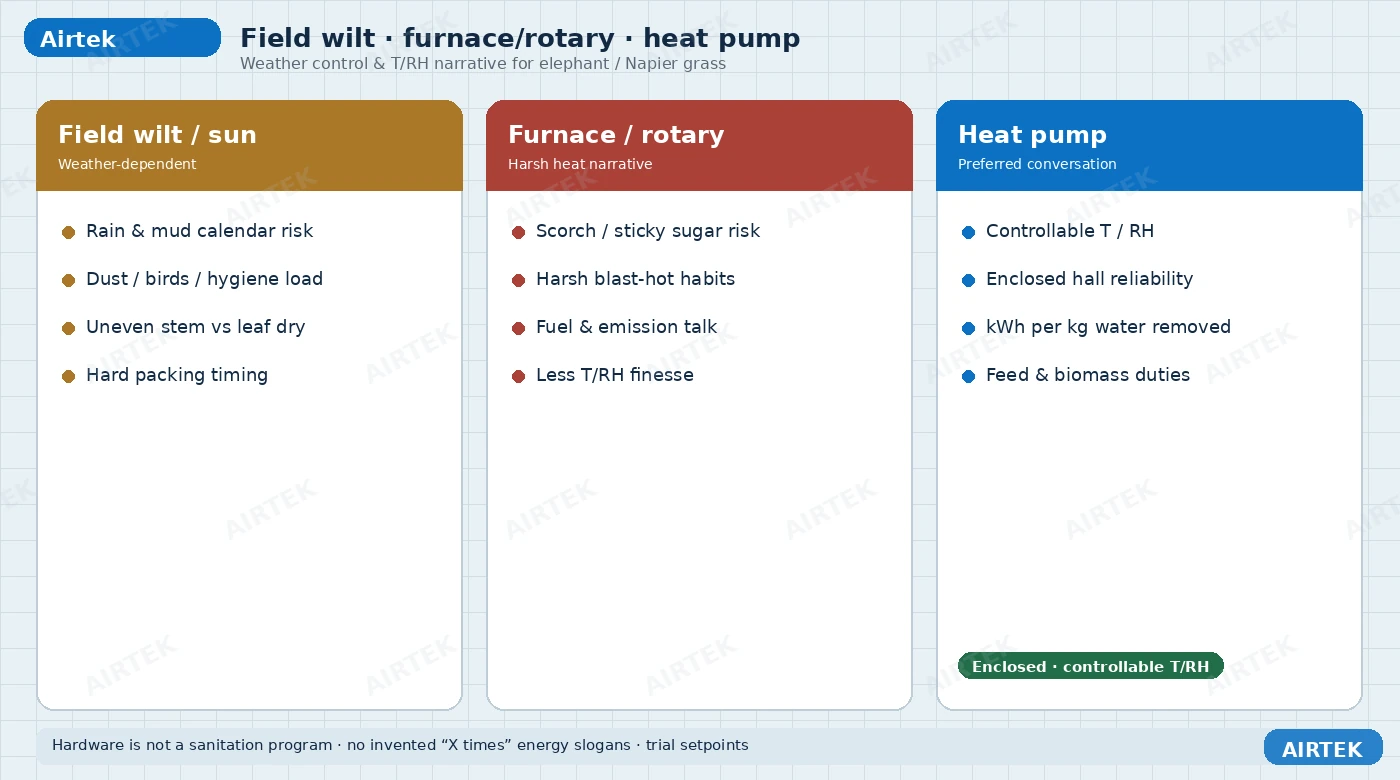
| Field wilt / sun | Low CapEx; weather & mold risk | Same | Hard calendar reliability |
| Electric resistance hot air | Simple heat; easy to over-temp protein/color | Higher heat OK if specs allow | Energy talk in kWh/kg water—no invented % |
| Gas / coal / biomass furnace hot air | Common on large rotary / belt lines | Common for fuel pathways | Scorch / smoke / emission conversations for feed buyers |
| Heat pump dryer | Controllable T/RH; enclosed; weather independence | Same levers; size from water load | Still needs chop, trials, honest wet-duty sizing |
Common process defects (industrial language)
| Defect | Typical causes | Soft mitigation |
|---|---|---|
| Matting / channeling | Unchopped long fiber; thick beds | Chop to uniform length; open air lanes |
| Wet stems / dry leaves | Stem vs leaf differential | Crush/press option; longer finish; thinner beds |
| Mold in store | Under-dried cores; humid pack | Confirm moisture class before pack; dry hold |
| Scorch / sticky sugars | Aggressive high heat on sugary lots | Moderate profile on feed duty; trial first |
| Trolley overload | Optimistic “kg dryer” nickname sizing | Size from wet kg + water removed—see capacity sizing |
FAQ — Napier grass heat pump drying
Q1. Can you dry Napier / elephant grass with a heat pump dryer?
A. Yes. Industrial heat pump dryers can dehydrate chopped Napier grass for feed or biomass pathways using controlled, dehumidified air. Exact temperature, humidity, hours, and dry yield follow plant trials and end-use moisture specs—not a blog tonnage claim.
Q2. What moisture should I target?
A. There is no single Airtek guarantee. Literature often discusses fresh grass around ~70–88% wb and storage / fodder / pellet pathways around roughly ~10–15% classes depending on use. Lock to your buyer COA or pellet mill SOP and confirm on trial.
Q3. Cabinet or KH multi-trolley for Napier?
A. Pilot / small lots → CD100KG, CDS100KG, CD200KG. Scale batch → KH300–KH1500. Size from wet kg/day and hours—not a fake TPH cutoff.
Q4. Do I need to chop before drying?
A. Usually yes for airflow and even finish. Literature and industrial practice often discuss chop lengths around roughly ~20–50 mm; optional pressing reduces free water. Confirm on your harvester and dryer trial.
Q5. What should I send Airtek for a Napier grass drying inquiry?
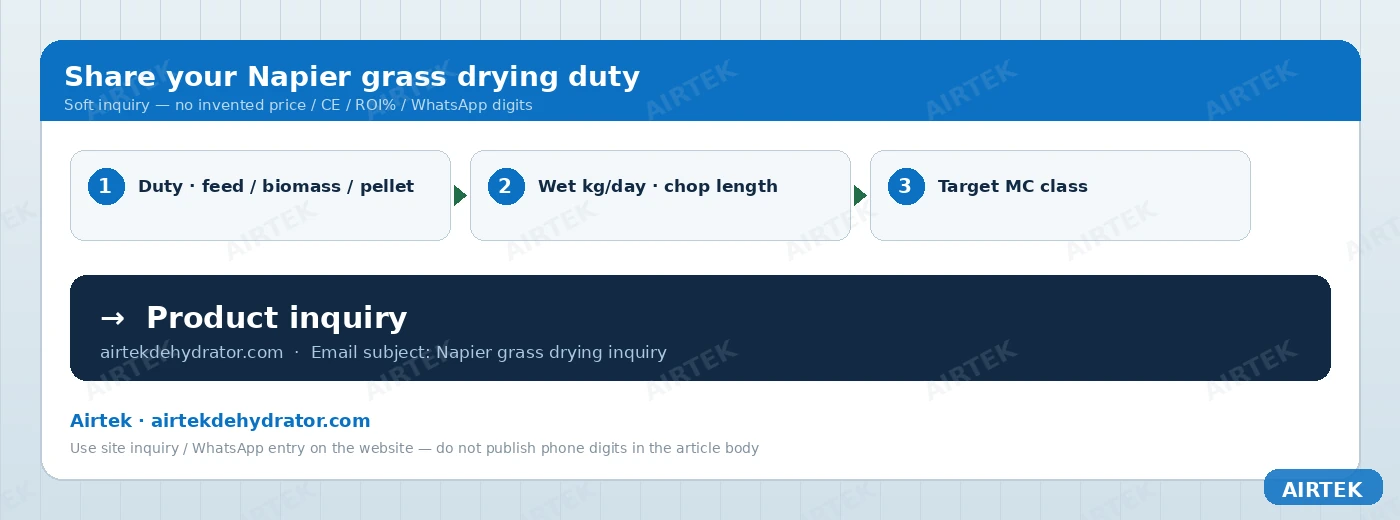
A. Send: end use (feed / biomass / pellet pathway), wet kg per batch or per day, chop length, press yes/no, target moisture language, hours/shifts, hall sketch, and power notes (confirm voltage and trade terms on inquiry). Use product inquiry, WhatsApp via the site’s contact entry (no phone digits in this article body), or email info@airtekdehydrator.com with subject Napier grass drying inquiry. Bring the product inquiry fields.
Talk to Airtek About Napier Grass Dryer Sizing
If you process Napier grass for feed or biomass, share wet daily tonnage, chop practice, and target moisture class. The Airtek team can discuss cabinet and KH multi-trolley options with clear soft trial framing—without inventing dry-kg, energy %, CE numbers, hectare yields, or prices.
Next step: send a product inquiry (or email info@airtekdehydrator.com, subject Napier grass drying inquiry) with wet infeed, duty, and trial goals.