
Buyers often ask for an industrial heat pump dryer capacity number first—“how many kg can it do?”—before they share wet infeed moisture or hours available. That order almost always produces mismatched quotes: one supplier answers in kg per batch, another in kg/h dry out, and neither converts cleanly to your daily wet tons.
This guide is for commercial buyers and plant engineers who need a sizing method, not a brochure slogan. It walks from wet input and target moisture → water removed → batch or continuous daily wet infeed → tray-area thinking → a utility and footprint checklist you can paste into RFQs. It stays educational: no invented “must buy model X above Y tons/day” cutoffs, and no competitor brand names.
Airtek supplies heat pump food dryer chambers and related industrial dehydrators for fruit and food plants. Exact machine dimensions always follow your wet mass, moisture targets, and hour calendar—not a single marketing band.
Soft note for buyers: formulas below are decision language under stated assumptions. Cycle time, loading density, and plant outputs remain open until validated on your product and site. Public capacity bands on Airtek pages are navigation aids, not contract guarantees.
What “industrial heat pump dryer capacity” means (buyer definition)
Industrial heat pump dryer capacity is not one universal number on a nameplate. In buyer language it usually means one of three things—and RFQs fail when these are mixed:
- Wet infeed capacity — how much wet product (kg or tonnes) you can load per batch or process per hour / day.
- Finished-goods capacity — how much dried product you ship after water is removed (always lower than wet infeed when moisture falls).
- Dehumidification / water-removal capacity — how much water (kg or L) the heat pump air loop can condense per hour under stated conditions—closer to engineering truth than a vague “kg dryer.”
A closed-loop heat pump food dryer conditions circulating air: it dehumidifies by condensation and reheats, so the plant’s real duty is driven by how much water must leave the product in the hours you operate—not by a slogan tonnage.
Airtek (airtekdehydrator.com) sizes chambers and lines from wet infeed, initial/final moisture (wet basis), geometry, and available hours. Compact cabinets (for example the CDS100KG cabinet food dryer) and larger chamber / belt options appear as selection navigation on the site; treat published ~100 kg class cabinets and hub bands roughly in the 200–3500 kg conversation range as guidance only—treat published capacity bands as selection guidance only until one public unify sentence is locked—never as a law that “above X tons/day you must buy Y.”
Related: Heat pump food dryer machine · Fruit drying machine · Batch vs continuous heat pump dryer · Heat pump dryer energy saving vs hot air · Product inquiry
Start from Wet Infeed and Target Moisture (Mass Balance)
Unify the units before you talk to suppliers
| Capacity language | Meaning | Common trap |
|---|---|---|
| Wet kg / batch | Mass loaded into trays or onto the belt infeed for one cycle | Confused with dry-out kg |
| Dry kg / batch | Finished mass after drying | Needs MC_i and MC_f |
| kg/h (continuous) | Steady wet in or dry out once bed depth and speed are set | Not comparable to “kg/batch” without an hour calendar |
| Tonnes / day | Batches × wet (or dry) per batch, or kg/h × hours | Hours and changeover often ignored |
Agree with your team whether the commercial target is daily wet processing, daily finished goods, or peak-week wet tons. Then write moisture on a wet-basis (% wb) basis and confirm the lab method with the buyer—confirm with your buyer COA.
Core symbols (wet basis)
MC_i: inlet moisture (% wb)MC_f: target moisture (% wb)W_i: wet infeed massW_f: finished massm_{dry}: dry-matter mass (approximately constant during drying)\Delta W: water removed (the load that drives heat-pump duty)
Formulas (method language—not an Airtek guarantee)
Dry matter:
m_{dry} = W_i \times \frac{100 - MC_i}{100}Finished mass:
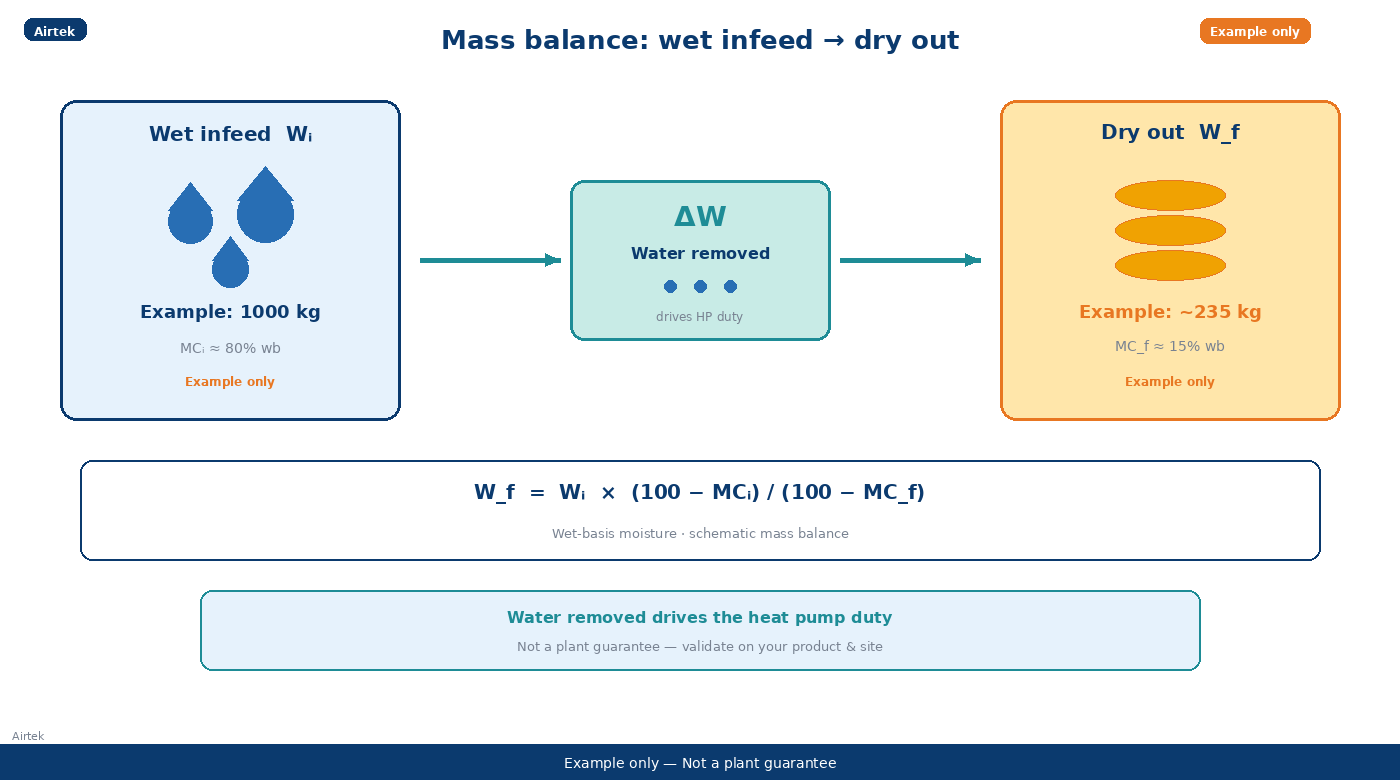
W_f = W_i \times \frac{100 - MC_i}{100 - MC_f}Water removed:
\Delta W = W_i - W_f = W_i \times \left(1 - \frac{100 - MC_i}{100 - MC_f}\right)Illustrative only (not a plant promise): if W_i = 1000\,\mathrm{kg}, MC_i = 80\%\,\mathrm{wb}, MC_f = 15\%\,\mathrm{wb}, then W_f \approx 235\,\mathrm{kg} and \Delta W \approx 765\,\mathrm{kg}. Without a measured cycle time T, you still cannot turn this into “N batches per day” as a contract clause—cycle time and shift plan must be validated on site.
Why water removed matters more than “kg dryer”
Two plants can both say “1 tonne dryer” and mean completely different duties: one removes a few hundred kg of water from already partially dried pieces; another removes most of a high-moisture fruit load. Ask suppliers to discuss kg water removed per hour (or per batch) under stated MC_i, MC_f, geometry, and ambient—then compare fairly. For energy framing (not invented % savings), see heat pump dryer energy saving vs hot air.
Crop-specific moisture thinking for fruit plants pairs well with Airtek’s banana and mango process notes—still as educational context, not yield guarantees.
Batch (kg/batch × Cycles/Day) vs Continuous (kg/h)
Architecture choice is covered in depth in batch vs continuous heat pump dryer. For capacity math, convert both to daily wet infeed under your hour calendar.
Batch / tray chamber
Let:
W_i= wet kg per batchT= full cycle time including heat-up, hold, cool-down, load/unload (project-specific)H= effective operating hours per day (project-specific)N \approx H / T(round down or by shift plan)
Then:
\text{Daily wet infeed} \approx N \times W_i, \quad \text{Daily finished} \approx N \times W_fAverage water-removal rate during the drying portion of the cycle:
\text{Approx. kg water/h} \approx \frac{\Delta W}{T_{drying}}Early high-humidity stages remove water faster than the late approach to MC_f; averages ≠ peak nameplate claims—validate on your product.
Continuous / belt or tunnel
Capacity is usually stated as kg/h wet in or kg/h dry out once bed depth and belt speed are locked.
\text{Daily wet infeed} \approx (\mathrm{kg/h\ wet}) \times H_{\mathrm{productive}}Subtract planned sanitation, changeovers, and ramp time from wall-clock hours. A continuous line that “looks bigger” can under-deliver if bed depth is limited by piece thickness or if upstream peeling cannot keep the belt full.
Apples-to-apples conversion checklist
| Step | Do this |
|---|---|
| 1 | Fix MC_i, MC_f, and wet vs dry reporting |
| 2 | State H and whether 24 h operation is realistic |
| 3 | Convert batch quotes to daily wet kg; convert belt quotes to the same daily wet kg |
| 4 | Add changeover / CIP time for multi-crop plants |
| 5 | Only then compare CapEx / labor stories confirm on the quotation |
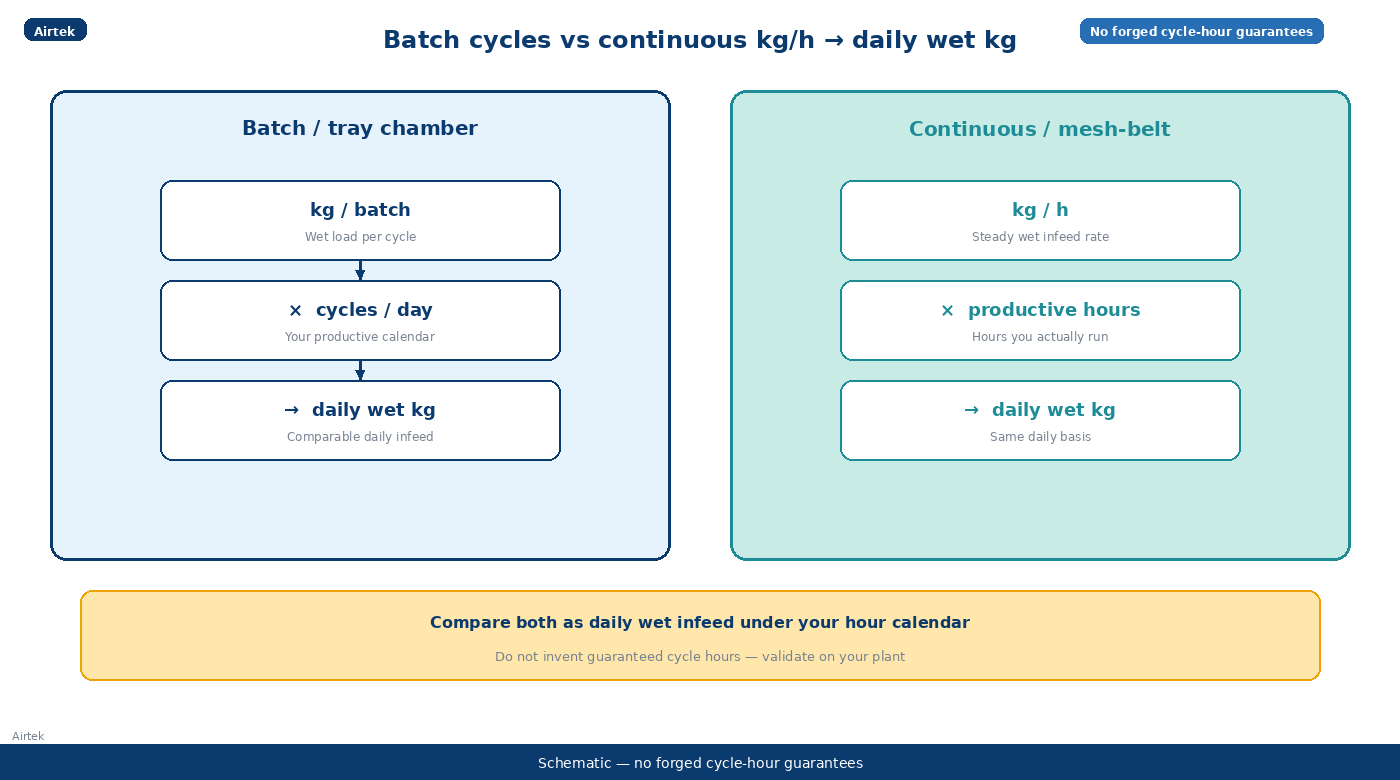
Do not treat any public “tons/day” figure as a universal switch from batch to continuous. Prefer the qualitative decision framework in the batch-vs-continuous guide, then size with mass balance.
Tray Area, Loading Density, and “Looks Full but Dries Slow”
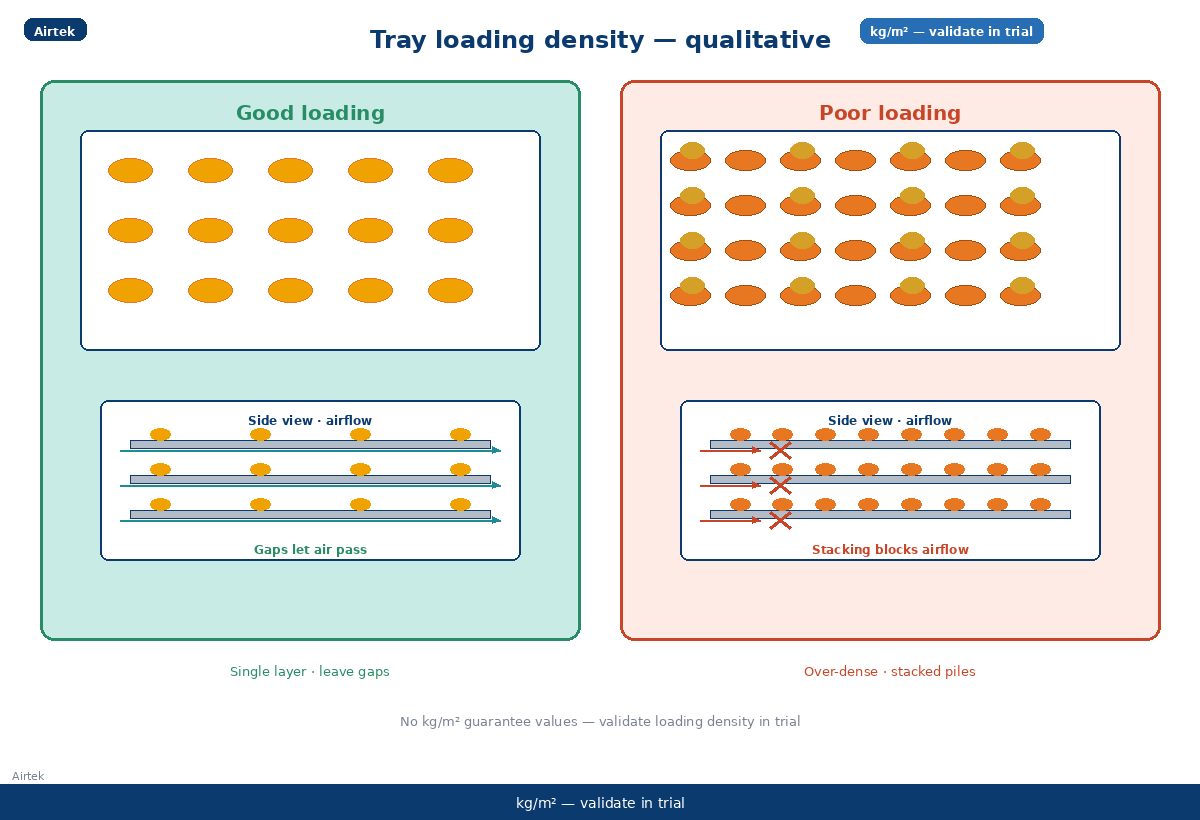
Buyers often size by counting trays or chamber volume. Geometry matters—but mass on the tray and air path through the bed matter more.
Qualitative loading rules (no invented kg/m² guarantees)
- Single-layer or controlled thickness for slices and chips usually dries more evenly than stacked wet piles.
- Overloading shrinks free cross-section for air, raises local humidity, and can create wet cores or case hardening—especially on thick fruit or whole pods.
- Uniform piece size reduces the spread between first-dry and last-dry pieces in the same batch.
- Trolley / rack alignment affects whether every tray sees similar airflow—confirm airflow design for your machine class.
Any numeric kg/m² loading density for a crop is site-specific until your trials (or a near-neighbor case under the same thickness and MC_f) confirm it. Do not paste a competitor’s density into an Airtek RFQ as if it were a nameplate law.
How to use tray area in RFQs without over-claiming
- State piece thickness and target layers per tray.
- Estimate wet kg per trolley from your trial loading—not from a blog.
- Multiply by trolleys per chamber and cycles per day.
- Cross-check that
\Delta W / T_{drying}stays inside a realistic dehumidification discussion with the supplier.
Compact cabinets such as CDS100KG publish tray count and tray size; useful drying mass still depends on product and loading. Larger chamber classes on the heat pump food dryer hub use capacity bands as navigation—again confirm unified site capacity language with sales.
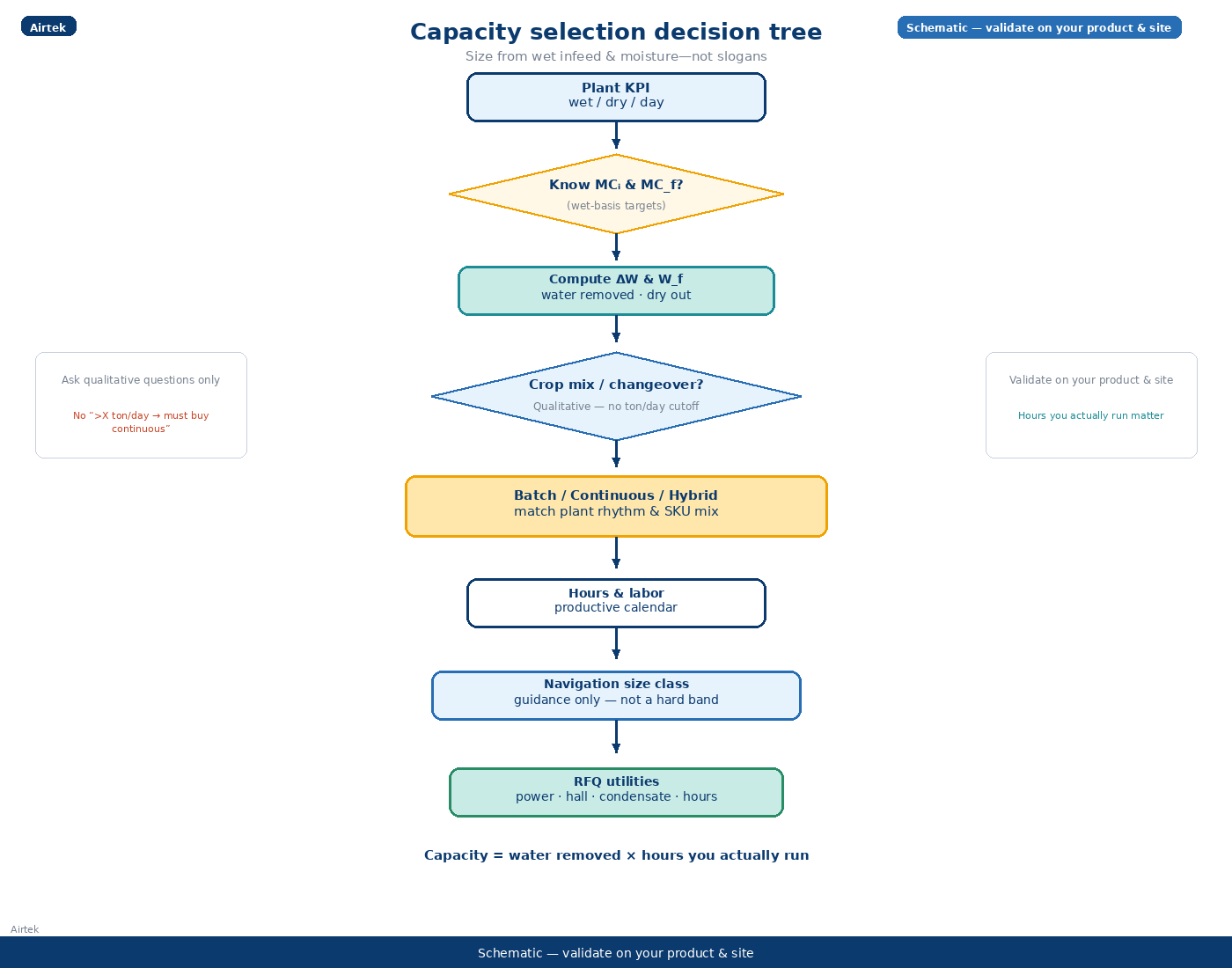
Decision Tree: From Plant Goal to Architecture and Size Class
Use this as a conversation map (also the hero visual). Every leaf still ends in share wet data for a project discussion—never a hard cutoff.
- What is the commercial KPI? Daily wet tons / daily dry tons / peak-week wet tons.
- Do you know
MC_iandMC_f(% wb)? If no → stop and measure or get buyer COA. - Compute
\Delta WandW_fwith the formulas above (under assumptions). - Crop mix & changeover? High SKU / seasonal → lean batch; stable thin geometry at high volume → consider continuous; mixed → hybrid.
- Hours & labor? Estimate
Nor productive kg/h under realisticH. - Map to navigation class (cabinet ~100 kg class / mid chamber / larger project)—guidance only—then confirm utilities and footprint.
- RFQ packet → Airtek product inquiry.
RFQ Utility & Footprint Checklist (Copy into Your Spec)
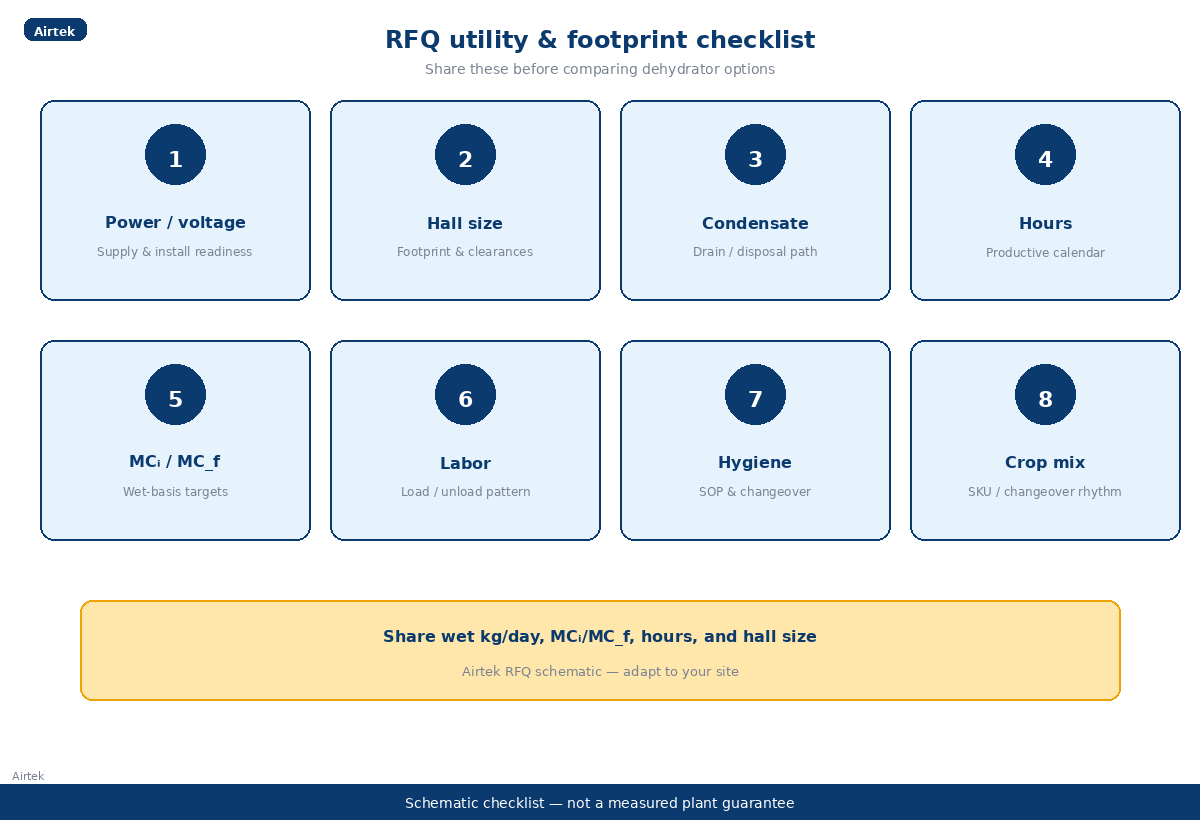
Send the same packet to every supplier so quotes compare:
Process & product
- [ ] Crop / SKU list and share of annual wet tonnage
- [ ] Piece geometry (slice thickness, whole vs cut, flakes)
- [ ]
MC_i/MC_f(% wb) and lab method - [ ] Target: daily wet kg, daily dry kg, or both; peak vs average
- [ ] Preferred architecture: batch / continuous / hybrid and why
Time & labor
- [ ] Hours per day, days per week, 24 h or not
- [ ] Load/unload labor model; number of operators per shift
- [ ] Changeover / sanitation frequency
Utilities & site
- [ ] Voltage / frequency / available kVA confirm at your plant
- [ ] Approximate hall length × width × height; door / trolley clearances
- [ ] Condensate drain location and capacity
- [ ] Ambient season extremes (affects heat-pump discussion)
- [ ] Exhaust / makeup-air constraints if any (closed-loop still needs site rules)
Hygiene & documentation
- [ ] Food-contact materials expectations (confirm grades on the quote)
- [ ] Logging / recipe programs needed for export audits
- [ ] Installation, commissioning, and training scope
What to ask the supplier to return
- Assumed
\Delta Wand indicative energy discussion (prefer kWh per kg water removed under stated assumptions—not a magic multiple) - Indicative chamber/belt dimensions and trolley/tray count
- Spare parts list (trays, fans, belts if continuous)
- Cleaning access design
- What remains open pending trials
Airtek public navigation currently mixes compact ~100 kg cabinet language with hub bands roughly 200–3500 kg (and larger custom discussion elsewhere). Until one public unify sentence is locked, treat all bands as selection aids—treat published capacity bands as selection guidance only until one public unify sentence is locked—and never invent “must buy X above Y tons/day.”
FAQ — Industrial heat pump dryer capacity
Q1. What does industrial heat pump dryer capacity actually mean?
A. It can mean wet infeed, finished dry mass, or water-removal (kg water/h) capacity. Ask which one a quote uses. Heat-pump systems are often best compared on water removed under stated moisture and hours, not on a single vague “kg” label.
Q2. How do I convert batch capacity to daily throughput?
A. Daily wet infeed ≈ (wet kg per batch) × (cycles per day). Cycles per day depend on full cycle time T and effective hours H—both project-specific until you include load/unload and sanitation. Convert continuous kg/h the same way: multiply by productive hours, then compare daily wet kg.
Q3. Can I size only from tray count or chamber volume?
A. Tray count and area are useful geometry inputs, but loading density (kg/m²) and airflow through the bed decide real wet mass and drying time. Any kg/m² figure without your thickness and target moisture is site-specific. Overloading trays is a common reason “the machine looks big but runs slow.”
Q4. When should I choose batch vs continuous for capacity?
A. Use capacity math after you choose plant rhythm: multi-SKU / frequent changeover favors batch chambers; stable high volume of similar thin pieces favors continuous belts. See batch vs continuous heat pump dryer. Do not use a universal tonnage cutoff.
Q5. What should I send Airtek to get a capacity discussion?
A. Send wet daily (or peak) tonnage, MC_i/MC_f, piece geometry, hours, hall sketch, voltage, and crop mix. Mention whether you lean cabinet, larger chamber, or belt. Use the product inquiry form. Compact options such as CDS100KG and broader bands on the category hub are starting points only.
Talk to Airtek About Capacity Sizing
If you are specifying or upgrading an industrial heat pump dehydrator, share your wet infeed, target moisture, hours, and hall constraints. The Airtek team can discuss chamber cabinets, larger heat pump chambers, or continuous options using mass-balance assumptions—and clearly mark what still needs plant trials.
Next step: open a product inquiry with wet kg/day (or peak week), MC_i/MC_f, crop list, and voltage. We will help frame industrial heat pump dryer capacity in comparable units—without pretending a brochure band is a contract output.