If you have ever walked a coastal belacan village after a monsoon morning, you already know the problem. The shrimp paste is half craft, half weather. Udang geragau or rebon get salted, pounded, sunned, fermented, pounded again—and every cloudy day stalls the calendar. Buyers in Malaysia, Indonesia, Singapore, and Thailand still want that familiar pungent umami. What they do not want is yard dust, rain re-wetting, or a moldy cake that fails a modern hygiene conversation.
So the question is not “can you dry belacan without sun?” It is: can you keep the regional flavor story while moving the water-removal step into a controllable chamber? For many SME plants, a heat pump dryer is the practical middle path—enclosed air, staged temperature and humidity, weather independence—without pretending the machine invents fermentation for you.
Airtek (ATK) builds heat pump food dryer chambers and open-loop multi-trolley solutions at airtekdehydrator.com. This guide stays honest: no fake client names, no invented dry-kg, hours, kWh, CE numbers, prices, or ROI%. Start from product inquiry.
Soft note: salt levels, fermentation days, and moisture targets below are regional process context / plant-trial conversation, not Airtek recipes or legal limits. Confirm with your house SOP, local food standard, and buyer COA.
What belacan / terasi drying actually is (kitchen + plant talk)
Belacan (Malaysia / Singapore), terasi (Indonesia), and related fermented shrimp pastes are salted, partially dried, pounded, and matured products. Drying is usually not a single “put it in and forget it” step—it sits between salt mix, early fermentation, pounding, cake forming, and later maturation.
A belacan heat pump dryer / shrimp paste dryer uses a heat-pump loop to condense moisture from circulating air and return warmer, drier air to trays or trolleys. Processors usually care about:
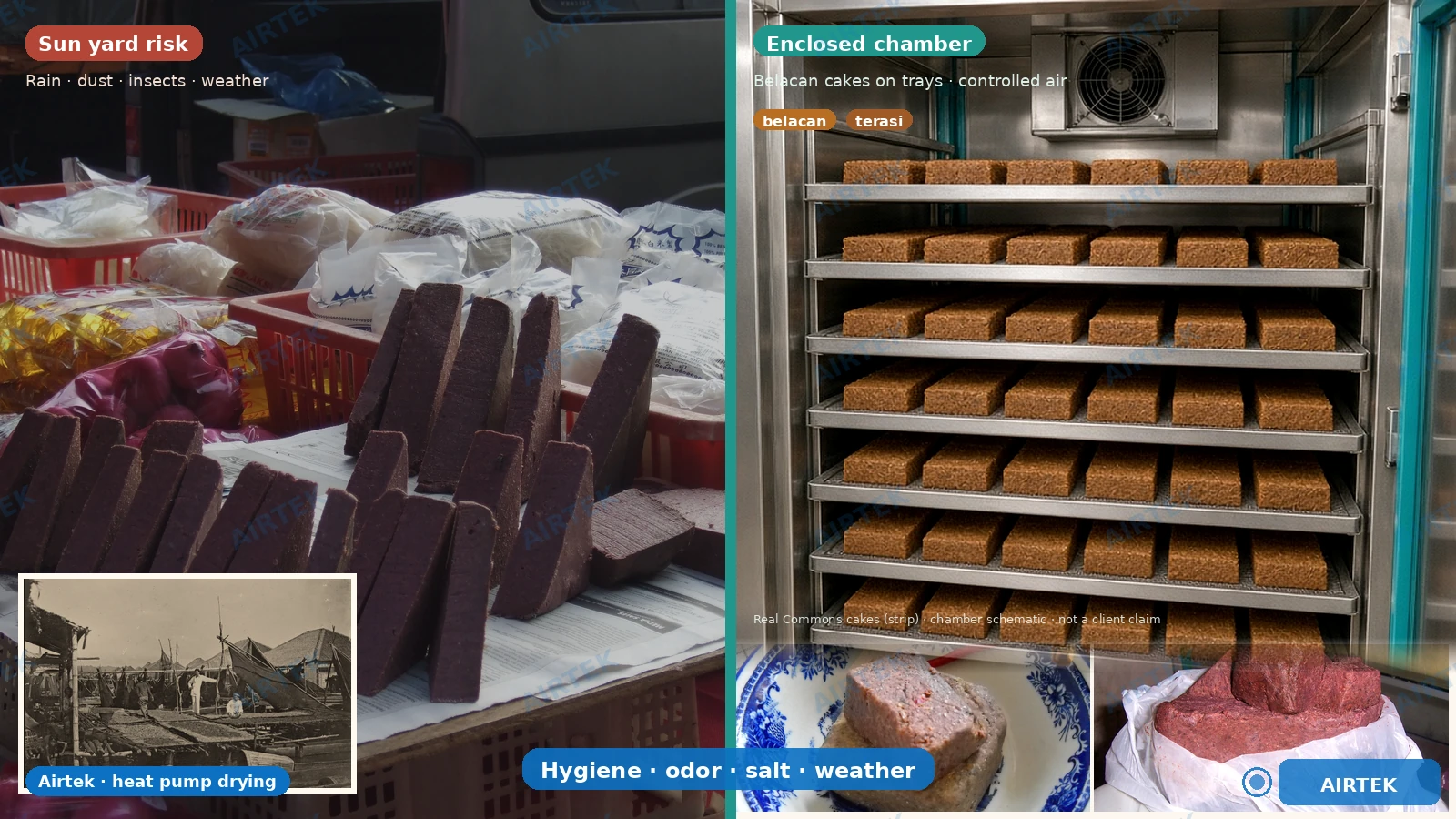
- Hygiene narrative — less open-yard dust, insects, and rain than traditional sun mats.
- Odor management — the pungent smell is part of the product identity; plants still need hall ventilation and neighbor-friendly layouts.
- Salt + water activity — salt lowers Aw; drying finishes stability for cake / pack forms.
- Calendar reliability — monsoon seasons should not decide export or retail fill dates alone.
- Honest capacity language — wet infeed + hours + target moisture, not a slogan “kg dryer” nameplate. See capacity sizing and the product inquiry / RFQ fields.
Related: Heat pump food dryer machine · Energy saving vs hot air · Product inquiry
A familiar process story (without inventing your recipe)
Every coastal plant has its own rhythm, but the outline often sounds like this:
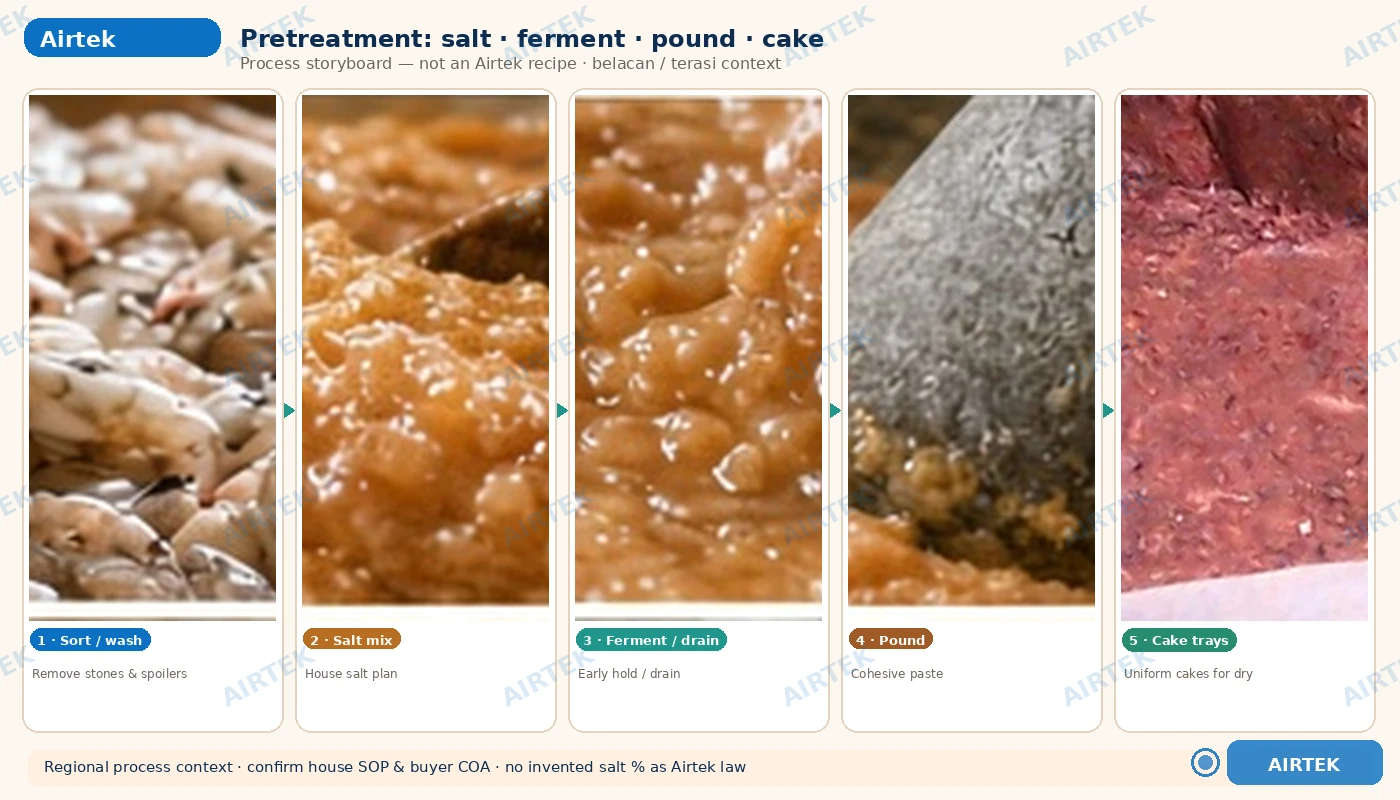
- Sort & wash — remove stones, plastic, small fish that can spoil the sensory profile.
- Salt mix — Malaysian belacan literature often discusses roughly ~4–10% salt at early mix; Indonesian terasi talks often cite higher salt (around ~15% in some process descriptions). Treat both as literature context—your house ratio rules.
- Early ferment / drain — overnight or multi-day holds depending on tradition.
- Pound / grind → cake — cohesive paste shaped for drying.
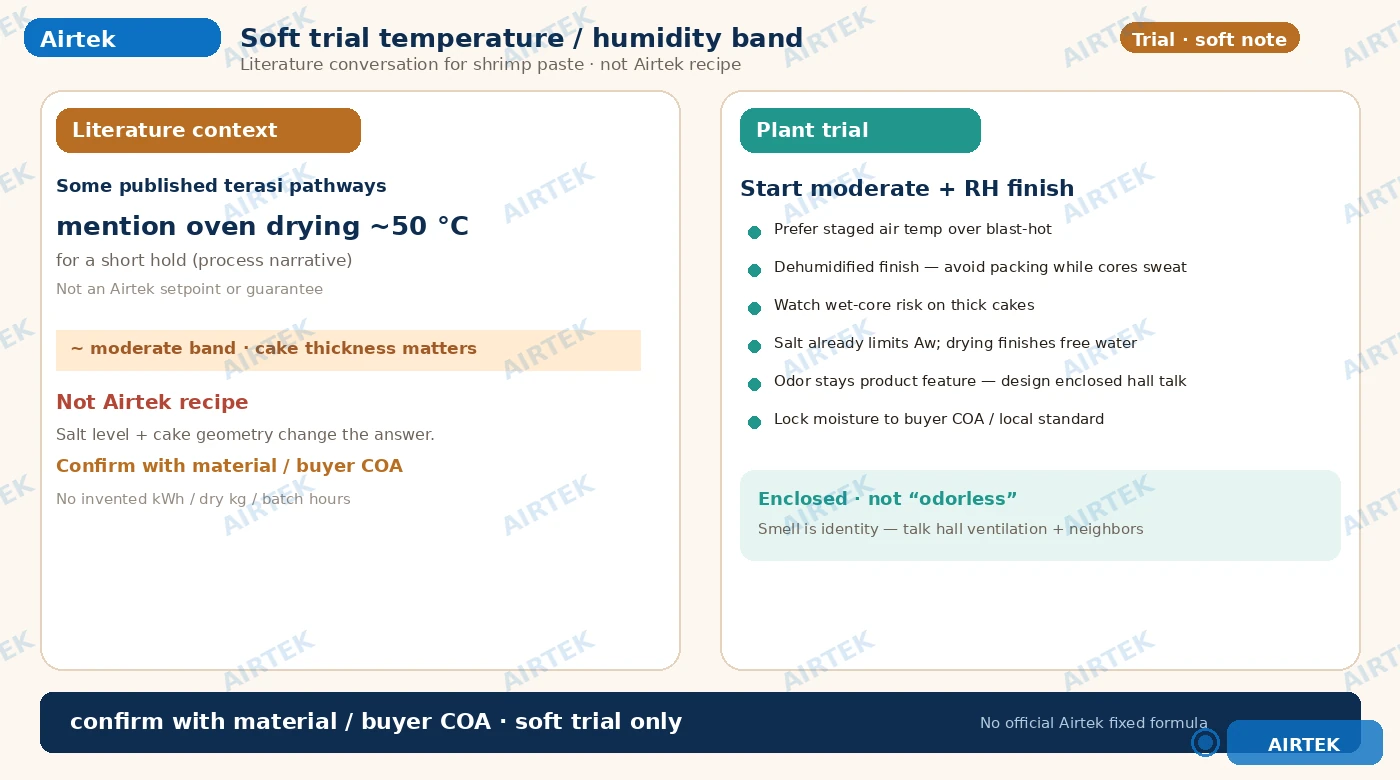
- Dry — traditionally sun; some published terasi pathways mention oven drying around roughly ~50 °C for a few hours as process narrative—not an Airtek setpoint.
- Further ferment / remill / re-dry — until texture and aroma hit the house standard.
- Pack — cakes, blocks, or powder pathways with different moisture conversations and local standard limits.
Heat pump drying steps into stages 5 (and sometimes remill re-dry), where weather used to decide quality.
Why heat-pump controlled air helps shrimp paste plants
| Lever | Plain-language benefit |
|---|---|
| Temperature as a staged profile | Prefer controlled air over “blast hot and hope.” Soft literature mentions moderate oven bands (e.g. roughly ~50 °C in some terasi process notes)—use only as conversation starters. Confirm on your salt level and cake thickness. |
| RH / dehumidification | Condensing moisture helps finish cakes without only raising heat—useful when salt already limits Aw but free water remains. |
| Enclosed hygiene | Less rain, birds, and roadside dust than open mats—still requires GMP and clean trays; a dryer is not a food-safety program by itself. |
| Weather independence | Monsoon calendars stay production calendars. |
| Odor containment narrative | Smell stays a product feature; enclosed rooms + plant exhaust strategy are easier to discuss with neighbors than open village mats. |
Energy talk belongs in kWh per kg water removed—not invented “X times greener” slogans. See heat pump dryer energy saving vs hot air.
Soft trial bands (salt, moisture, cake geometry)
Treat this as a plant-trial conversation, not a guarantee.
| Topic | Soft discussion | Notes |
|---|---|---|
| Salt | Early mix literature ranges vary widely by country / house style | Confirm with your SOP & buyer; do not invent a universal % |
| Moderate dry conversation | Some published terasi pathways describe oven drying around roughly ~50 °C for a short hold | Literature context—not Airtek recipe |
| Target moisture / form | Paste, dry cake, and powder pathways carry different moisture conversations and local standard limits | Lock to buyer COA / local standard—do not invent a global % as Airtek law |
| Cake thickness | Thick cakes → wet core risk; thin uniform cakes dry more evenly | Geometry matters as much as °C |
| RH finish | Prefer dehumidified finish; avoid packing while cores sweat | Exact RH from trial |
Do not publish invented batch kg, cycle hours, or kWh from this blog.
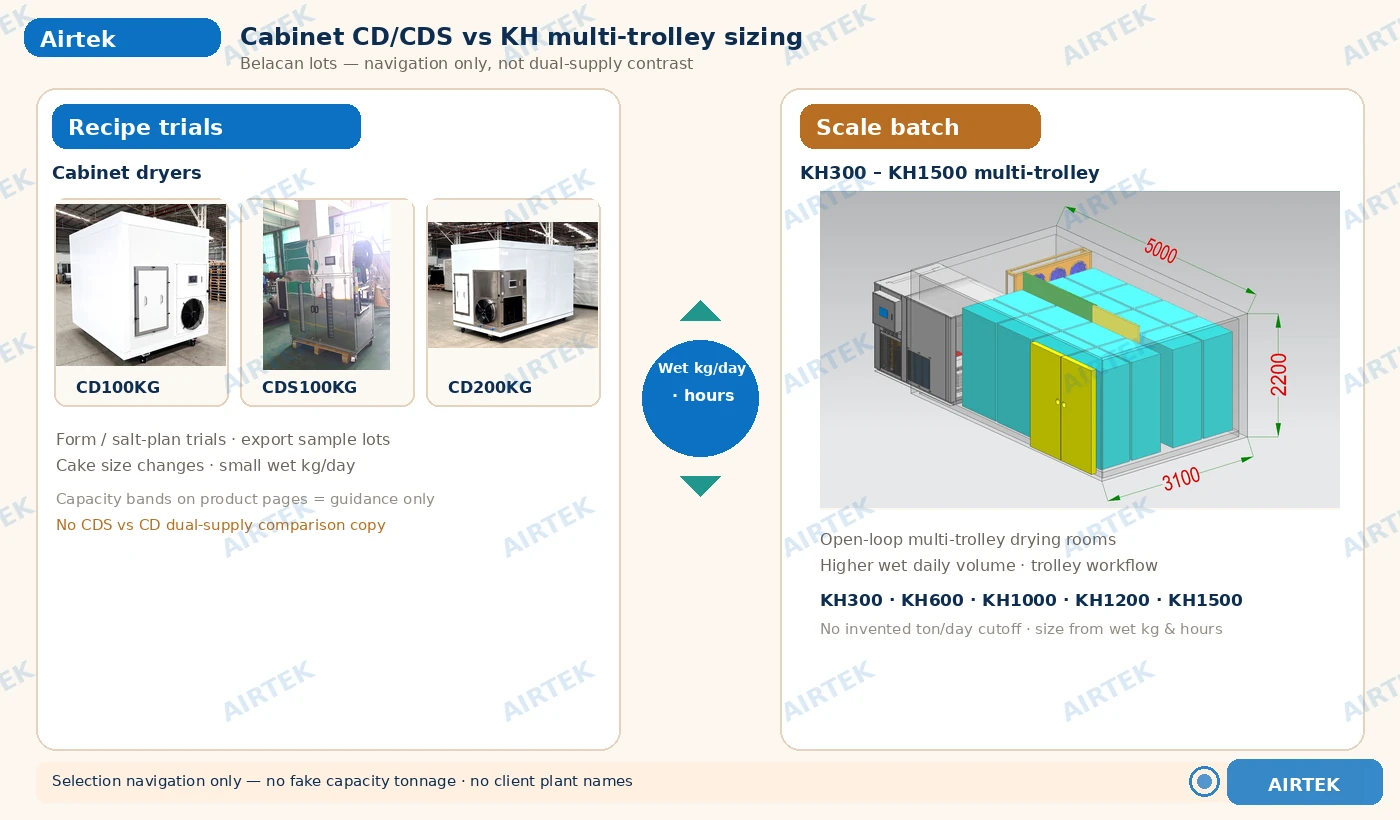
Cabinet vs multi-trolley sizing (Airtek models)
Pick architecture from lot size and labor model. No CDS vs CD dual-supply comparison copy—both cabinets are selection navigation only.
Small lots / R&D / multi-SKU → cabinets
| Model | Role in belacan projects | Link |
|---|---|---|
| CD100KG | Compact cabinet for salt/cake thickness trials | Product page |
| CDS100KG | Compact cabinet option for trial / small commercial lots | Product page |
| CD200KG | Larger cabinet when wet daily volume grows but you still want a single chamber | Product page |
Cabinets fit house-recipe trials, export sample cakes, and plants that also dry other seafood SKUs. Published capacity bands are guidance only—not a contractual dry-kg promise for shrimp paste. Confirm via inquiry.
Scale batch → KH open-loop multi-trolley
| Model | Navigation use | Link |
|---|---|---|
| KH300 | 6-trolley open-loop | Product page |
| KH600 | 12-trolley scale-up | Product page |
| KH1000 | 16-trolley | Product page |
| KH1200 | 20-trolley | Product page |
| KH1500 | 24-trolley | Product page |
Multi-trolley KH suits repeat batch when wet daily volume and hall layout justify trolley logistics. Voltage and trade terms are confirmed per project—never fixed as public facts here. See also batch vs continuous.
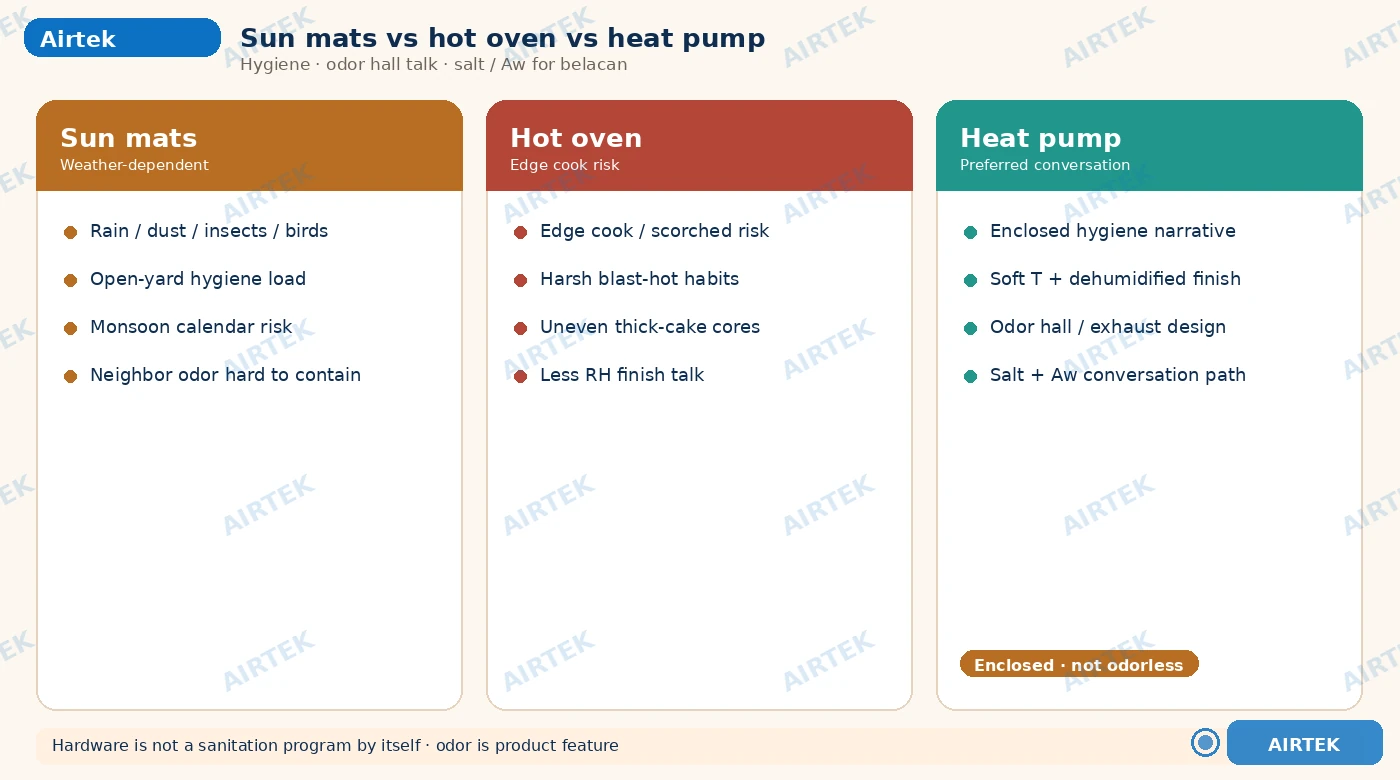
Sun yard vs chamber: hygiene, odor, salt (buyer talk)
| Method | What coastal plants like | What export / modern retail push back on |
|---|---|---|
| Sun mats | Low CapEx; traditional sensory story | Rain, dust, birds, insects, uneven cakes, calendar risk |
| Simple hot air / oven | Familiar moderate heat narrative | Easy to over-dry edges / cook aroma if unsupervised |
| Heat pump dryer | Controllable T/RH; enclosed; monsoon independence; softer energy talk in engineering units | Still needs salt discipline, GMP, odor hall design, and honest sizing |
Common defects (process language)
| Defect | Typical causes | Soft mitigation |
|---|---|---|
| Wet core / surface crust | Thick cakes; aggressive heat | Thinner uniform cakes; RH strategy; staged profile |
| Mold / slimy pack | Under-dried; humid hold; weak salt plan | Confirm moisture before pack; dry hold; house salt SOP |
| Off / rancid notes | Foreign fish; dirty wash; long wet holds | Sort carefully; shorten open holds; hygiene plan |
| Neighbor odor complaints | Open sun mats next to housing | Enclosed chamber + plant exhaust design conversation |
| Color / dye scandals (history) | Illegal colorants in some markets | Honest process + buyer lab—never a dryer fix |
FAQ — Belacan / shrimp paste heat pump drying
Q1. Can you dry belacan or terasi with a heat pump dryer?
A. Yes. Industrial heat pump dryers can remove water from salted shrimp paste cakes / intermediates using controlled, dehumidified air. Fermentation and salt plans remain your house craft—the dryer does not replace them. Hours and dry yield follow plant trials and buyer / local-standard moisture language.
Q2. What temperature should I use for shrimp paste drying?
A. There is no single Airtek guarantee temperature. Some published terasi process notes mention oven drying around roughly ~50 °C for a short hold—that is literature context, not an Airtek recipe. Prefer a plant-trial conversation: start moderate, control RH, and validate against salt level, cake thickness, and buyer COA.
Q3. Cabinet or KH multi-trolley for belacan?
A. Small lots / recipe trials → CD100KG, CDS100KG, CD200KG. Scale batch → KH300–KH1500. Size from wet kg/day—not a fake tonnage cutoff.
Q4. Will a heat pump remove the belacan smell?
A. No—and you usually do not want it to. The pungent aroma is part of the product. What enclosed drying helps is hygiene and neighbor-management narratives (less open-yard exposure). Plan hall ventilation separately from the dryer SKU conversation.
Q5. What should I send Airtek for a belacan drying inquiry?
A. Send: form (paste / cake / powder pathway), salt plan language, wet kg per batch or per day, cake size, target moisture / local-standard notes, hours/shifts, hall sketch (including odor exhaust notes), and power notes (confirm voltage and trade terms on inquiry). Use product inquiry, WhatsApp via the site’s contact entry (no phone digits in this article body), or email info@airtekdehydrator.com with subject Belacan drying inquiry. Bring the product inquiry fields.
Talk to Airtek About Belacan Drying
If you make belacan, terasi, or related shrimp paste for domestic retail or export, share your form, wet daily tonnage, and buyer moisture notes. The Airtek team can discuss cabinet and KH multi-trolley options with clear soft trial framing—without inventing dry-kg, energy %, CE numbers, or prices.
Next step: send a product inquiry (or email info@airtekdehydrator.com, subject Belacan drying inquiry) with wet infeed, salt/cake notes, and trial goals.