
Heat Pump vs Electric Resistance Food Dryer: Total Cost of Ownership
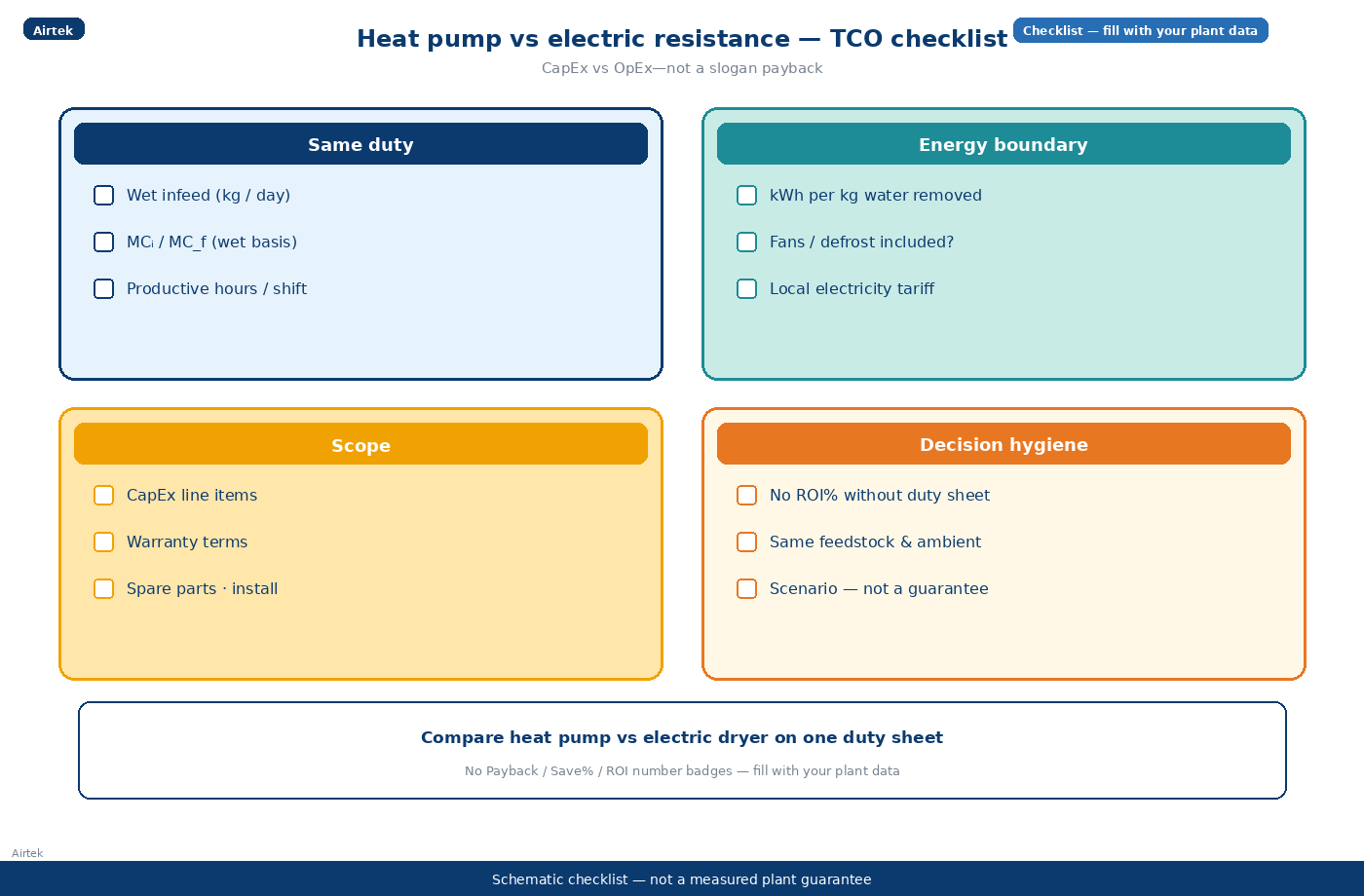
When buyers search heat pump dryer vs electric dryer, they usually want a total cost of ownership (TCO) frame for food plants: what you pay to buy the machine, what you pay every month to remove water from fruit or food, and which quote assumptions make two proposals comparable.
This guide is commercial and educational. It separates CapEx from OpEx, lists what actually drives electricity use, briefly distinguishes electric resistance, closed-loop heat pump, and conventional hot-air paths, and ends with a quotation comparison checklist. It does not invent return-on-investment percentages, recovery years, guaranteed energy-savings %, client names, or certificate numbers.
Airtek builds heat pump food dryer chambers and related industrial dehydrators for fruit and food plants. Exact electricity bills always follow your wet infeed, moisture targets, hours, and local tariff—not a brochure slogan.
Soft note: CapEx/OpEx tables and COP/SMER language below are decision frameworks. Any plant recovery story or “saves X%” figure needs your wet mass, moisture targets, hours, and tariff. For the exhaust / heat-recovery mechanism story (sibling angle), see heat pump food dryer energy saving vs hot air.
What “heat pump dryer vs electric dryer” / TCO means (buyer definition)
In buyer language, heat pump vs electric resistance food dryer usually means comparing a closed-loop heat pump food dehydrator with a dryer that uses electric resistance heaters (direct electric elements) to heat air—on total cost of ownership, not on a single sticker price.
- CapEx: purchase price of the dryer and related scope you must buy once—chamber, heat-pump or heater package, trays/trolleys, controls, freight, installation, commissioning (scope varies by quote).
- OpEx: recurring cost to run the plant duty—mainly electricity to remove water, plus fans and auxiliaries, maintenance, spare parts, and labor for load/unload where relevant.
- TCO: CapEx + OpEx over a planning horizon you choose. TCO is a model you build with shared assumptions, not a magic number a vendor can responsibly guarantee without your data.
An electric resistance dryer converts electricity to heat at roughly 1:1 at the elements. A closed-loop heat pump dryer uses electricity mainly to drive a refrigeration cycle that condenses moisture and recovers latent heat for reheat—so energy per kilogram of water removed is often discussed in COP / SMER language rather than 1:1 heating. Exact kWh, COP, and SMER are project- and climate-dependent—buyer questions, not universal promises.
Airtek supplies industrial / commercial heat pump food dehydrators. Start from the heat pump food dryer machine hub. Use published capacity bands as selection aids only.
CapEx vs OpEx: How to Frame the Comparison (No Fake ROI)
Marketing conversations often jump to “recovers cost in N years.” Without shared duty and tariff, that sentence is not a comparison—it is a slogan.
Use a teaching table instead. Fill the right-hand column with your numbers later; leave blanks open rather than inventing them.
| Cost bucket | What to include | Typical buyer trap | How to model (method only) |
|---|---|---|---|
| Machine CapEx | Dryer / heat-pump package, trays, controls as quoted | Comparing a bare heater cabinet to a full heat-pump line with different scope | Line-item the same scope on both quotes |
| Installation CapEx | Freight, rigging, electrical connection, condensate drain, commissioning | Ignoring hall work that one technology needs more of | Ask for installation scope in writing |
| Energy OpEx | kWh × local tariff × hours under a defined wet duty | Using a marketing “X times more efficient” without kg water removed | Prefer kWh per kg water removed × water load × tariff |
| Maintenance OpEx | Filters, refrigerant service rules, heaters, fans, trays | Assuming “no maintenance” for either technology | Ask spare-parts list and service interval language |
| Labor OpEx | Load/unload, changeover, sanitation time | Ignoring that CapEx-cheap gear may need more labor | Tie to batch vs continuous rhythm — see batch vs continuous |
| Risk / quality OpEx | Rework from uneven drying, humidity swings, product color loss | Invisible until export claims appear | Qualitative; do not invent defect % |
Do not fill any skeleton with invented recovery years or “saves 40% forever.” If a supplier states a recovery period, ask which wet kg/day, moisture pair, hours, tariff, and included auxiliaries were assumed—confirm with a project calculation. Prefer kWh per kg water removed under identical wet assumptions.
What Drives Electricity Use (Buyer Questions, Not Guarantees)
Electricity is usually the largest OpEx lever in an all-electric drying comparison. Drivers are physical—not slogan-based.
- How much water you must remove — set by wet infeed and moisture targets.
- Ambient and season — tropical wet seasons and cold dry seasons change duty.
- Loading density and airflow — overfilled trays lengthen drying time and can raise fan and compressor hours.
- Setpoints — temperature and RH programs change compressor and heater use.
- Hours and utilization — annualize with your calendar, not a brochure 24/7 assumption.
- COP / SMER language as questions — measured or estimated? Full batch? Fans, defrost, auxiliaries included?
Mechanism detail lives in the sibling post: heat pump food dryer energy saving vs hot air.
Three Paths Buyers Often Confuse (Short Distinction)
| Path | How moisture typically leaves | Heat story (qualitative) | TCO conversation focus |
|---|---|---|---|
| Electric resistance (direct heat) | Often with exhaust or chamber venting, design-dependent | Electricity → heat ≈ 1:1 at the elements | CapEx may look lower; OpEx sensitive to tariff × water load |
| Closed-loop heat pump | Condensate drain; air recirculated | Compressor moves recovered latent heat to reheat air | CapEx often higher; OpEx via kWh/kg water, COP/SMER questions |
| Conventional hot-air (fuel or electric + exhaust) | Humid exhaust outdoors | Sensible + latent heat largely dumped with exhaust | Fuel/electric + make-up air; see energy sibling |
This post focuses on heat pump vs electric resistance as an all-electric CapEx/OpEx comparison for food dryers. We do not land laundry comparisons here.
Quotation Comparison Checklist (Same Duty, Same Assumptions)
Same product duty
- Same wet infeed mass and reporting basis
- Same initial / final moisture and agreed lab method
- Same piece geometry / thickness / loading density language
- Same productive hours per day and days per week
Same energy boundary
- Assumed kWh per kg water removed (or SMER) stated as measured vs estimated
- Boundary clear: compressor only vs fans + defrost + auxiliary heaters included
- Local voltage / frequency / available kVA stated
- Tariff used for any OpEx illustration written down (buyer’s number)
Same commercial scope
- What is in CapEx: chamber, trays, heat pump or heaters, controls, spare starter kit
- Warranty length and what it covers
- Spare parts list and lead times
- Installation, commissioning, training included or excluded
Decision hygiene
- No invented return-on-investment % or recovery years accepted without the duty sheet above
- Architecture (batch vs continuous) decided with plant rhythm — batch vs continuous heat pump dryer
- Machine selection Soft: How to choose a commercial food dehydrator
FAQ — Heat pump vs electric resistance food dryer (TCO)
Q1. What does heat pump dryer vs electric dryer mean for TCO?
A. It usually means comparing a closed-loop heat pump food dehydrator with an electric resistance dryer on CapEx + OpEx, not on sticker price alone. Build TCO from scoped CapEx plus electricity (prefer kWh per kg water removed × water load × tariff), maintenance, and labor—without inventing return-on-investment percentages or recovery years.
Q2. Why might heat-pump CapEx look higher while OpEx looks lower?
A. Heat-pump packages include a refrigeration circuit and controls that resistance heaters do not. Resistance heating is ~1:1 electricity-to-heat at the elements, so high water loads and high tariffs often push OpEx up. Whether TCO favors heat pump on your site depends on water removed, hours, tariff, and quote scope—not a universal rule.
Q3. What should I ask instead of “how many times more efficient?”
A. Ask for kWh per kg water removed (or SMER) under stated product, loading, ambient, and whether fans/defrost/auxiliaries are included. Mechanism expansion: energy saving vs hot air.
Q4. How do I compare two quotations fairly?
A. Lock the same wet infeed, moisture targets, hours, voltage, assumed kWh/kg water (with boundary), warranty, and spare-parts scope. Reject recovery-year slides that omit those inputs.
Q5. What should I send Airtek for a TCO-oriented discussion?
A. Share wet kg/day (or peak week), moisture targets, crop list, hours, hall constraints, voltage, and local electricity tariff. Mention whether you are comparing against resistance heaters or hot-air exhaust systems. Use the product inquiry form.
Talk to Airtek About CapEx, OpEx, and Your Duty
Soft next reads: hub · G1 energy · G3 batch vs continuous · choosing commercial machine
Next step: open a product inquiry with wet infeed, moisture targets, hours, voltage, and local tariff. We will discuss total cost of ownership as a shared model—without pretending a brochure efficiency multiple is a contract bill.