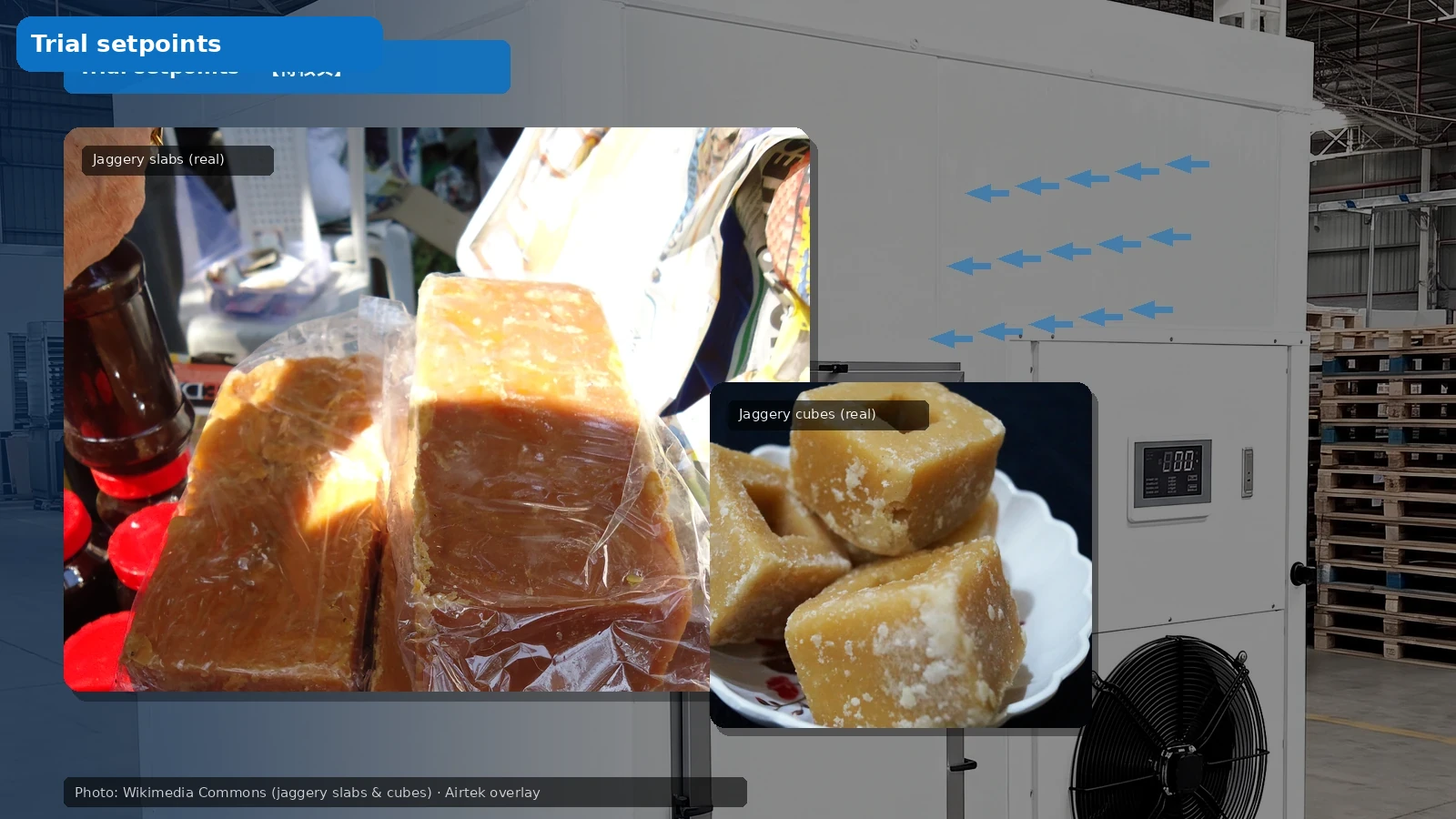
Yes. Commercial plants can dry jaggery slabs (blocks / cakes) and jaggery cubes — including cane jaggery / gur and palm jaggery / palm sugar solids — in an industrial heat pump dryer. Controlled temperature and humidity help the buyer conversation around surface moisture, stickiness, mold risk, and color stability, compared with open sun yards or harsh coal / gas high-heat blasts—without inventing a guaranteed retention percentage, dry-kg yield, or batch hour.
This guide is for jaggery / gur / palm sugar processors and export raw-material plants in India, South Asia, Southeast Asia, and Africa. It covers soft process language, pretreatment, literature-informed trial temperature/humidity framing, cabinet vs multi-trolley sizing on Airtek models, and common defects. It does not invent dry-kg guarantees, hours, kWh figures, CE numbers, prices, ROI%, or client names.
Airtek (ATK) builds heat pump food dryer chambers and open-loop multi-trolley drying solutions at airtekdehydrator.com. Exact SKUs and setpoints follow your composition (including reducing sugar), piece size, and plant trial—start from product inquiry.
Soft note for buyers: temperature and humidity ranges below are conversation guides for plant trials, not Airtek guarantees or universal legal limits. Composition, piece geometry, and target moisture / water activity change the answer. Confirm setpoints on your material and buyer COA before locking a production SOP.
What “jaggery drying” means for buyers (definition)
Jaggery drying here means removing residual moisture from solidified sugar solids—slabs (boards, cakes, blocks) or cubes—until the product is stable enough for storage, packing, and export, using enclosed, conditioned air rather than only open sun.
A jaggery dryer / jaggery heat pump dryer (also searched as dry jaggery slabs, jaggery cubes dehydrator, heat pump jaggery drying, palm jaggery dryer, gur drying machine) uses a heat-pump loop to condense moisture from circulating air and return warmer, drier air to trays or trolleys. Buyers usually care about:
- Hygroscopic sugar solids — jaggery picks up moisture from humid air; soft surfaces stick, mold, or “sweat” in pack if under-dried or poorly held.
- Surface vs core — slabs and cubes can case-harden (dry crust, wet interior) if heat is pushed hard without humidity control.
- Color and flavor narratives — scorched edges and harsh open-fire / coal / gas blasts are common quality complaints.
- Honest capacity language — wet infeed + hours + target moisture / Aw, not a slogan “kg dryer” nameplate. See industrial heat pump dryer capacity sizing.
Related: Heat pump food dryer machine · Energy saving vs hot air · product inquiry / RFQ fields · Product inquiry · Sea moss heat pump drying (sister soft-product guide)
Why heat-pump controlled T/RH helps jaggery (soft claim)
Freshly formed jaggery is high-sugar, hygroscopic, and often still carries free syrup or uneven moisture after cooling and cutting. Open sun yards depend on weather; coal / gas / blast hot air can push operators toward scorched edges, sticky centers, whitening / mold in pack, or cracked faces—especially when piece size varies.
Heat pump drying does not magically lock every flavor note or invent a shelf-life certificate. What it offers, in buyer language:
| Lever | Why processors discuss it |
|---|---|
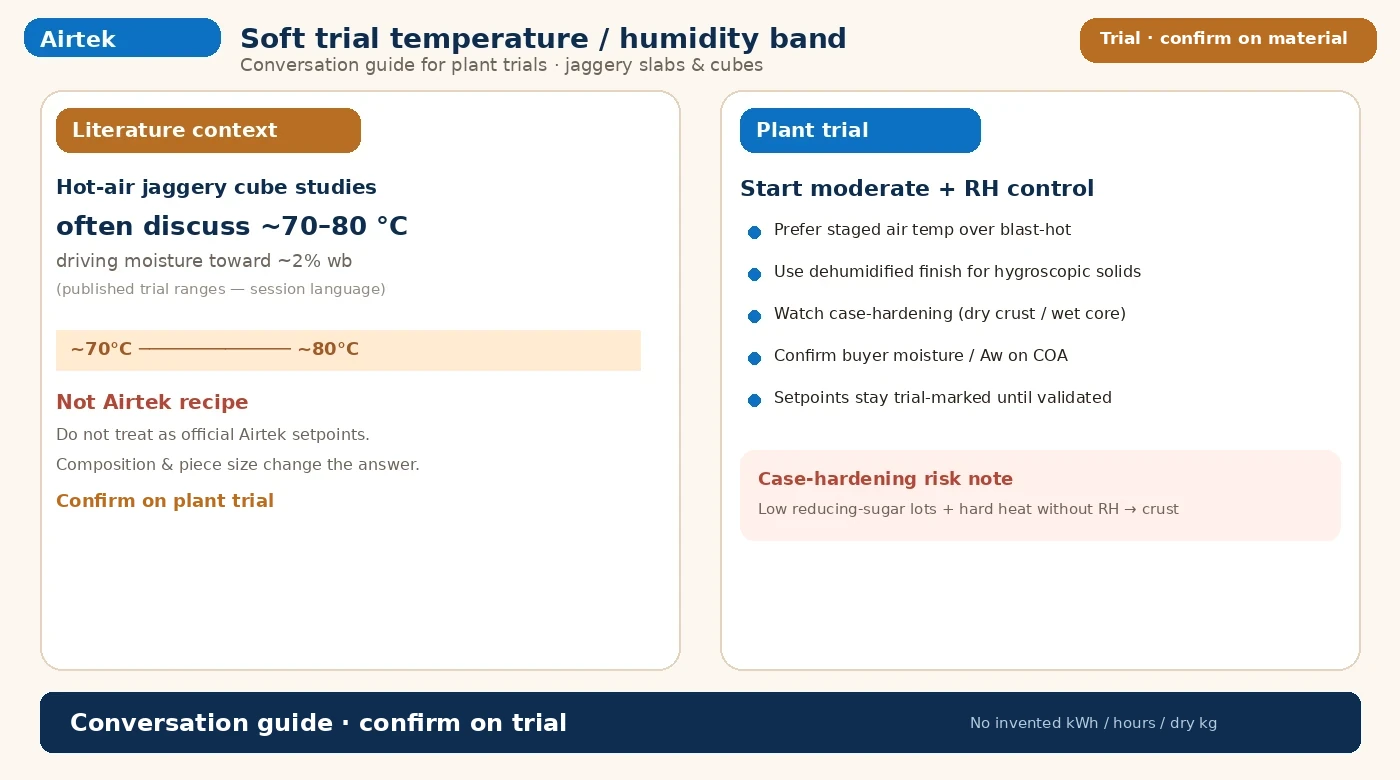
| Temperature as a staged profile | Prefer controlled air temperature over “blast hot and dump air.” Literature on hot-air jaggery cube drying often discusses elevated bands (commonly around ~70–80 °C in published trials) to drive moisture toward storage-safe low single digits (one cube study discusses targets toward roughly ~2% wb)—frame as literature context, not an Airtek recipe. Low reducing-sugar lots may show case-hardening if temperature is pushed hard without humidity control. Final plant setpoints follow material trials. |
| RH / dehumidification | Condensing moisture out of the loop helps finish hygroscopic solids without only raising heat; critical for stickiness / mold risk conversations |
| Enclosed hygiene narrative | Less dust, insects, birds, and rain than open yards—still requires GMP; hardware is not a sanitation program by itself |
| Weather independence | Crush / boiling season peaks should not depend on sunny calendar days alone |
Energy intensity belongs in engineering units (kWh per kg water removed under stated assumptions)—not invented “X times more efficient” slogans. See heat pump dryer energy saving vs hot air.
Slabs vs cubes: material traits and pretreatment
What you are loading
| Form / trait | Process implication |
|---|---|
| Slabs (blocks / cakes) | Thicker geometry → longer core drying; risk of wet center + dry crust if heat is aggressive |
| Cubes | More uniform piece size usually dries more evenly; still hygroscopic; tray contact can stick if syrup remains |
| High sugar / hygroscopic | Needs controlled RH finish and dry packing hold; do not invent batch hours in a blog |
| Free syrup / wet clumps | Waste dryer capacity and glue trays together—drain and portion first |
| Reducing-sugar composition | Affects softening, browning, and case-hardening risk—confirm on each batch before locking a curve |
Pretreatment checklist (qualitative)
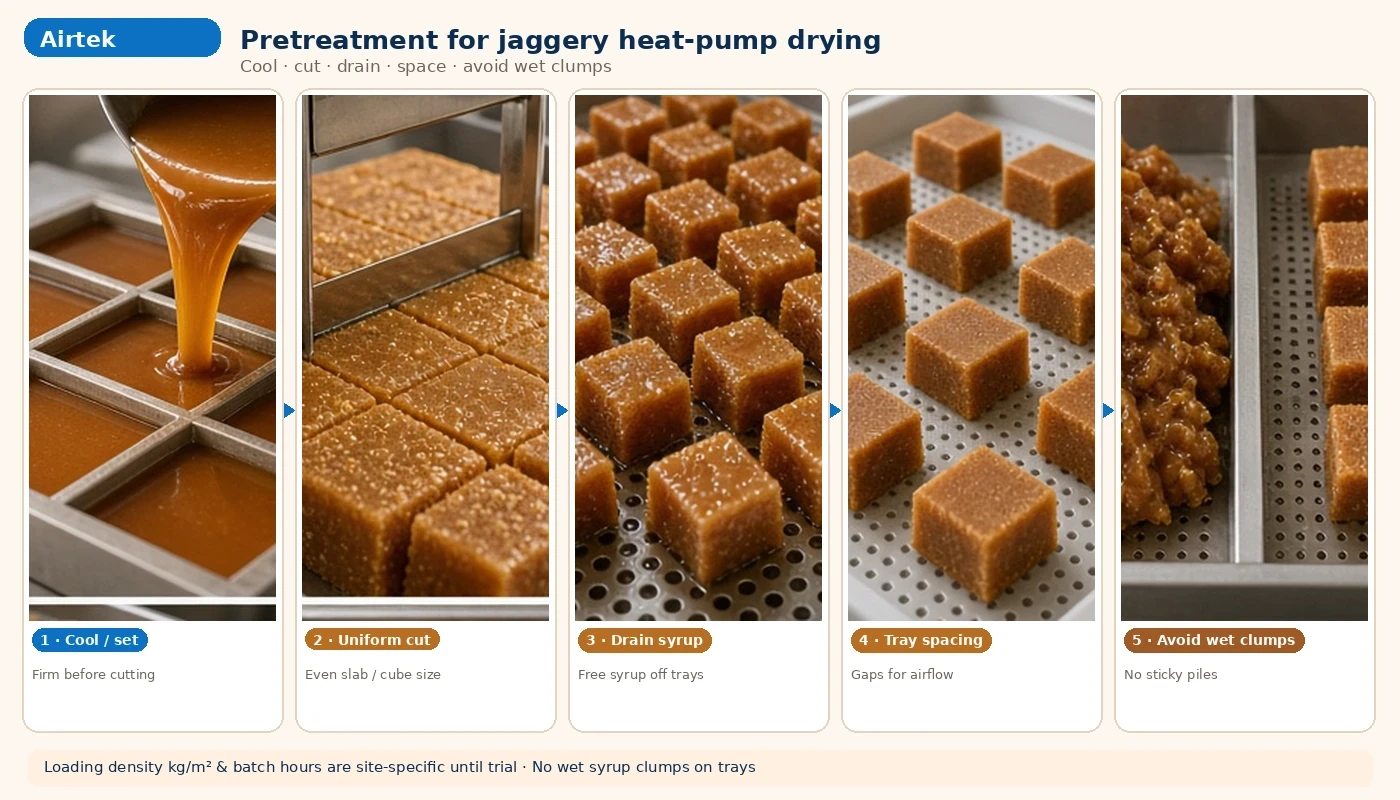
- Cool / set — allow poured jaggery to firm before cutting; soft, warm slabs deform and stick.
- Uniform cut — even slab thickness or cube size; mixed sizes force uneven finish.
- Drain free syrup — wipe or drain residual syrup before tray loading.
- Tray spacing — leave air lanes; avoid wet clumps and stacked wet pieces.
- Sort — remove foreign matter, scorched pour scraps, and under-set pieces before the chamber.
Any loading density (kg/m²) should be validated on your own trial with the same tray, piece size, and target moisture. Do not copy a fruit-chip density into a jaggery quote.
Soft trial temperature / humidity bands
Treat the following as a starting conversation for plant trials, not an Airtek guarantee, not a regulatory limit, and not a promise of dry kg or hours. Trial setpoints must follow composition (reducing sugar), piece size, and buyer moisture / Aw—confirm on trial. Prefer starting moderate and validating before copying any literature hot-air band into a production SOP.
| Stage (qualitative) | Soft discussion band | Notes |
|---|---|---|
| Literature context (hot-air cubes) | Published hot-air cube studies often discuss roughly ~70–80 °C to drive moisture toward storage-safe low single digits (e.g. toward ~2% wb in one cube study) | Not an Airtek recipe; method and piece size differ—use only as literature context |
| Conservative plant-trial conversation | Start with a moderate controlled profile; raise heat only after airflow and RH strategy are proven on your slabs/cubes | Avoid hard °C law in quotes |
| Case-hardening risk | Low reducing-sugar jaggery may form a dry crust while cores stay wet if temperature is pushed hard without humidity control | Soft risk framing; confirm composition on trial |
| Fresh / infeed moisture class | Some sources discuss fresh jaggery moisture in a roughly ~10–12% class before further drying for storage | Buyer COA may differ—lock to your inbound and destination specs |
| RH / late stage | Prefer dehumidified finish over “just raise heat”; exact RH setpoints come from plant trial | Closed-loop / controlled air helps; open-loop KH sites still need plant RH strategy |
| Target product moisture / Aw | Lock to buyer COA / packing / export needs | Do not invent a global % wb as Airtek law |
Do not publish invented batch kg, cycle hours, or kWh from this blog. Size from wet infeed and water removed—see capacity sizing and the product inquiry / RFQ fields.
Cabinet vs multi-trolley open-loop sizing (Airtek models)
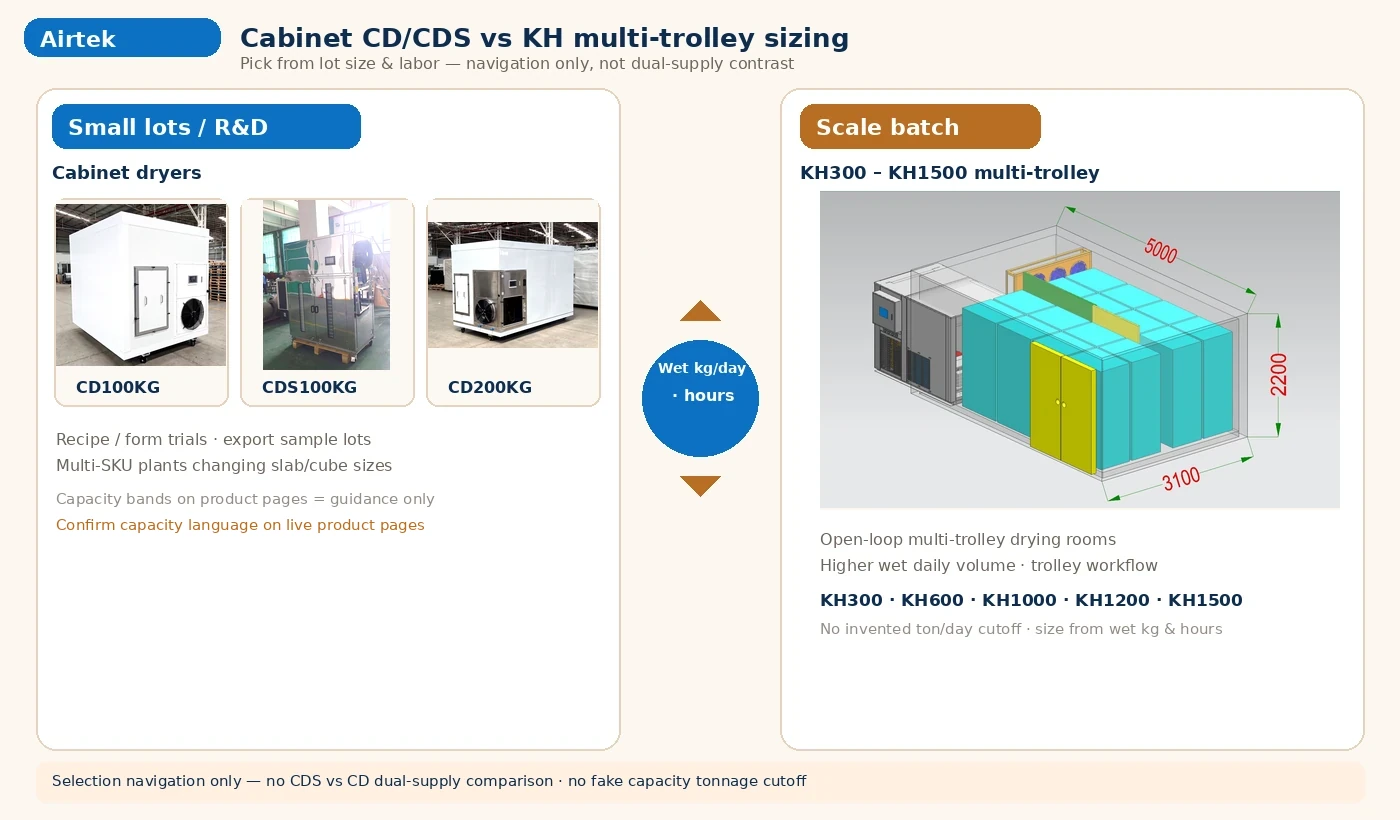
Pick architecture from lot size and labor model, not from marketing nicknames. No CDS vs CD dual-supply comparison copy—both cabinets are listed as selection navigation only.
Small trial / R&D / small lots → cabinet dryers
| Model | Role in jaggery projects | Link |
|---|---|---|
| CD100KG | Compact cabinet for small lots and recipe trials | Product page |
| CDS100KG | Compact cabinet option for trial / small commercial lots | Product page |
| CD200KG | Larger cabinet when wet daily volume grows but you still want a single chamber | Product page |
Cabinets fit SKU trials (slab vs cube, cane vs palm), export sample lots, and multi-product plants that change recipes often. Published capacity bands on product pages are guidance only—not a contractual dry-kg promise for jaggery. Confirm live page details and project sizing via inquiry.
Scale batch production → KH open-loop multi-trolley
| Model | Navigation use | Link |
|---|---|---|
| KH300 | 6-trolley open-loop drying solution | Product page |
| KH600 | 12-trolley scale-up | Product page |
| KH1000 | 16-trolley | Product page |
| KH1200 | 20-trolley | Product page |
| KH1500 | 24-trolley | Product page |
Multi-trolley KH solutions suit repeat batch production when wet daily tonnage and hall layout justify trolley logistics. Site temperature, hall RH, and power are confirmed per project—voltage and trade terms are never written as fixed public facts in this article.
For architecture trade-offs (labor, changeover, continuous vs batch), see batch vs continuous heat pump dryer.
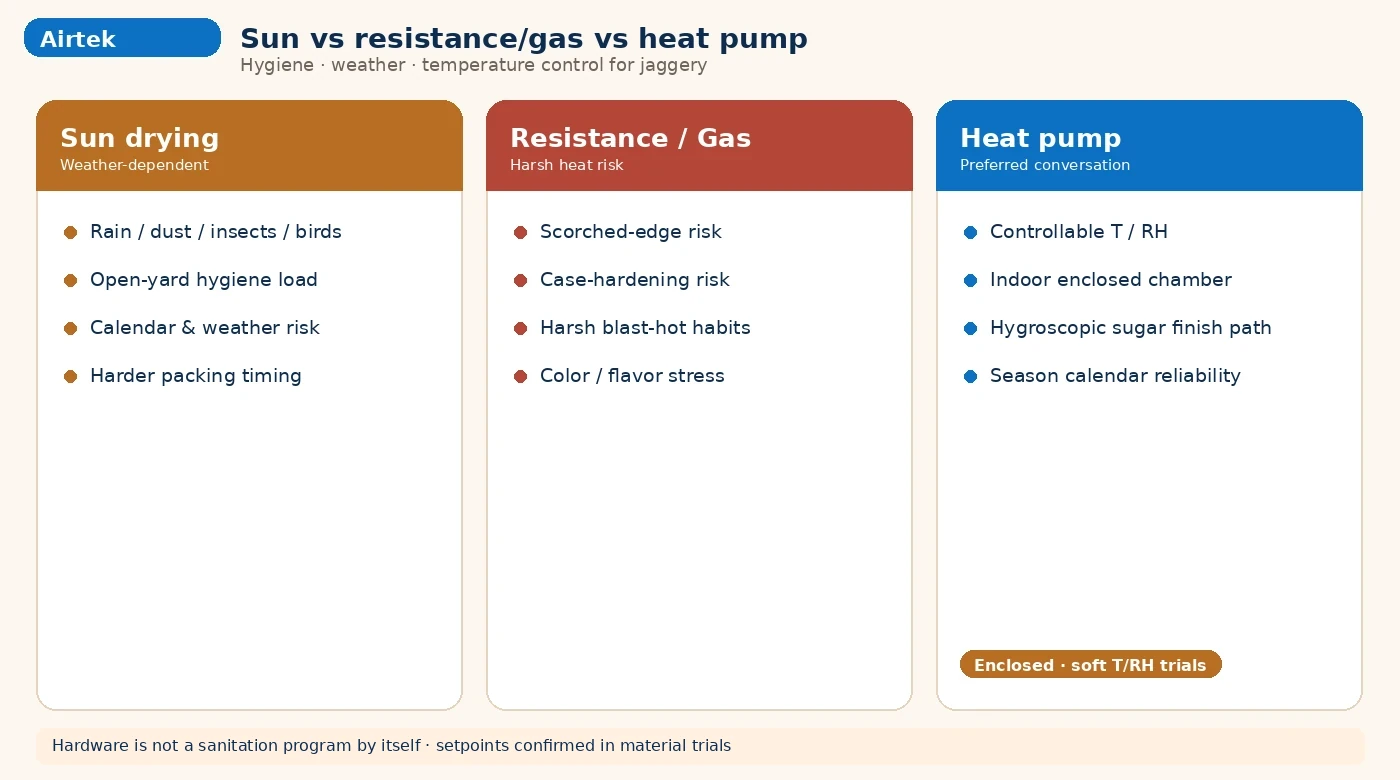
vs sun drying, electric resistance, and gas (buyer framing)
| Method | Buyer-relevant points | Soft caveat |
|---|---|---|
| Sun drying | Low CapEx narrative; high weather / dust / insect / bird / rain risk; uneven moisture on thick slabs | Hard to hit export calendar reliability in monsoon seasons |
| Electric resistance hot air | Simple heat; easy to over-temperature edges; energy discussion often worse in kWh/kg water | See energy / TCO blogs when comparing OpEx—no invented % |
| Gas / coal hot air | Common in some regions; hygiene, smoke, and scorch narratives matter for packed / export buyers | Scorched edges and contamination risk conversations |
| Heat pump dryer | Controllable T/RH for hygroscopic sugar, enclosed chamber or room, weather independence, soft energy story in engineering units | Still needs trials, GMP, and honest wet-duty sizing |
Link the energy discussion to heat pump dryer energy saving vs hot air. Do not invent a jaggery-specific savings percentage.
Common defects (process language)
| Defect | Typical plant causes (qualitative) | Soft mitigation |
|---|---|---|
| Sticking to trays | Residual syrup, warm soft pieces, overcrowded trays | Cool/set → drain → uniform cut; release liner / hygiene-approved tray practice per plant SOP |
| Whitening / mold | Under-dried cores, humid packing, wet hold after dryer | Confirm moisture / Aw against buyer COA before pack; dehumidified finish; dry hold |
| Soft re-absorption | Hygroscopic solids in humid hall / poor barrier pack | Cool dry hold; moisture-barrier pack; hall RH control |
| Scorched edges | Aggressive high heat, uneven airflow, thin edges next to hot zones | Moderate staged profile; verify airflow across trolley |
| Cracking / case hardening | Hard heat without humidity control; low reducing-sugar lots; thick slabs | Softer start; RH strategy; thinner / more uniform pieces—confirm composition on trial |
Never diagnose a buyer’s COA fail from a blog alone—use lab methods agreed with the destination customer.
FAQ — Jaggery heat pump drying
Q1. Can you dry jaggery slabs and cubes with a heat pump dryer?
A. Yes. Industrial and commercial heat pump dryers can dehydrate cane jaggery / gur, palm jaggery, and related sugar solids in slab or cube form using controlled, dehumidified air. Exact temperature, humidity, hours, and dry yield follow plant trials and buyer moisture / Aw specs.
Q2. What temperature should I use for a jaggery cubes dehydrator?
A. There is no single Airtek guarantee temperature. Hot-air literature on jaggery cubes often discusses roughly ~70–80 °C toward storage-safe low single-digit moisture (e.g. toward ~2% wb in one study)—that is literature context, not an Airtek recipe. Prefer a conservative plant-trial conversation: start moderate, control RH, and validate against composition (reducing sugar), piece size, and buyer COA. Do not invent batch hours.
Q3. Cabinet dryer or multi-trolley KH for jaggery / gur?
A. Small lots / R&D / multi-SKU trials usually start on cabinets such as CD100KG, CDS100KG, or CD200KG when useful. Scale batch production points to KH open-loop multi-trolley solutions (KH300–KH1500). Size from wet kg/day and hours—not a fake tonnage cutoff.
Q4. Why not only sun-dry jaggery slabs?
A. Sun drying can work in ideal weather but struggles with rain, dust, insects, birds, uneven moisture on thick slabs, and export calendar reliability. A heat pump dryer gives enclosed, controllable air for hygiene and hygroscopic finish narratives—still requiring pretreatment, GMP, and correct packaging.
Q5. What should I send Airtek for a jaggery drying inquiry?
A. Send: form (slabs vs cubes; cane vs palm), piece size / thickness, wet kg per batch or per day, cool/set and cut practice, target moisture / Aw language from buyer COA, hours/shifts, hall sketch, and power notes for your site (confirm voltage and trade terms on inquiry—this page does not fix a default). Use the product inquiry form, WhatsApp via the site’s contact entry (no phone digits in this article body), or email info@airtekdehydrator.com with subject Jaggery drying inquiry. Bring the product inquiry fields so quotes stay comparable.
Talk to Airtek About Jaggery Drying
If you process jaggery slabs, cubes, gur, or palm sugar solids for domestic pack or export, share your form, wet daily tonnage, and buyer moisture notes. The Airtek team can discuss cabinet and KH multi-trolley options with clear soft trial framing—without inventing dry-kg, energy %, CE numbers, or prices.
Next step: send a product inquiry (or email info@airtekdehydrator.com, subject Jaggery drying inquiry) with wet infeed, form, and trial goals. We will help frame an industrial jaggery dryer / palm jaggery dryer project around soft process control and comparable capacity units.