
When commercial buyers search buy industrial heat pump fruit dryer, they are rarely looking for a thermodynamics lecture. They need a request-for-quotation (RFQ) checklist: what to ask so quotes are comparable, what to send for a fair trial dry, and which commercial scopes (power, chamber materials, certifications, spare parts, install) must be written down before a purchase order.
This guide is for plant owners, procurement, and process engineers who are ready to order or shortlist an industrial / commercial heat pump fruit dryer—not for hobby dehydrator shopping. It covers capacity and moisture language, power and footprint, food-contact materials, soft certification and spare-parts questions, controls/logging, install/training scope, and a trial drying / sample protocol without inventing client names, certificate numbers, ROI%, energy-savings %, or fake case studies.
Airtek supplies heat pump food dryer chambers and related industrial dehydrators. Exact SKUs, materials grades, and commercial terms always follow your wet duty and the written quote—not a brochure slogan.
Soft note for buyers: the checklist below is decision language. Capacity bands, material grades, warranty years, and trade terms that remain project-specific stay open until locked on a quote or plant trial. Do not treat this article as a contract. For sizing math, see industrial heat pump dryer capacity sizing (also: hub capacity sizing section). For CapEx/OpEx framing, see heat pump dryer vs electric resistance TCO.
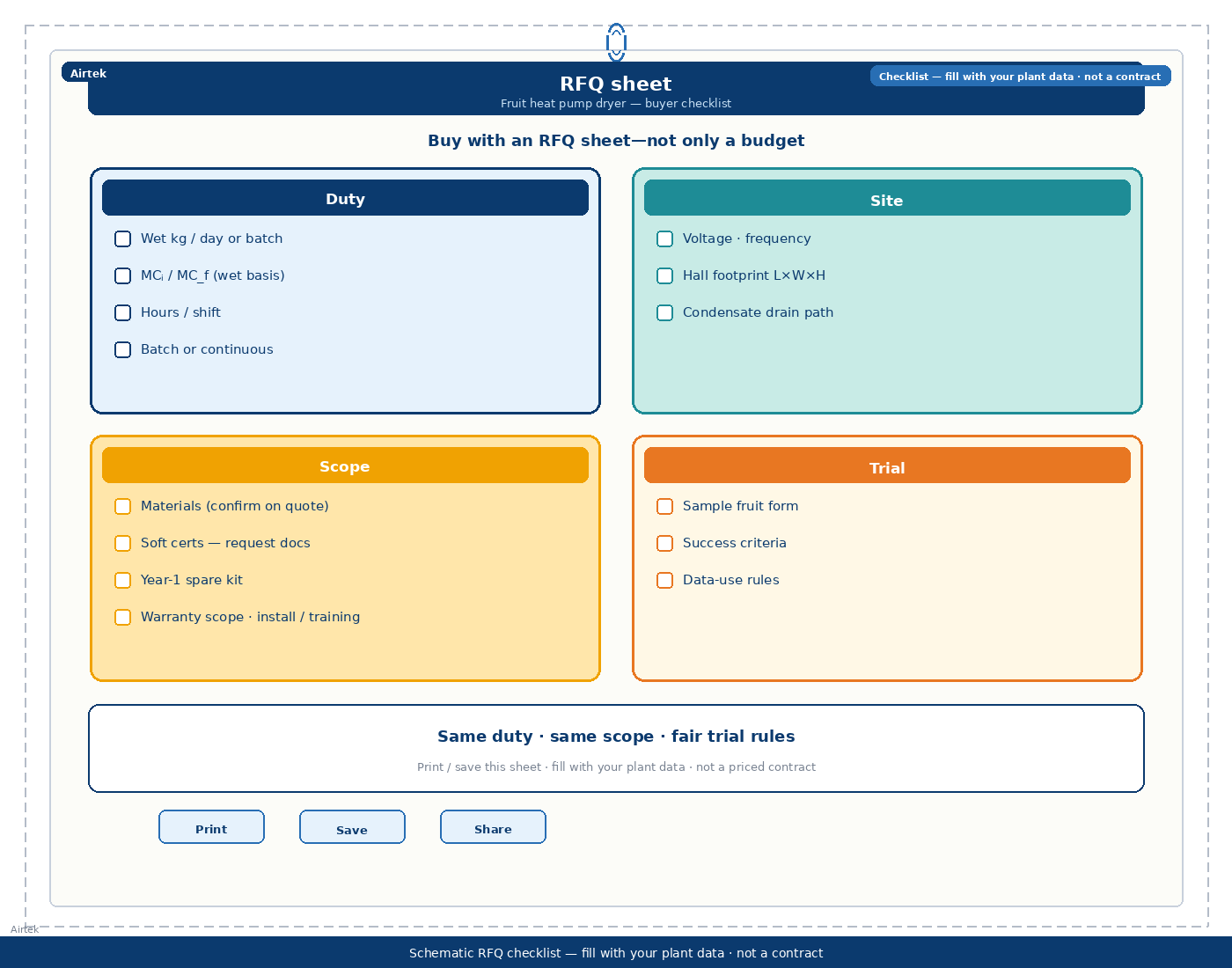
What an industrial fruit heat pump dryer RFQ means (buyer definition)
An industrial fruit heat pump dryer RFQ is a structured buyer request that asks suppliers to quote a closed-loop heat pump food dehydrator for fruit (chips, slices, rings, pieces, or related food SKUs) under shared assumptions—so CapEx, scope, and performance language can be compared.
In buyer language, a useful RFQ usually locks three layers:
- Duty — wet infeed (kg/batch or kg/day),
MC_i/MC_f(% wb), geometry, hours, and whether you mean batch (kg/batch × cycles) or continuous (kg/h). - Machine & site scope — chamber/tray materials, voltage/frequency, footprint, utilities (condensate, drainage, hall clearances), controls/logging, install and training.
- Commercial & proof — what is included in the price, warranty and spare parts, soft certification statements (never invent certificate numbers), and—if offered—trial drying / sample rules before PO.
A closed-loop heat pump food dryer conditions circulating air: moisture condenses on a cold evaporator and latent heat is recovered for reheat. That is why RFQs should talk about water removed and hours, not only a vague “kg dryer” nameplate. Architecture choice (tray chamber vs continuous) belongs in batch vs continuous heat pump dryer; energy intensity questions belong in heat pump dryer energy saving vs hot air.
Airtek (airtekdehydrator.com) discusses compact cabinets such as the CDS100KG cabinet food dryer and larger chamber options from the category hub as selection navigation. Published capacity bands are guidance only—selection guidance until one public unify sentence is locked—not a law that “above X tons/day you must buy Y.”
Related: Heat pump food dryer machine · Fruit drying machine · Batch vs continuous heat pump dryer · Heat pump dryer energy saving vs hot air · Product inquiry
RFQ Block A — Duty: Wet Capacity and Moisture Targets
Paste this block into every supplier RFQ so answers use the same duty sheet.
| Ask | Why it matters | Soft guidance |
|---|---|---|
| Crop list & cut form | Banana chips ≠ mango slices ≠ pineapple rings ≠ chili | Link crop notes when helpful: banana, mango; chili heat pump dryer (live); pineapple process post when published |
| Wet infeed | kg/batch or tonnes/day (state wet vs dry basis) | Prefer wet infeed + hours; see capacity sizing |
MC_i / MC_f (% wb) | Sets water removed \Delta W—the real heat-pump duty | Agree lab method with your buyer COA—confirm with your project COA |
| Hours / shifts | Converts batch or kg/h into daily wet throughput | Do not assume brochure 24/7 |
| Batch vs continuous preference | Labor, changeover, hall layout | Decision frame: batch vs continuous |
| Peak week vs average week | Avoid undersizing for harvest peaks | State both if seasonal |
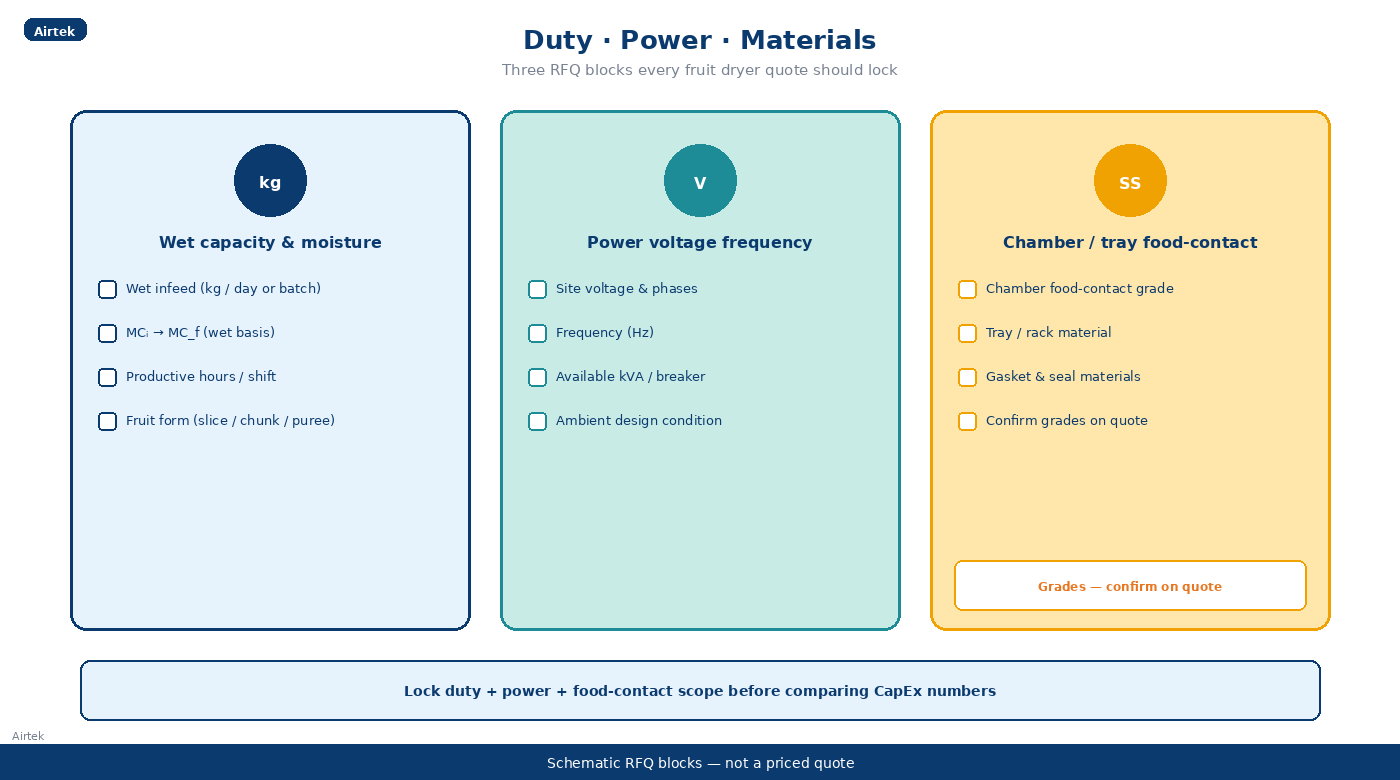
Buyer hygiene: reject quotes that answer only “1000 kg dryer” without stating wet vs dry, moisture pair, and hours.
RFQ Block B — Power, Voltage, Frequency, and Utilities
| Ask | Notes |
|---|---|
| Site voltage / phases / frequency | e.g. local industrial supply—confirm at your plant |
| Available kVA / breaker headroom | Heat-pump + fans + auxiliaries |
| Soft starter / inverter expectations | If your plant standard requires them |
| Condensate drain path | Closed-loop units produce condensate—plan drainage |
| Hall temperature / ventilation | Affects reject heat and comfort—qualitative site note |
| Water / compressed air (if any) | Only if your process needs wash-down or air tools—do not invent plant needs |
Power mismatch is one of the fastest ways an “ordered” machine sits in customs or fails commissioning. Put your electrical nameplate data in the RFQ; do not ask the vendor to guess.
RFQ Block C — Chamber, Tray, and Food-Contact Materials
Fruit plants care about hygiene and corrosion as much as capacity.
| Ask | Soft language (do not invent grades) |
|---|---|
| Chamber interior material | Food-contact suitable stainless or other stated finish—grade / finish locked on the written quotation |
| Trays / trolleys / mesh | Material, mesh size language, cleanability |
| Seals, gaskets, drain fittings | Food-area suitability as stated on quote |
| Surface treatment / polish | If your audit checklist requires a finish callout—confirm on quote |
| Spare tray count | Starter set vs full production rotation |
Do not copy a stainless “grade number” from a blog into a PO. Lock materials on the written quotation for your SKU and hygiene regime.
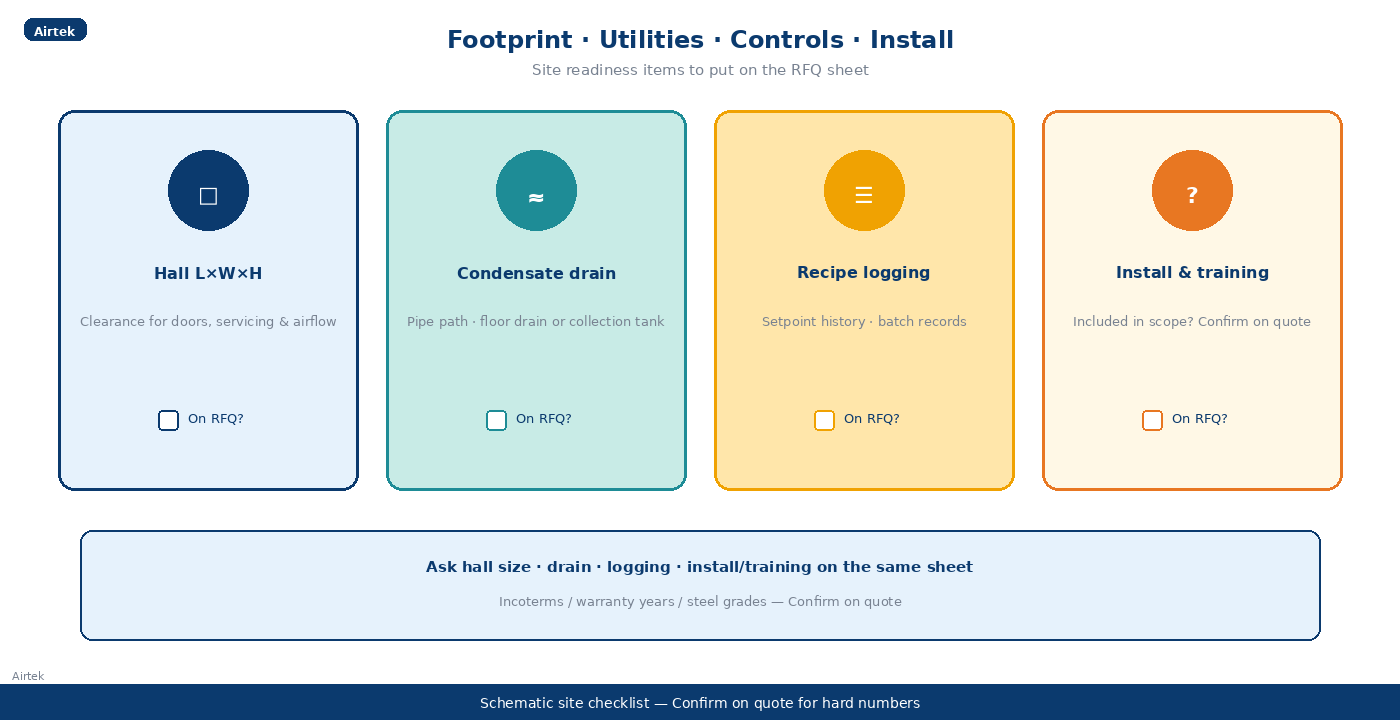
RFQ Block D — Footprint, Layout, and Site Fit
| Ask | Why |
|---|---|
| Machine L × W × H (as quoted) | Door, elevator, aisle clearance |
| Service clearances | Compressor / filter / tray pull space |
| Weight / floor loading | Civil note for heavy chambers—confirm civil notes for your project |
| Infeed / outfeed workflow | Manual tray carts vs continuous belt interfaces |
| Noise / heat reject expectations | Qualitative neighbor / HVAC planning |
Architecture (many small cabinets vs one larger chamber vs continuous) should follow labor and crop mix—not footprint alone. Pair this block with capacity sizing and batch vs continuous.
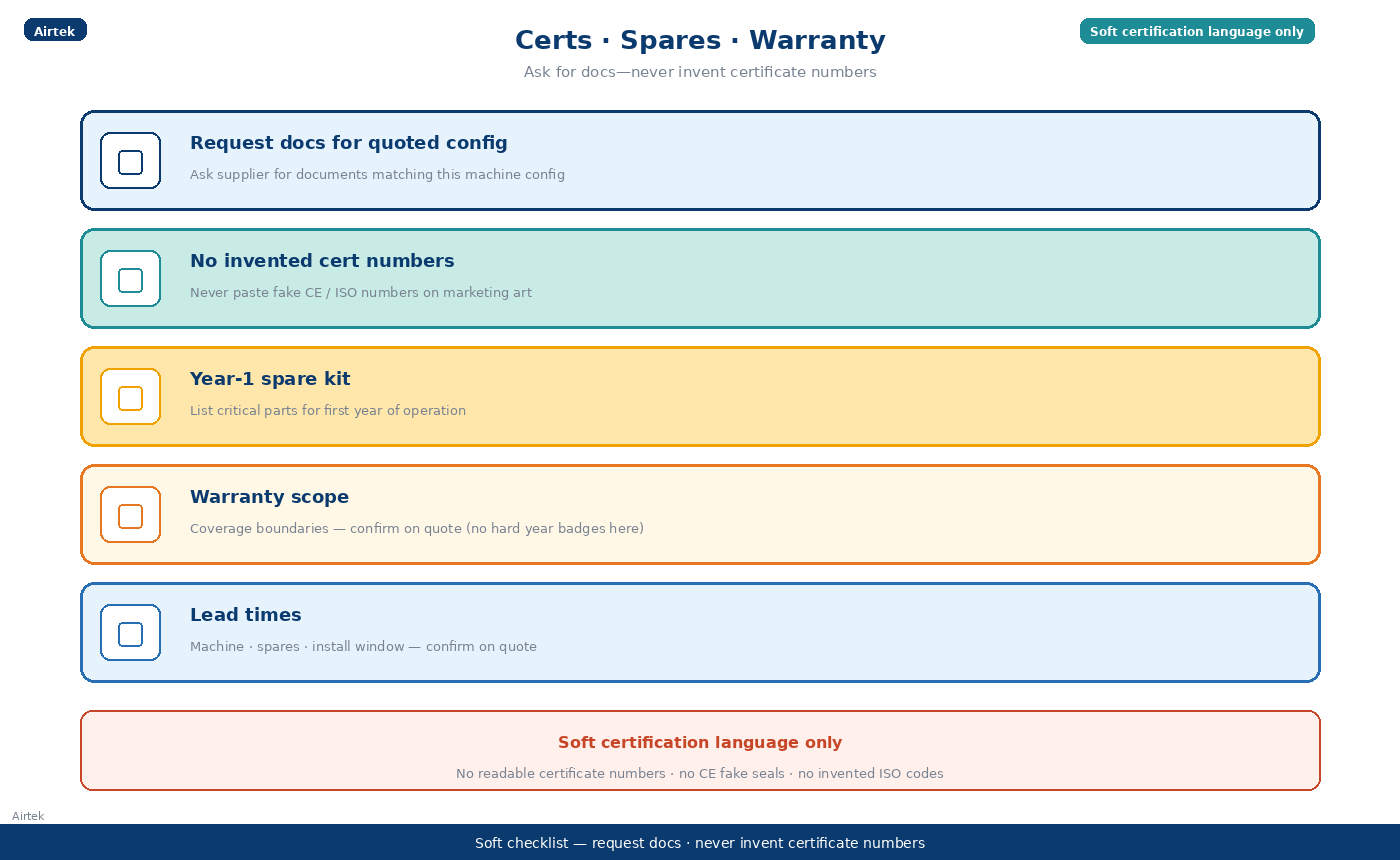
RFQ Block E — Certifications (Soft), Spare Parts, and Warranty
Certifications — soft questions only
Buyers often ask “Is it CE?” Export plants may also ask about destination-market electrical or food-equipment expectations.
Soft RFQ language (recommended):
- Ask which directives / standards the supplier claims conformity to, and request documentation listed on the quote.
- Never invent or publish a certificate number in marketing copy or in this checklist as if it were universal.
- Treat CE (or other marks) as scope- and configuration-dependent—until the supplier attaches the relevant declaration or certificate set to your machine configuration.
Spare parts and warranty
| Ask | Why |
|---|---|
| Warranty length and covered assemblies | Compressors, controllers, chamber—confirm on quotation terms |
| Recommended spare-parts kit (year 1) | Filters, sensors, seals, tray mesh, contactor classes as applicable |
| Lead times for critical spares | Export plants need realistic logistics language |
| Remote support / language | Who diagnoses alarms after install |
| Consumables vs warranty parts | Avoid surprise OpEx—see TCO framing in heat pump vs resistance TCO |
RFQ Block F — Controls, Logging, Install, Training, and Commercial Terms
Controls and logging
| Ask | Soft guidance |
|---|---|
| Temperature / humidity program capability | Fruit recipes need staged T/RH language—not a single dial |
| Recipe storage / multi-step programs | Useful for export SKU families |
| Data logging / export for audits | Ask what is included vs optional— |
| Alarm / interlock list | Over-temp, door, compressor faults—as stated on quote |
| Language of HMI / manuals | Match operator language |
Install and training scope
Write explicitly whether the quote includes: freight to port or site, rigging, electrical connection, commissioning, operator training days, and recipe start-up assistance. CapEx that looks “cheap” often excluded these—compare scope, not sticker price alone (TCO checklist).
Incoterms and payment
Use only confirm-on-quote language:
- Incoterms (e.g. EXW / FOB / CIF family)—confirm on quote and contract
- Payment schedule and currency—confirm on contract
- Do not invent “standard Airtek Incoterms” in public blog copy.
Energy OpEx discussion (kWh per kg water removed, tariff) remains a sibling topic: heat pump dryer energy saving vs hot air.
Trial Drying / Sample Protocol (No Invented Client Stories)
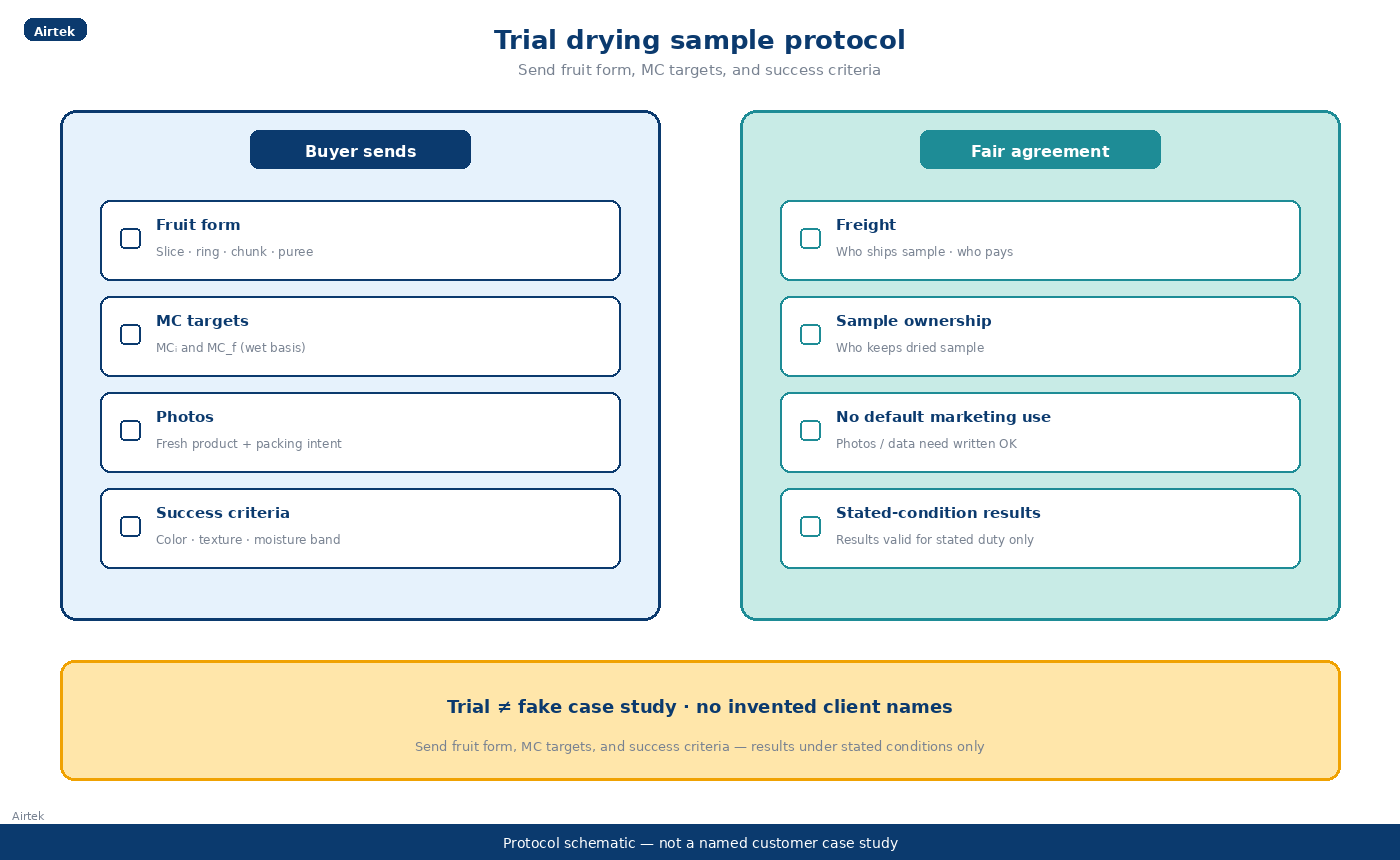
A fair trial protects both buyer and supplier. It is not a substitute for naming fake “Client X in Country Y” case studies—and this article will not invent any.
What buyers should send (or bring)
| Item | Why |
|---|---|
| Fruit form | Whole / peeled / sliced; thickness target; variety note if known |
Approximate MC_i and target MC_f | Or buyer COA moisture band—confirm with buyer |
| Photos of current product / defects | Stickiness, browning, case hardening clues |
| Pack / label constraints | Sulfuring, additives, soft-dried vs low-moisture snack |
| Batch size for trial | Enough for lab moisture checks—not a full production promise |
| Success criteria in writing | e.g. visual grade + lab moisture method—not “tastes like competitor brand” |
What a fair trial agreement should cover (checklist language)
- [ ] Who pays freight for samples and return of leftover product
- [ ] Who owns dried samples and residual raw material after the trial
- [ ] Whether photos / moisture data may be used in marketing (default: no, unless you opt in)
- [ ] That trial results are under stated loading and setpoints, not a contract capacity guarantee
- [ ] Next step if trial is acceptable (quote revision, PO conditions)—still without inventing ROI%
- [ ] Safety / food-hygiene handling of customer fruit on the supplier floor
Soft takeaway: a trial answers “can this closed-loop heat pump path work on our cut and moisture targets?” It does not by itself prove annual tonnes, energy %, or payback.
Crop-specific educational context (still not yield guarantees): banana, mango; chili (live); pineapple when published.
One-Page RFQ Paste List (Downloadable-Style Summary)
Use this as a single paste block when you contact Airtek or other suppliers:
- Crops + cut forms + wet kg/day (or kg/batch) + hours
MC_i/MC_f(% wb) + lab method note- Batch vs continuous preference + hall constraints
- Voltage / phases / frequency + condensate drain notes
- Chamber / tray food-contact expectations (grades on quote)
- Soft certification documentation request (no invented numbers)
- Warranty + year-1 spare kit + lead times
- Controls / logging / install / training included or excluded
- Incoterms & payment: confirm on quote—
- Trial sample plan (fruit form, success criteria, data-use rules)
Navigation SKUs such as CDS100KG are starting points only; final selection follows the duty sheet above.
FAQ — Buy industrial heat pump fruit dryer (RFQ)
Q1. What does it mean to buy an industrial heat pump fruit dryer via RFQ?
A. It means asking suppliers to quote a closed-loop heat pump fruit dehydrator under a shared duty and scope sheet—wet capacity, moisture targets, power, materials, certifications documentation, spare parts, install/training—so proposals are comparable. It is not the same as buying a small household dehydrator online.
Q2. What capacity number should I put on the RFQ first?
A. Prefer wet infeed (kg/batch or kg/day) plus MC_i/MC_f and hours—not a lone “kg dryer” slogan. Convert batch and continuous language to daily wet kg under your calendar. Method detail: industrial heat pump dryer capacity sizing; architecture: batch vs continuous.
Q3. How should I ask about CE or other certifications?
A. Ask which standards the quoted configuration claims, and request the documents attached to that quote. Do not invent certificate numbers for web copy or RFQs. Marks can be configuration-dependent until documents match your configuration.
Q4. What makes a fair trial drying / sample protocol?
A. Send clear fruit form, moisture targets, photos, and written success criteria; agree who pays freight, who owns samples, and whether data may be published (default no). Treat results as stated-condition evidence, not a fake multi-country case study or ROI proof.
Q5. What should I send Airtek to start a quotation discussion?
A. Paste the one-page RFQ list above into a product inquiry: wet duty, power, hall notes, material/hygiene expectations, and whether you want a trial protocol. Browse the heat pump food dryer hub and fruit drying machine pages for navigation; use CDS100KG only as a compact reference point. For energy and CapEx/OpEx questions, see energy saving vs hot air and TCO.
Talk to Airtek with an RFQ Sheet—Not Only a Budget Number
If you are ready to buy an industrial heat pump fruit dryer, bring a checklist, not only a target price. Airtek can help turn wet infeed, moisture targets, power, and hygiene expectations into a scoped discussion—mark what remains open until quote or trial—and keep certification and commercial terms honest.
Next step: open a product inquiry with the paste list in this article. We will talk scope and next trials—without inventing client names, certificate numbers, or brochure ROI%.