
Pineapple is a high-sugar tropical fruit that rewards careful dehydration—and punishes blunt heat. For processors in Southeast Asia, Latin America, West Africa, and other production belts, turning ripe pineapple into dehydrated rings, chips, spears, or ingredient pieces is a classic surplus-to-export story. The same sugar that buyers love for flavor also drives tray stickiness, surface caramelization, and case hardening if temperature and humidity are staged poorly.
This guide focuses on commercial pineapple heat pump drying for dehydrated products—not oil-fried pineapple chips. It covers sugar-related drying risks, qualitative geometry (chips vs rings vs chunks), trial-language temperature/humidity staging, snack vs soft-dried vs powder end-markets, moisture discussion bands with destination COA caveats, and transparent yield thinking (assumptions first—never a fake guaranteed %).
Airtek builds heat pump food dryer chambers and related fruit drying machines for export-oriented plants. Exact setpoints and kg dried per tonne always follow your cultivar, cut form, and buyer COA—not a brochure promise.
Soft note for buyers: figures and bands below are literature and trade discussion ranges under stated assumptions—not guaranteed factory outputs. Final moisture, additives, sulfuring, and labeling must follow your destination-market buyer requirements. Items that remain open need plant or buyer confirmation before RFQ language hardens.
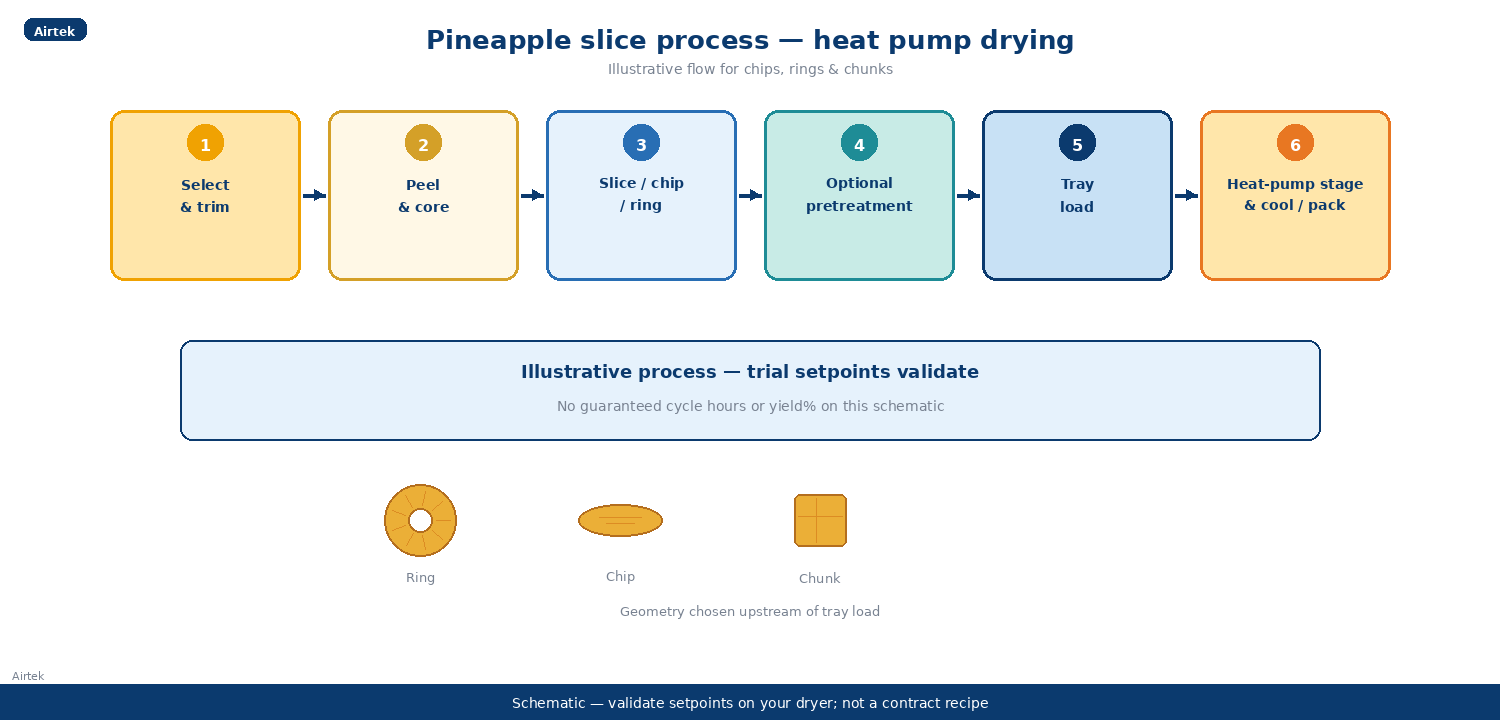
What commercial pineapple heat pump drying means (buyer definition)
Commercial pineapple heat pump drying is the industrial dehydration of ripe pineapple into dehydrated chips, rings/slices, spears, chunks, or ingredient pieces using a closed-loop heat pump dryer—not an oil fryer. Moist chamber air meets a cold evaporator, where water condenses and latent heat is recovered; the refrigerant rejects heat at the condenser to rewarm the air before it returns to the trays. That supports programmable temperature and humidity, milder air for high-sugar fruit, and weather-independent batches in humid tropics.
Buyers should separate SKUs carefully:
| SKU family | Process story | Moisture language |
|---|---|---|
| Dehydrated snack chips / rings | Tray or belt heat-pump (or other dehydrator) moisture removal | Dried-fruit / buyer COA bands—confirm destination-market rules with your buyer |
| Soft dried / high-moisture preserved styles | Often preservatives or other preservation + milder finish | Different labeling and Aw story than low-moisture chips |
| Ingredient / powder pathway | Dehydrate then mill or cut for bars, bakery, seasoning | Often driven toward lower moisture than chewy soft fruit |
| Fried pineapple chips | Oil fryer line | Not interchangeable with dehydrated moisture or yield talk |
Exact cycle hours, tray density, and kg dried per tonne depend on cultivar, peel/core basis, thickness, pretreatment, and final moisture—use planning bands and plant trials, not brochure guarantees.
Airtek (airtekdehydrator.com) supplies industrial / commercial heat pump fruit dehydrators—including compact cabinets such as the CDS100KG cabinet food dryer—and discusses larger chamber options on the category hub. Share wet batch size, rings vs chips vs chunks, and target moisture for a practical equipment discussion.
Related: Heat pump food dryer machine · Fruit drying machine · Banana heat pump drying process & yield · Mango heat pump drying chips & export slices · Heat pump dryer energy saving vs hot air · Batch vs continuous heat pump dryer · Product inquiry
High-Sugar Risks: Stickiness, Caramelization, and Case Hardening
Pineapple pulp is rich in free sugars. That is good for flavor and bad for lazy dryer profiles.
| Risk | What operators see | Process implication (qualitative) |
|---|---|---|
| Tray / piece stickiness | Slices glue to mesh, clump on cool-down, tear when peeled off | Food-grade tray finish; light release aids where buyer/additive rules allow; avoid sealing packs while warm and tacky; cool before moisture-barrier packing |
| Surface caramelization / browning | Dark edges, “toasted” or burnt-sugar notes, uneven amber | Early aggressive heat cooks sugar at the surface while cores stay wet; prefer staged T/RH over “blast hot and hope” |
| Case hardening | Hard crust outside, soft or wet core; later mold or soft spots after pack | Inlet air too hot and too dry too early collapses surface pores; keep RH from collapsing so hard that diffusion stalls |
| Sugar / syrup skin (osmotic or honey dips) | Slow drying, sticky coat, higher residual moisture in trials | Extra solids change mass balance; honey/sugar pretreatments can impede moisture loss—validate on your SKU |
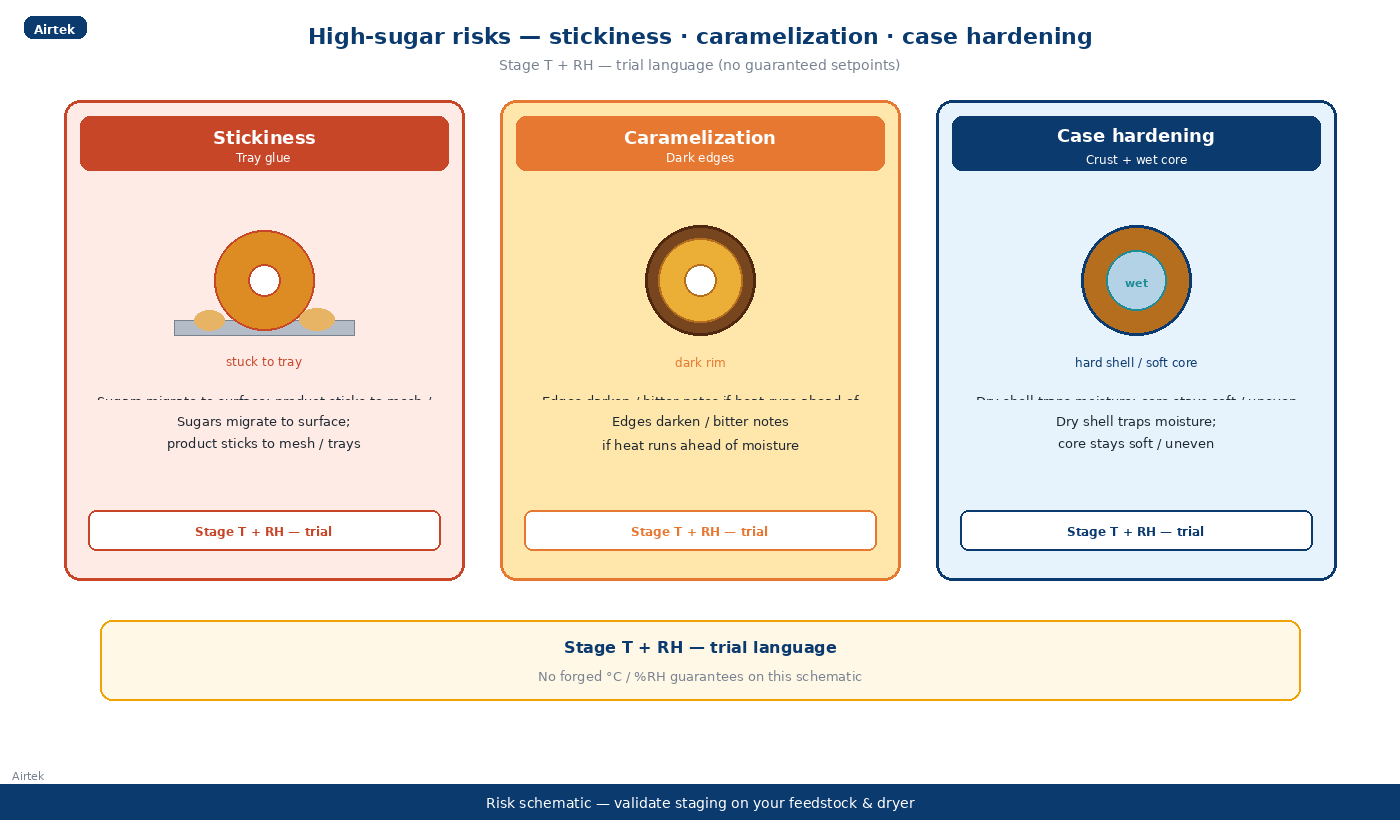
Heat pump drying does not remove these risks by brand name alone. What a closed-loop heat pump food dryer offers is independent control of temperature and humidity so you can stage free-water removal, falling-rate drying, and finish without dumping humid tropical air into an open exhaust oven and guessing.
Practical habits (soft language):
- Sort bruised or fermented fruit before cutting—sugar + damage accelerates off-notes.
- Keep cut thickness uniform; the thickest piece sets stop time.
- Do not equate “darker = drier”; verify moisture with a lab method agreed with the buyer.
- Clean trays between sticky batches; sticky residue seeds the next stickiness problem.
Geometry: Chips vs Rings vs Chunks
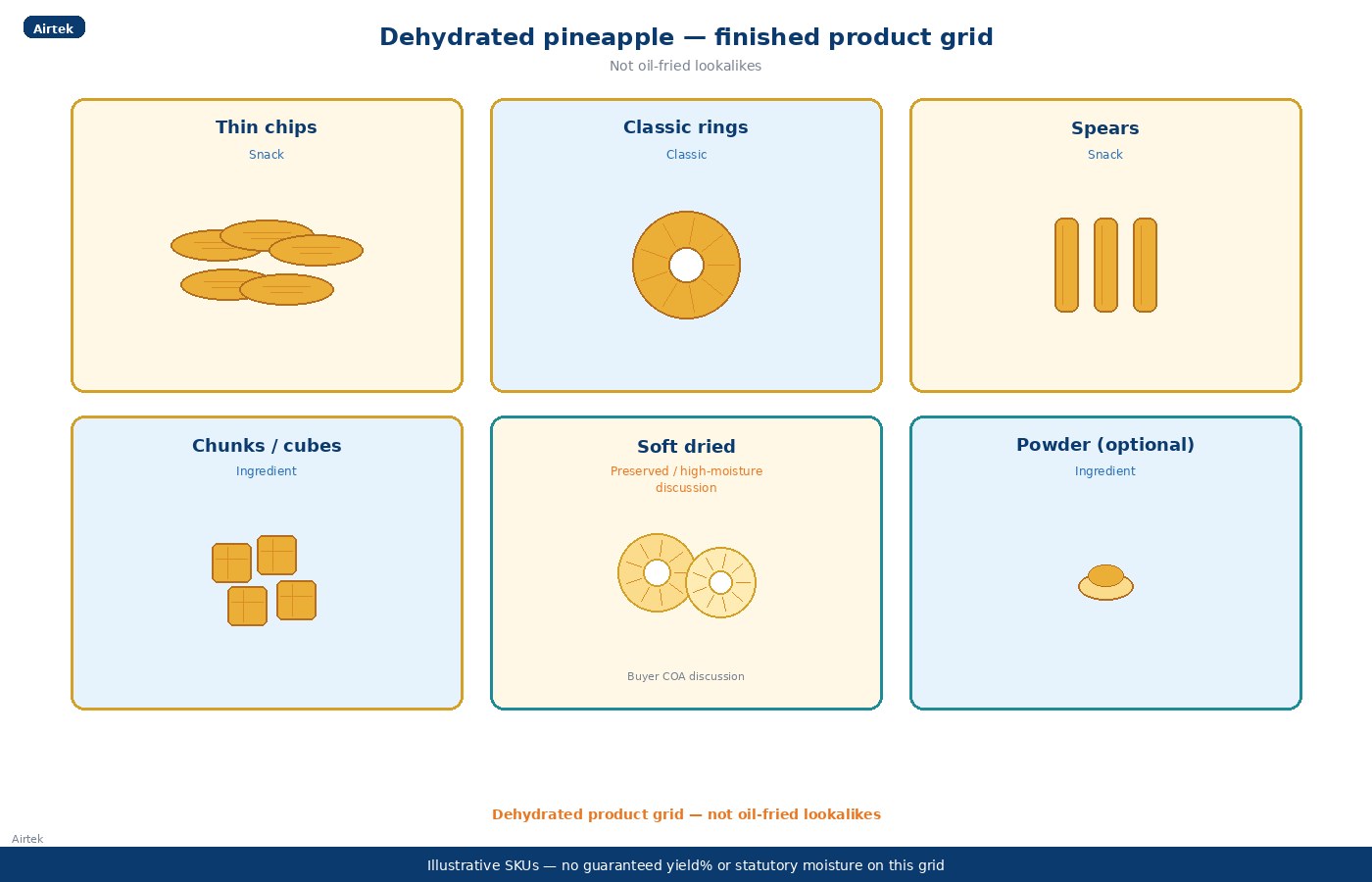
Geometry sets diffusion path, tray utilization, and whether the SKU reads as snack chip, classic ring, or ingredient chunk.
| Form | Typical discussion | Time & uniformity | Commercial fit |
|---|---|---|---|
| Thin snack chips / flake-like slices | Often on the order of a few mm when thickness is controlled | Fastest; best batch uniformity if knives are consistent | High-turn snack packs; remill feedstock if carefully finished |
| Rings / slices (classic dried pineapple) | Mid thickness; center hole geometry affects airflow through the stack | Medium; edges dry faster than flesh near the core ring | Mainstream dried-pineapple bags, trail mixes |
| Spears / strips | Long diffusion paths along one axis | Medium–slow; watch edge over-dry | Snacking and gift packs |
| Chunks / cubes / tidbits | Thickest effective path | Slowest; wet centers and case-hardening risk rise | Ingredient, bakery, soft-fruit styles; needs patient staging |
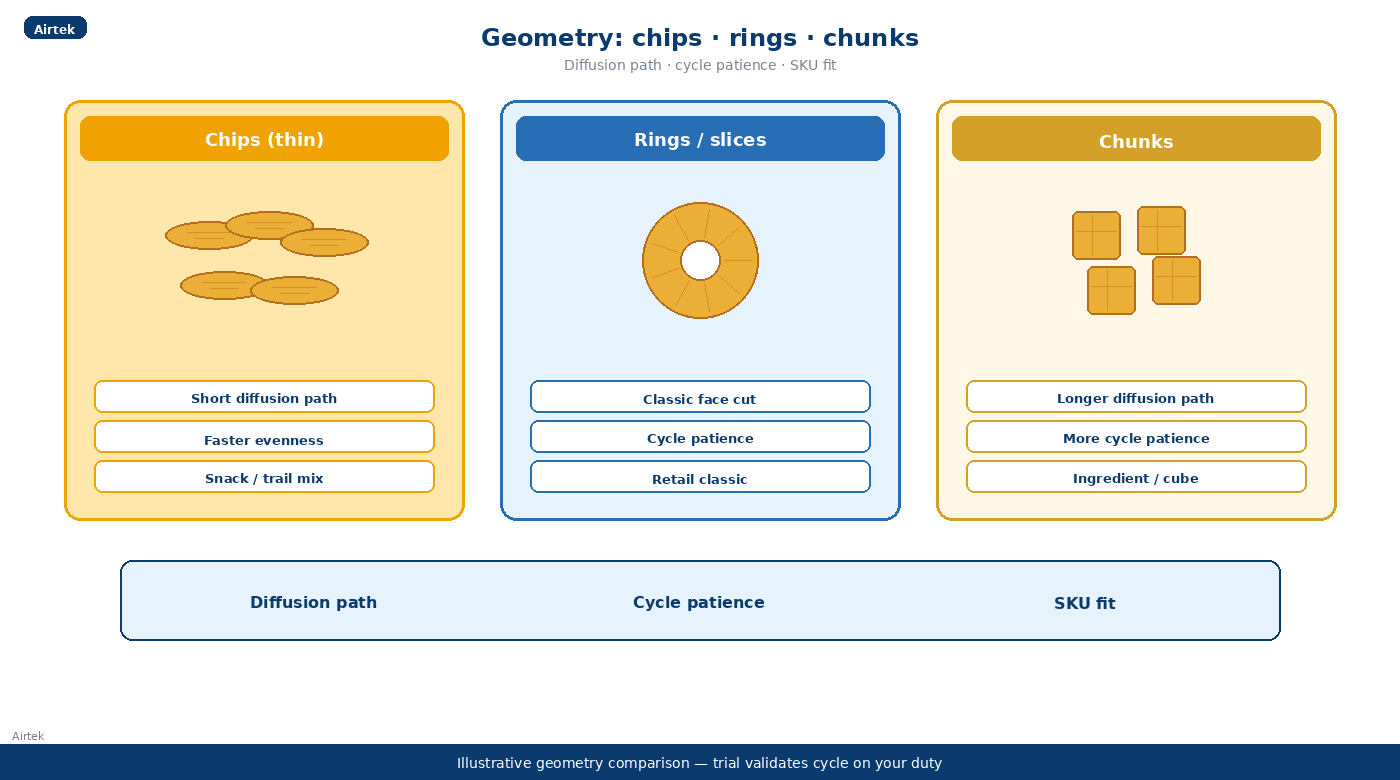
Selection logic: export snack chips → thinner, uniform pieces on tray heat-pump lines. Soft / high-moisture preserved styles → thicker geometry plus preservation strategy, with longer cycles. Uneven knives mean thin pieces over-dry and shatter while thick pieces fail moisture QA.
Tray loading (qualitative only)
Leave gaps; stacking creates wet pockets and glued clumps. Industry pages sometimes quote generic fruit loading densities and air speeds.
Any specific kg/m² or m/s figure is a generic reference band at best—not an Airtek guaranteed setpoint. Validate loading and airflow on the machine and cultivar.
Temperature and Humidity Staging (Trial Language Only)
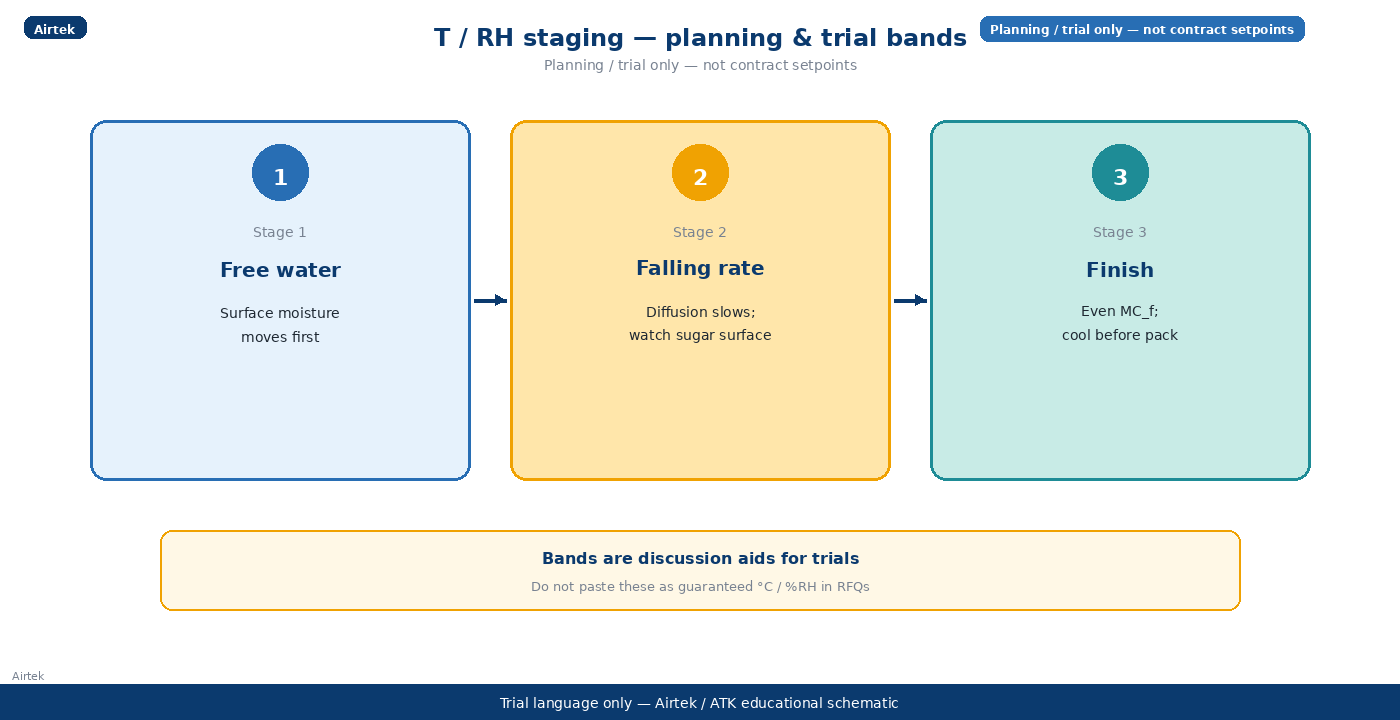
Closed-loop heat pump dryers matter for pineapple because temperature and relative humidity can be programmed with more independence than a simple open-exhaust hot-air oven. That helps manage sugar surfaces without inventing a contractual hour table.
Use the bands below as planning language for trials—not as factory setpoints copied into a purchase contract. Do not treat any blog hour range as an Airtek guarantee.
Stage thinking (no invented plant-hour guarantees)
| Stage | Goal | Qualitative process band |
|---|---|---|
| 1 · Surface free water | Remove unbound moisture without scorching sugar | Mild-to-moderate chamber air; keep RH from collapsing so hard that surfaces case-harden |
| 2 · Falling-rate drying | Pull moisture from ring/chip cores while holding color | Often the longest stage for thick rings/chunks; quality-focused fruit heat-pump literature commonly explores roughly mild-to-moderate air temperatures (often discussed in the broader fruit-HPD conversation around low-to-mid tens of °C up toward ~50–60 °C class trials in older oven studies)—site-specific |
| 3 · Finish / equilibration | Hit target moisture / Aw without darkening edges | Slightly gentler finish; avoid “cooking” high-sugar surfaces into caramel notes |
Research / trade anchors (soft language only):
- Oven and cabinet fruit studies on pineapple slices have used temperatures on the order of roughly ~60–65 °C class runs for finite hours in published pretreatment comparisons—useful as process research context, not an Airtek recipe card.
- Heat-pump and hybrid fruit-drying reviews emphasize controlled low-to-moderate temperatures and humidity for quality-sensitive tropical fruit; combined vacuum + heat-pump routes appear in research for color and rehydration—again context, not a plant guarantee.
- Exact °C / %RH / hour curves for your cultivar, thickness, and SKU must come from trial logs.
Project-level setpoints, cycle hours, and kWh per kg water removed remain plant trial outcomes—never brochure law.
For how closed-loop recovery differs from hot-air exhaust loss—and what to ask about energy metrics—see How heat pump dryers cut energy use vs conventional hot-air dryers. If you are still choosing tray chambers versus a continuous belt for fruit geometry, see Batch vs continuous heat pump dryer.
End-Markets: Snack Chips vs Soft Dried vs Ingredient / Powder
Do not quote one moisture, one yield, and one dryer size for every pineapple SKU.
| End-market | What buyers usually buy | Process / pack notes |
|---|---|---|
| Snack chips / crisp-leaning dehydrated pieces | Thin geometry, fruit-forward chew or semi-crisp | Lower moisture discussion than soft fruit; moisture-barrier pack after cool-down |
| Classic chewy rings / slices | Uniform color (natural yellow–amber), no hard/sticky clumps | Texture “firm but chewable” language is common in trade notes |
| Soft dried / high-moisture preserved | Softer chew; often preservatives or other preservation | Labeling and Aw differ; do not reuse low-moisture chip specs |
| Ingredient (bars, bakery, yogurt mix-ins) | Size-stable pieces, controlled Aw | Spec sheets often tighter on defects and moisture method |
| Powder / flake pathway | Mill after drying | Usually driven toward lower moisture than chewy soft fruit; fines and hygiene matter |
| Fried chips (different line) | Oil snack | Separate process, moisture language, and yield story entirely |
Related tropical-fruit process notes on the same plant calendar: banana heat pump drying process and yield and mango heat pump drying for chips and export slices.
Moisture Targets: Discussion Bands, Not Universal Law
Typical initial moisture (soft)
Ripe pineapple flesh is a high-moisture feedstock. Processing and composition summaries commonly place fresh pulp in a high wet-basis band (often discussed around the roughly ~80–87% wb conversation range depending on cultivar and ripeness). Confirm wet-basis vs dry-basis with your lab before quoting capacity.
Target moisture by product type (frameworks)
| Product | Typical target moisture discussion | Notes |
|---|---|---|
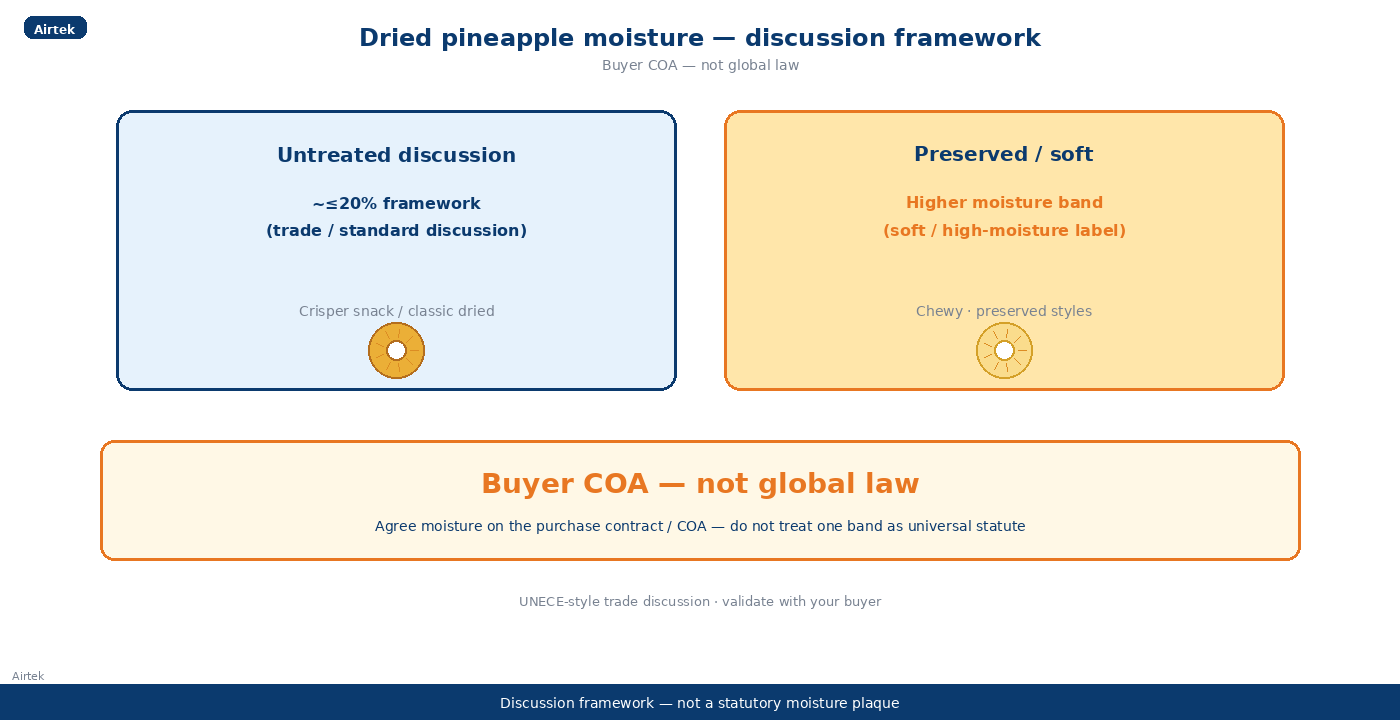
| Untreated dehydrated rings / slices / chips | Trade and UNECE-style frameworks often discuss not exceeding ~20% for untreated dried pineapple | Too wet → soft, sticky, mold risk; too dry / over-dried → hard, woody chew (some home/commercial notes warn about very low moisture becoming hard) |
| Preserved / treated soft or high-moisture styles | Public UNECE-aligned discussion: above ~20% up to ~44% when preservatives or other preservation are used; bands roughly ~26–44% often labeled soft fruit / high moisture in that framework | Different SKU from low-moisture snack chips |
| Powder / flake pathway | Often driven toward lower moisture than chewy soft fruit | Milling and packaging rules differ |
| Fried pineapple chips | Oil-containing snack | Moisture specs are not interchangeable with dehydrated slices |
Export / standards framing (discussion aids—not universal law)
Public documents useful for RFQ conversations include:
- UNECE-aligned dried pineapple moisture language (public summaries): untreated dried pineapples not exceeding 20.0% moisture; treated / preserved product may sit above 20.0% and not exceeding 44.0%, with ~26–44% labeled soft fruit / high moisture in that framework.
- CBI / EU market notes for dried pineapple: quality talk often stresses uniform soft/pliable texture without hard or sticky parts, natural yellow–amber color, and buyer preference for chewable—not rock-hard—product; EU buyers commonly expect GFSI-recognized food-safety schemes (IFS, BRCGS, FSSC 22000, SQF, etc.) even when legislation does not name one scheme—confirm with the specific buyer.
- Presentation forms in trade notes: whole slices, half slices, broken slices, spears, tidbits, chunks, cubes.
Exact legal caps and buyer COAs still vary by destination (EU retail, US snack brands, Middle East, Japan, etc.). Use UNECE / trade notes as conversation frameworks. Do not treat one number as a global mandatory limit—and never apply fried-chip moisture language to heat-pump dehydrated pineapple.
For microbial stability, many snack buyers also care about water activity and moisture-barrier packaging after cool-down—not moisture percentage alone.
Dehydrated Pineapple vs Fried Pineapple Chips (Do Not Confuse Them)
| Fried pineapple chips | Dehydrated / dried pineapple | |
|---|---|---|
| Process | Thin pieces fried in hot oil | Moisture removed by sun, hot air, solar, vacuum, or heat pump |
| Composition | Absorbs oil | Little or no oil unless coated later |
| Texture story | Crispy oil snack | Chewy to semi-crisp fruit-forward snack / ingredient |
| Moisture language | Often written for oil snacks | Follow dried fruit standards / buyer COAs |
| Equipment story | Fryer lines | Fruit drying machine / heat pump dehydrator territory |
Always specify which product you are quoting capacity, moisture, and yield for.
Yield Thinking: Assumptions First (No Fake Guaranteed %)
Never treat a single kilogram number as a law of nature. First confirm whether the buyer’s “1 tonne” means whole fruit with peel and core or already peeled, cored flesh, then lock initial and final moisture assumptions.
Mass-balance idea
W_f = W_{\text{in dryer}} \times \frac{100 - MC_i}{100 - MC_f}where MC_i and MC_f are moisture % wet basis, and W_{\text{in dryer}} is the mass that actually enters the dryer (usually flesh pieces—not whole pineapples with peel and core).
Dry matter is approximately conserved during drying; water removal \Delta W = W_i - W_f is the engineering load that drives dryer sizing conversations.
Transparent assumptions (dehydrated route—planning only)
Pineapple has a large peel and fibrous core. Edible flesh recovery after peeling and coring varies widely by cultivar, ripeness, and trim severity. Treat pulp recovery as a plant-measured %, not a brochure constant—confirm pulp recovery on your cultivar.
| Parameter | Conservative | Mid (illustrative) | Optimistic |
|---|---|---|---|
| Whole fruit in | 1000 kg | 1000 kg | 1000 kg |
| Edible flesh after peel + core | Lower recovery | Mid recovery | Higher recovery |
Initial moisture MC_i | Higher end of fresh band | Mid | Lower end |
Final moisture MC_f | Higher finish (e.g. untreated discussion near ~20%) | Mid snack band | Lower finish |
Writer-safe posture (no invented universal %):
- Quote yield only after stating peel/core basis and
MC_i/MC_f. - Use the mass-balance formula above for RFQ math; fill numbers from your lab and trim line.
- After crumbs, stickiness losses, and sorting rejects, apply a plant loss % is site-specific—validate on trials—do not invent a global scrap percentage.
- Osmotic / sugar-infused soft dried routes change solids—do not reuse plain dehydrated yield math without a separate solids balance.
If a buyer demands a single “kg dried per tonne” marketing claim without assumptions, refuse the fake precision and send a assumption sheet instead.
For capacity language (wet infeed vs dry-out vs water removed), see Airtek’s industrial heat pump dryer capacity sizing method, or start from the heat pump food dryer hub and product inquiry.
Why Heat Pump Fits Pineapple (Qualitative)
| Dimension | vs traditional sun drying | vs simple hot-air / open exhaust drying |
|---|---|---|
| Sugar / color control | Less dust, insects, rain rewetting, and uneven sun bleach | Milder T + controllable RH → better story against caramelized edges when profiles are tuned |
| Stickiness management | Enclosed chamber; repeatable cool-down discipline | Programmable finish stage vs weather scatter |
| Energy conversation | Continuous production regardless of rain season | Recovers condensation latent heat; ask suppliers for kWh per kg water removed under comparable loads—not vague “saves X%” slogans |
| Hygiene / compliance story | Enclosed chamber supports cleaner GMP narratives | No combustion flue contact with food; condensate can be managed |
| Operations | Delivery dates less hostage to weather | Exact ROI depends on local electricity tariffs—site numbers must be calculated case by case |
One-line takeaway: A pineapple heat pump dryer helps processors run cleaner, more controllable, weather-independent dehydration with a stronger anti-stickiness / anti-caramelization process story than sun drying or blunt hot-air systems—when tray loading and staging are validated on the fruit you actually buy.
Practical Checklist Before You Scale Pineapple Drying
- Define the SKU: dehydrated chips / rings, soft high-moisture preserved, ingredient pieces, powder pathway—or fried chips (different line).
- Lock ripeness, peel+core vs flesh basis, and target moisture (and Aw if your buyer asks)—confirm destination-market buyer COA.
- Choose geometry (chips vs rings vs chunks) for the cycle time and chew you can sell.
- Plan pretreatment (acid dips, optional sulfuring, osmosis) against your market’s additive rules—confirm residue and labeling rules for your market.
- Validate tray loading and airflow on your dryer—do not treat generic industry ranges as guarantees.
- Size the heat pump chamber to your wet infeed per batch and water-removal load, not only to a hoped-for dry-out tonnage.
- Package for moisture barrier after product cool-down; confirm labeling for untreated vs preserved / soft-fruit styles.
FAQ — Pineapple heat pump dryer
Q1. Can you dry pineapple commercially in a heat pump dryer?
A. Yes. Closed-loop heat pump dryers remove moisture by condensation and heat recovery at relatively mild, controllable air conditions, which suits high-moisture, high-sugar pineapple when geometry, pretreatment, and tray loading are validated. This guide covers dehydrated chips, rings, and ingredient pieces—not fried pineapple chips.
Q2. What moisture should dehydrated pineapple target?
A. Public UNECE-aligned frameworks often discuss ≤20% for untreated dried pineapple, and above 20% up to ~44% for treated / preserved styles (with soft/high-moisture labeling language in roughly the ~26–44% discussion band in that framework). Trade notes also emphasize chewable texture without hard or sticky clumps. These are RFQ conversation aids—not a single global legal cap. Confirm your buyer COA and never reuse fried-chip moisture language. Confirm destination-market rules with your buyer.
Q3. Why does pineapple stick or caramelize in the dryer?
A. Free sugars drive tray stickiness, surface caramelization under blunt early heat, and case hardening when air is too hot and too dry too early. Stage temperature and RH on a closed-loop heat pump, keep thickness uniform, cool before packing, and validate release practices against buyer additive rules. Exact °C/%RH/hour curves remain trial outcomes.
Q4. How much dried pineapple from 1 tonne of fresh fruit?
A. First lock whether “1 tonne” means whole fruit (peel + core) or already peeled, cored flesh, then set MC_i / MC_f. Use mass balance W_f = W_{\text{in dryer}} \times (100 - MC_i)/(100 - MC_f). Flesh recovery % and plant scrap % are site-specific—do not invent a universal guaranteed kg/tonne or yield %. Osmotic / sweetened routes need a separate solids balance.
Q5. What should I send Airtek for a pineapple heat pump dryer RFQ?
A. Send: whole fruit vs peeled/cored flesh basis, wet kg per batch or day, chips vs rings vs chunks, pretreatment plan, target moisture (and Aw if asked), destination market, hall size / voltage, and whether you need batch tray chambers (e.g. compact CDS100KG class navigation) or are comparing continuous options. Use the product inquiry form. For energy metrics, see heat pump dryer energy saving vs hot air; for architecture choice, see batch vs continuous.
Talk to Airtek About a Pineapple Heat Pump Dryer
If you are scoping a commercial dehydrated pineapple chips, rings, or ingredient line, share your wet batch size, product form (thin chips vs rings vs chunks), pretreatment plan, target moisture, and destination market. The Airtek team can help match a heat pump dehydrator capacity and drying program to your fruit—not a one-size brochure promise.
Next step: send a product inquiry with your raw-material basis (whole fruit or peeled/cored flesh) and daily throughput goal. We will respond with a practical equipment discussion for your plant.