
Dried chili and red pepper sell on color, cleanliness, and moisture discipline as much as on heat units. A buyer who opens a carton of dull, browned, or mold-risky pods will not care that the dryer was “big.” For spice and seasoning plants, a chili heat pump dryer conversation should start with how you protect carotenoid color and hit export moisture language—not with invented energy percentages.
This guide is for commercial processors and exporters working with whole pods, flakes/rings, or a powder pathway. It stays qualitative on moisture and yield: public standards are cited only as conversation frameworks, and destination COA limits stay open until your buyer confirms them. No competitor brand names; no fake client case studies.
Airtek builds heat pump food dryer chambers for fruit and food plants, including spice-adjacent SKUs that share the same closed-loop dehumidification idea. Exact sizing follows wet infeed, geometry, and target moisture—see also Airtek’s industrial heat pump dryer capacity sizing method, or start from the category hub and product inquiry.
Soft note for buyers: color and moisture targets below are process language, not universal legal limits for every market. Items marked for validation stay open until confirmed on your cultivar, cut form, and destination COA. Do not treat any single % moisture as a global law.
What a “chili heat pump dryer” means (buyer definition)
A chili heat pump dryer (also discussed as red pepper / capsicum heat pump drying) is an industrial or commercial dehydrator that uses a closed-loop heat pump to condition circulating air—dehumidifying by condensation and reheating—while chili product sits on trays (batch chamber) or, less often for irregular whole pods, moves on a continuous belt when geometry and volume allow.
For spice buyers, “capacity” still means wet infeed and water removed under stated hours—not a slogan tonnage. What is distinctive versus generic fruit chips is the quality brief: protect red–orange color, avoid smoke/dust contamination narratives common in open sun drying, and land moisture in a band your export COA accepts (confirm destination-market rules with your buyer).
Airtek (airtekdehydrator.com) supplies heat pump chamber dryers (including compact cabinets such as CDS100KG) and discusses larger chamber / belt options on the heat pump food dryer hub. Share pod vs flake form, daily wet kg, and buyer moisture/color notes for a project discussion—not a brochure “one moisture fits all” claim.
Related: Heat pump food dryer machine · Fruit drying machine · Batch vs continuous heat pump dryer · Heat pump dryer energy saving vs hot air · Banana process note · Mango process note · Product inquiry
Color Retention: What You Are Really Protecting
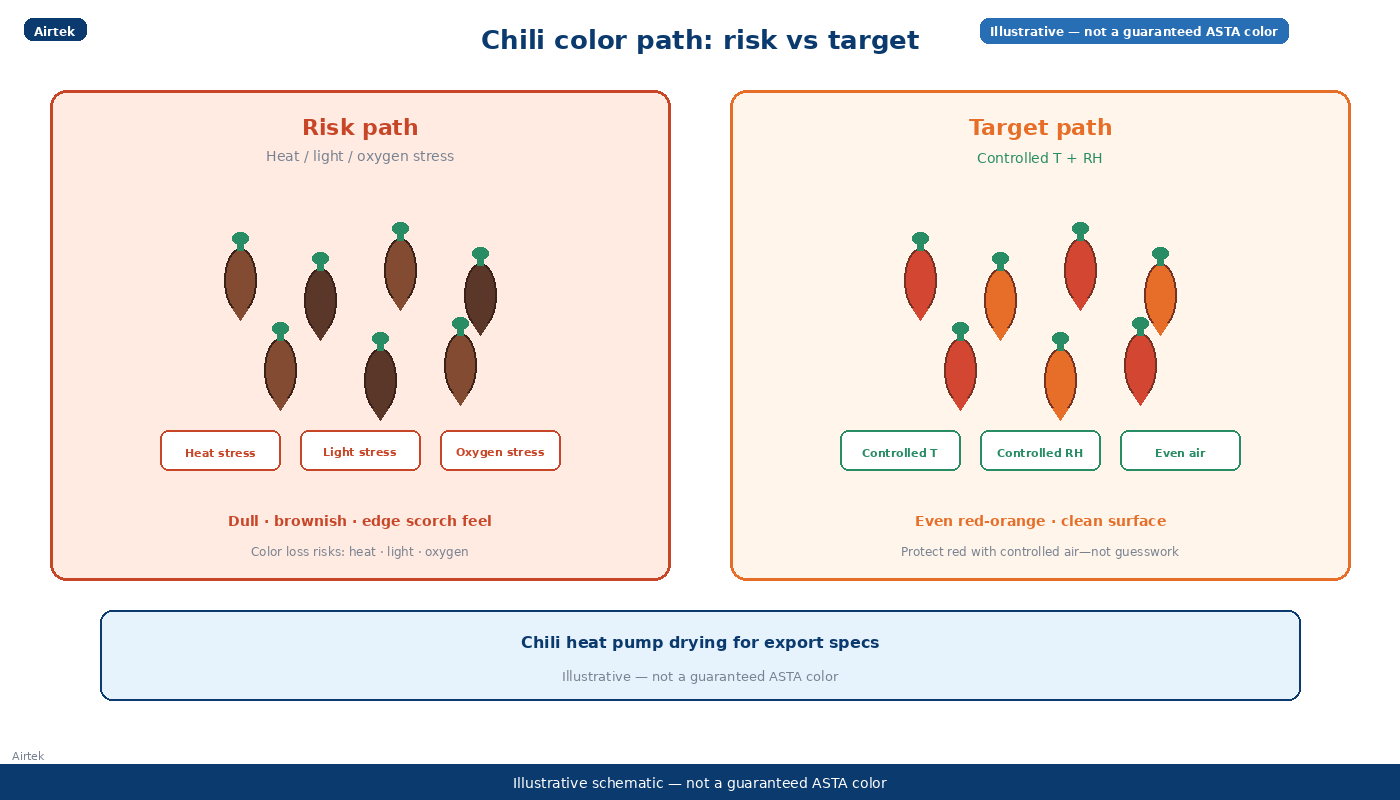
Red and orange chili color is largely carried by carotenoid pigments. In plant practice, color loss is accelerated by a familiar trio:
| Stress | What operators see | Process implication |
|---|---|---|
| Excess heat | Browning, “toasted” notes, flat red | Prefer controlled temperature profiles over “blast hot and dump air”; exact setpoints must be validated on your material |
| Light | Fade in storage or during uncovered handling | Limit UV/strong light on wet and dried product; pack promptly |
| Oxygen / time | Gradual dulling after drying | Cool, moisture-barrier pack; minimize open hold times |
Heat pump drying does not magically freeze carotenoids in place. What it offers is a weather-independent, enclosed air loop where you can stage temperature and humidity instead of fighting sun, rain, and dusty yards. That supports export hygiene and color narratives better than open sun drying—without inventing a guaranteed ASTA color value for every cultivar.
Practical color habits (qualitative):
- Sort damaged or mold-suspect pods before loading.
- Avoid scorching edges with aggressive early heat while cores are still wet.
- Do not equate “darker = drier”; verify moisture with a lab method agreed with the buyer.
- Keep dried product out of direct sun on the packing table.
If your buyer asks for extractable color (e.g. ASTA color methods used in the spice trade), treat the number as a COA negotiation—not as something a blog can promise from dryer brand alone.
Moisture Targets: Frameworks, Not Universal Law
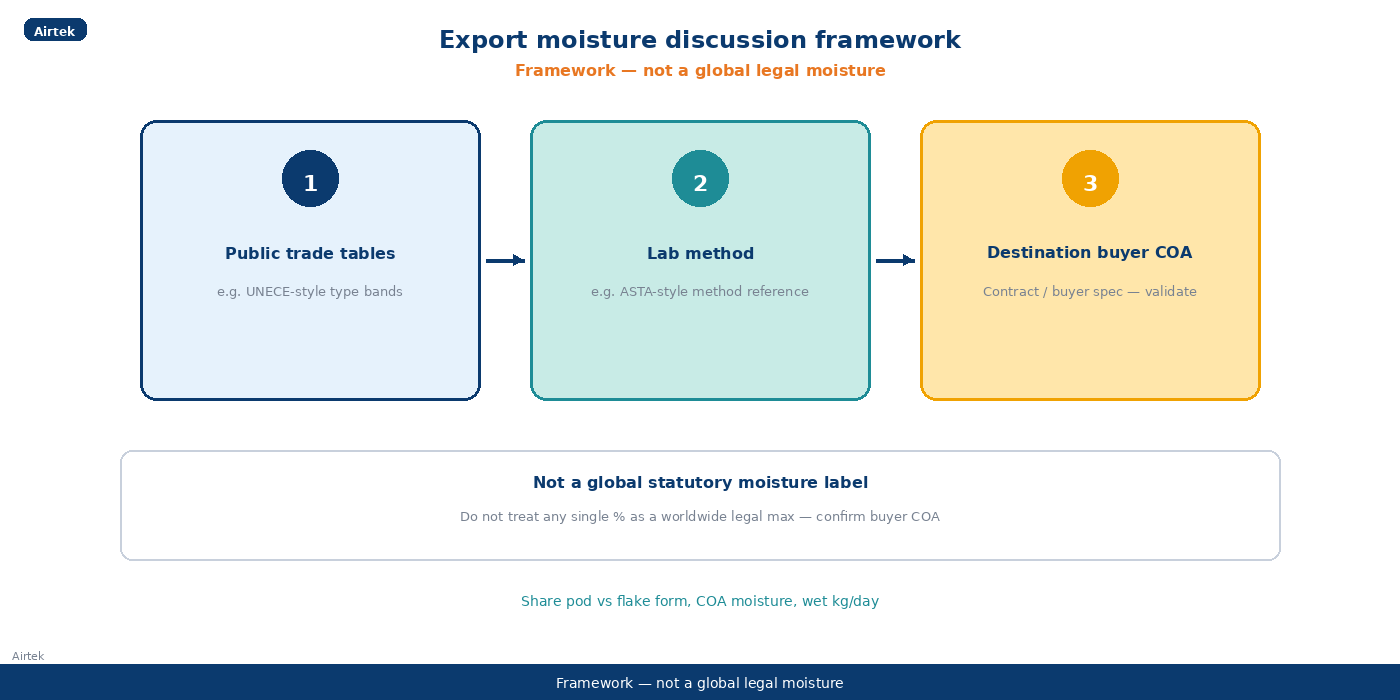
Moisture is where RFQs go wrong: one trader says “10%,” another cites a type-specific table, and a powder line needs a different conversation than whole pods.
How to talk about standards without over-claiming
Public trade documents such as UNECE recommendations for whole dried chilli peppers discuss maximum moisture by commercial type (examples in public tables differ by flesh texture—e.g. values discussed in the order of roughly high single digits to low teens % m/m depending on type). Those figures are a conversation starter for whole dried chillies at export-control thinking—not a substitute for your destination regulation or private buyer COA—confirm with destination regulation or private buyer COA.
Laboratory methods matter as much as the number. Spice-industry methods (for example ASTA moisture approaches such as loss-on-drying style methods used for capsicums) define how moisture is measured. Quoting a % without agreeing the method creates false fails.
Buyer-safe language for RFQs:
- “Target moisture band per destination COA, wet basis / method TBD—.”
- “Whole pods vs flakes vs powder may need different bands and sampling plans.”
- “We will not print a single global legal moisture on marketing pages as if it applied to every cultivar and market.”
Wet core vs surface-dry (case hardening—qualitative)
Aggressive heat with poor humidity control can dry the surface while the interior of thick flesh or tightly packed flakes stays wet. Later, moisture equilibrates—or mold risk appears in storage. Closed-loop control helps you slow the late stage and hold air drier without simply raising temperature. Exact programs remain cultivar- and cut-specific.
Loading Density Risks on Trays
Chili geometry fights airflow:
| Form | Loading risk | Qualitative mitigation |
|---|---|---|
| Whole pods | Hollow pods nest and block air; thick shoulders dry last | Single layer or controlled overlap; orient for air lanes; avoid crushing |
| Flakes / rings | Easy to pile into a dense bed | Limit bed depth; break up mats mid-cycle if safe and hygienic |
| Pre-grind pieces for powder | Fines sift and blind mesh | Screen fines; shallower layers; consider two-stage dry then mill |
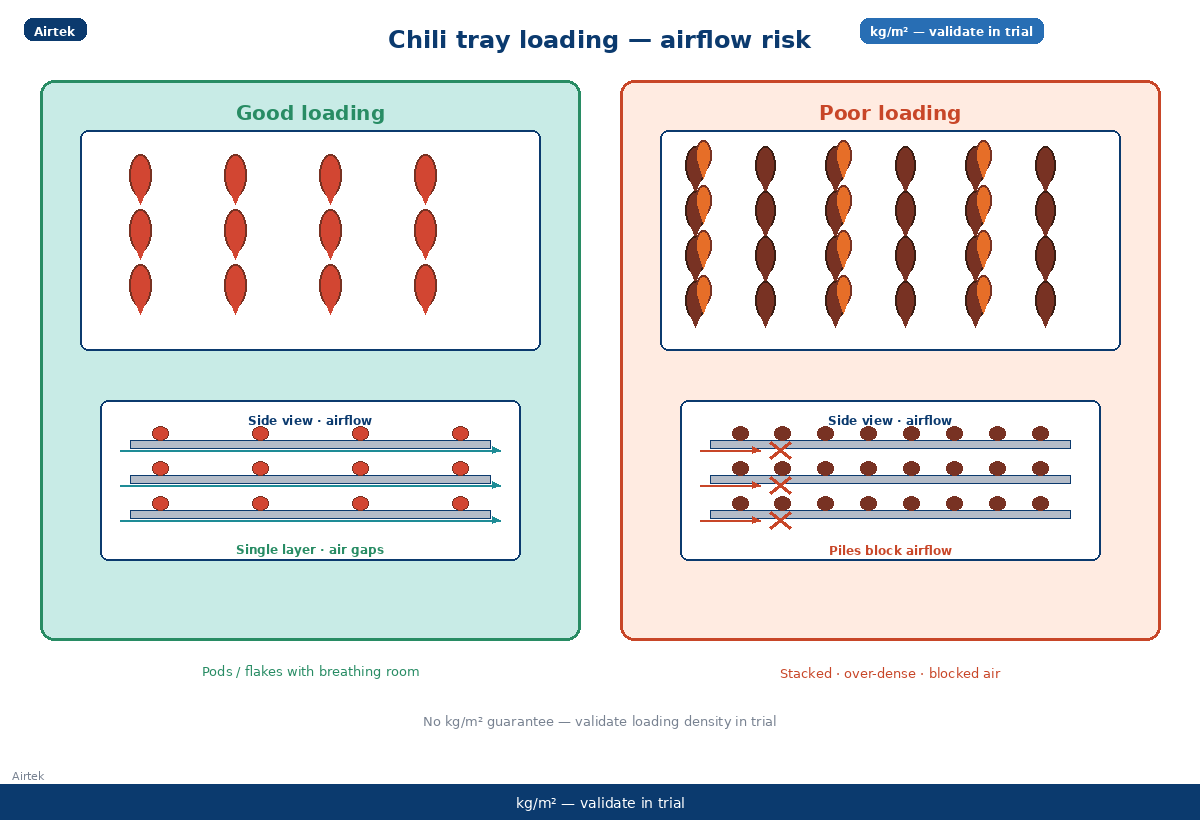
Overloading is the most common plant-floor reason for uneven color and wet pockets. Any kg/m² figure is site-specific until your trial on the same tray, thickness, and MC_f. Do not copy a density from another crop’s blog into a chili quote.
Batch tray chambers usually fit multi-SKU spice plants better when pod sizes and recipes change; continuous belts need more uniform, free-flowing geometry—see batch vs continuous. Capacity math (wet infeed → water removed → daily hours) follows the same discipline as fruit plants; use Airtek’s capacity sizing article, or ask via inquiry with wet kg/day.
Why Closed-Loop Humidity Control Helps Spices
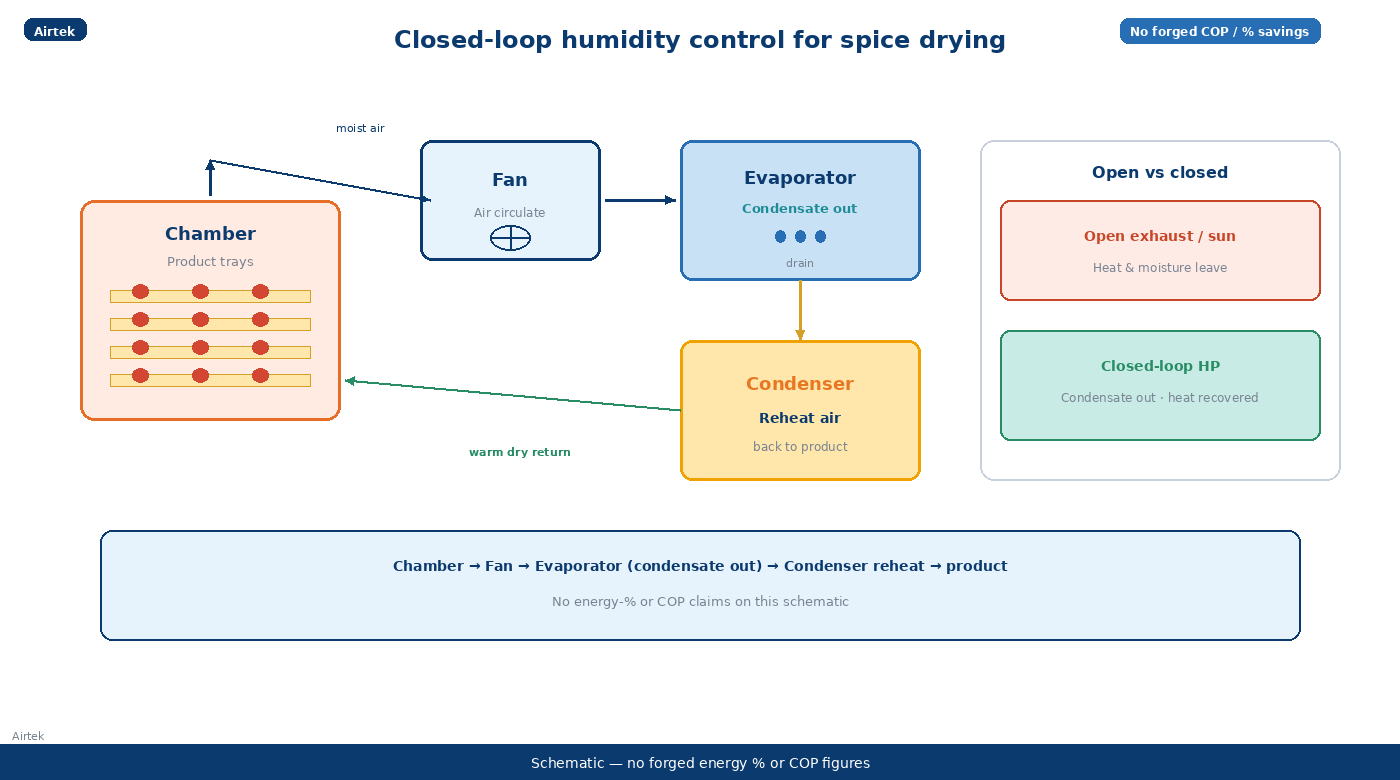
Open exhaust hot-air dryers and sun yards remove moisture by throwing humid air away. A heat pump food dryer can condense water out of the loop and return warmed, drier air to the product. For chili and red pepper, the buyer-relevant points are:
- RH as a lever, not only temperature — You can keep driving moisture out in the late stage without defaulting to scorched heat.
- Indoor, weather-independent schedules — Export plants care about repeatable calendar days during harvest peaks.
- Hygiene narrative vs open sun — Less exposure to dust, insects, and uncontrolled yard humidity (still requires GMP—drying hardware is not a sanitation program by itself).
- Energy discussion in engineering units — Prefer kWh per kg of water removed under stated assumptions over marketing “times more efficient” slogans; see heat pump vs hot air energy. Do not invent a chili-specific saving %.
Closed-loop does not remove the need for sorting, sanitation, and correct packaging. It gives you controllable air so color and moisture specs are easier to chase consistently.
Whole Pods vs Flakes vs Powder Pathway
| Pathway | Drying emphasis | Notes |
|---|---|---|
| Whole pods (export / retail) | Shape, stem/calyx rules per buyer, even moisture, visual color | Often batch trays; gentle handling |
| Flakes / crushed rings | Faster water path; watch bed depth and fines | Good candidate for higher tray utilization if airflow stays open |
| Powder pathway | Usually dry to a millable moisture, then grind; sometimes finish-dry powder carefully | Fines management; separate allergen/hygiene plan if shared lines |
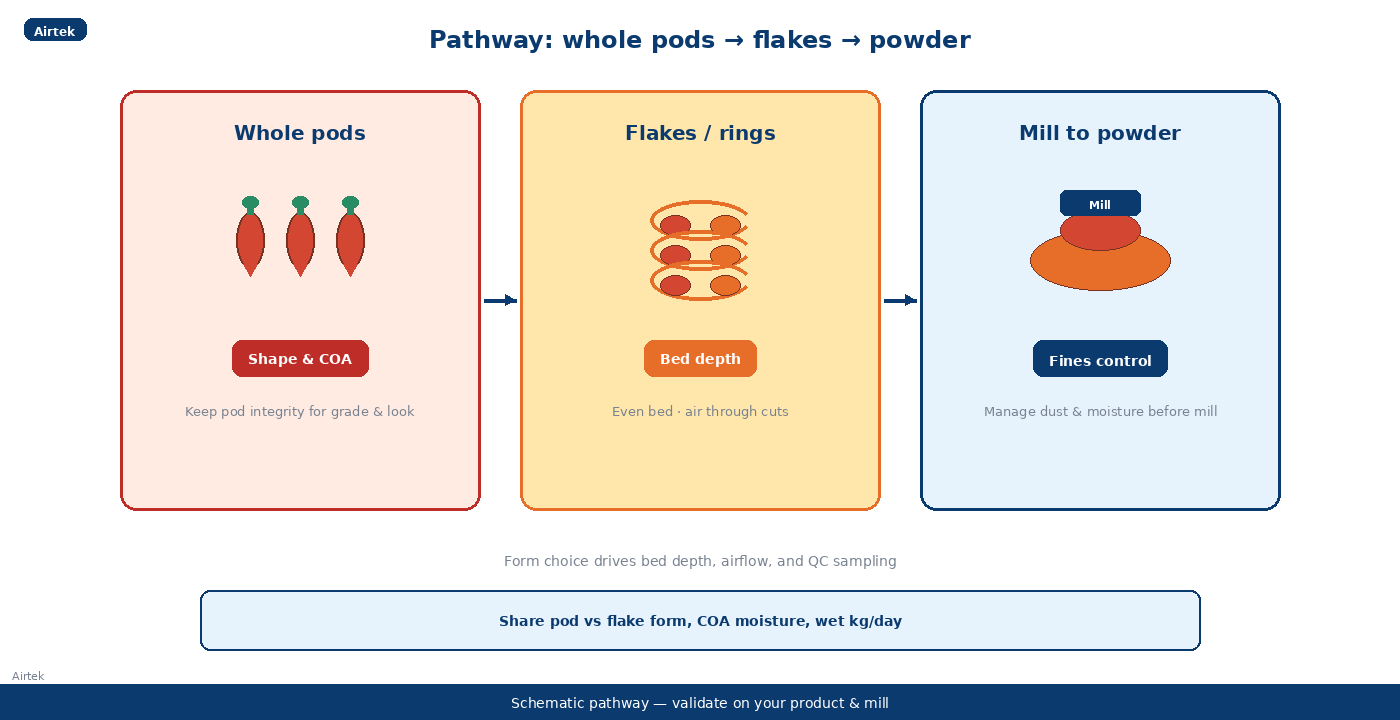
Many plants run whole and flake SKUs on the same chamber family with documented changeover—qualitatively similar to multi-crop fruit discipline. Powder lines add milling dust control outside the dryer scope of this article.
Fruit chip process posts (banana, mango) share pretreatment and tray logic; chili replaces sugar-chip priorities with color + spice moisture COA priorities.
Soft Yield Thinking (Only with Assumptions)
Finished kg from wet tonnes depends entirely on MC_i, MC_f, and inedible losses (stems, discard). Without measured inlet moisture and waste factors, this article does not publish a hard kg-dry-per-tonne-wet for chili.
If you need a planning sketch, use the same mass-balance idea as capacity sizing:
W_f = W_i \times \frac{100 - MC_i}{100 - MC_f}…then subtract sorting losses. Label every spreadsheet row as assumption until trials and COA align. Airtek will not treat a blog example as a contractual yield.
FAQ — Chili heat pump dryer
Q1. What is a chili heat pump dryer used for?
A. It dries chili / red pepper / capsicum products—whole pods, flakes, or pieces bound for milling—using closed-loop heat pump dehumidification and reheat. Buyers care about color retention, moisture per COA, and hygiene versus open sun or poorly controlled hot air.
Q2. What moisture should dried chili reach for export?
A. There is no single global number this blog can mandate. Public frameworks (e.g. UNECE-style tables for whole dried chillies by commercial type) and lab methods (e.g. ASTA moisture methods for capsicums) are discussion tools. Lock the band and method on your **destination buyer COA.
Q3. How do I protect red color during drying?
A. Limit unnecessary heat stress, light, and long open holds; avoid case hardening from aggressive early heat; verify dryness with agreed lab methods rather than color alone. Closed-loop RH control helps you finish drying without defaulting to scorching temperatures—setpoints remain cultivar-specific.
Q4. Is batch or continuous better for chili?
A. Irregular whole pods and frequent SKU changes often favor batch tray chambers. Continuous belts need more uniform, free-flowing geometry and stable volume. See batch vs continuous heat pump dryer. Size from wet infeed and hours—not a fake tonnage cutoff.
Q5. What should I send Airtek for a chili / red pepper project?
A. Send: form (whole / flake / powder pathway), cultivar notes, wet kg/day or peak week, target moisture language from buyer COA, color requirements if any, hours, voltage, and hall sketch. Use the product inquiry form. Compact cabinets such as CDS100KG and larger options on the hub are navigation starting points only.
Talk to Airtek About Chili and Red Pepper Drying
If you export dried chilli, red pepper flakes, or run a powder pathway, share your cut form, buyer moisture/color notes, and wet daily tonnage. The Airtek team can discuss heat pump chamber options and loading discipline with clear project-validation markers—without inventing yield or energy guarantees.
Next step: send a product inquiry with product form, wet infeed, and export spec notes. We will help frame a chili heat pump dryer project around color-safe process control and comparable capacity units.