
Mango is one of the world’s most important tropical fruits—and one of the easiest to lose to surplus, soft fruit, and long logistics. For processors across South and Southeast Asia, Latin America, and Africa, turning ripe mango into dehydrated slices, snack chips, or ingredient pieces is a practical way to extend shelf life and capture export value.
This guide focuses on commercial mango heat pump drying for dehydrated products—not oil-fried mango chips. It covers where mangoes come from, moisture targets buyers actually talk about, pretreatment and slice thickness for color retention, qualitative temperature/humidity staging, transparent yield thinking from 1 tonne of fruit, and why a closed-loop heat pump food dryer often fits export-oriented fruit plants.
Soft note for buyers: figures below are literature and industry ranges under stated assumptions—not guaranteed factory outputs. Final moisture, additives, and labeling must follow your destination-market buyer requirements.
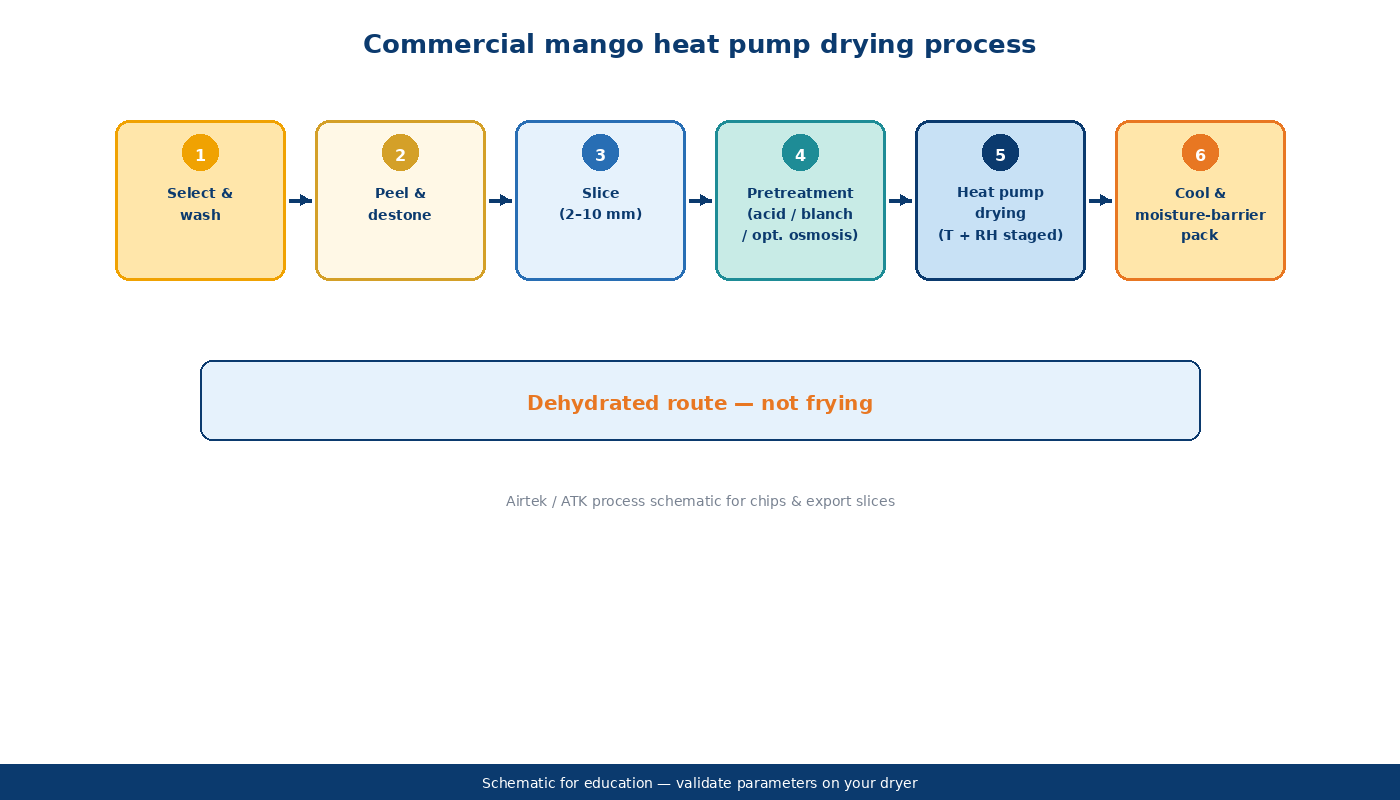
What commercial mango heat pump drying means (buyer definition)
Commercial mango heat pump drying is the industrial dehydration of ripe mango into dehydrated chips, export slices, or ingredient pieces using a closed-loop heat pump dryer—not an oil fryer. Moist chamber air meets a cold evaporator, where water condenses and latent heat is recovered; the refrigerant rejects heat at the condenser to rewarm the air before it returns to the trays. That supports programmable temperature and humidity, milder air for sugar-rich fruit, and weather-independent batches in humid tropics.
Buyers should separate SKUs carefully: dehydrated / dried mango follows dried-fruit moisture and labeling frameworks (often discussed around ~10–15% wb for many snack slices; confirm destination COA). Fried mango chips are a different process and moisture language. Exact cycle hours, tray density, and kg dried per tonne depend on cultivar, peel/stone basis, thickness, pretreatment, and final moisture—use planning bands and plant trials, not brochure guarantees.
Airtek (airtekdehydrator.com) builds industrial / commercial heat pump fruit dehydrators for export-oriented plants. Share wet batch size, thin chips vs thicker slices, and target moisture for a practical equipment discussion.
Related: Heat pump food dryer machine · Fruit drying machine · Banana heat pump drying process & yield · Heat pump dryer energy saving vs hot air · Batch vs continuous heat pump dryer · Product inquiry
Global Mango Origins: Fresh Trade vs Drying Opportunity
FAOSTAT-linked summaries group mangoes, mangosteens, and guavas. On that aggregate basis, world production sits on the order of ~60–62 million tonnes in recent years (about ~61 Mt in 2023 and a little over ~62 Mt in 2024 in public secondary summaries). Approximate leading producers include:
| Rank | Country | Approx. production order of magnitude |
|---|---|---|
| 1 | India | ~26–28 Mt (often ~40%+ of the world total on this aggregate) |
| 2–3 | Indonesia / China | each roughly ~4 Mt |
| 4–6 | Mexico, Brazil, Pakistan (and nearby peers) | each roughly ~2–3 Mt class |
| — | Also significant for processing stories | Thailand, Vietnam, Egypt, Bangladesh, Philippines, Kenya, and others |
Fresh trade and domestic use differ by country. India is by far the largest producer and consumes most fruit at home; Latin American and some Southeast Asian exporters move larger shares of fresh mango into long-haul markets. Dried mango (slices, pieces, sweetened or unsweetened) is a classic surplus-and-value-addition story wherever peel/seed waste management, snack brands, and ingredient buyers already exist.
There is no single public table for “share of mango acreage dedicated to drying.” Treat drying as a seasonal surplus + export SKU decision—not a fixed global percentage.
Related process reading (another high-moisture tropical fruit on a tray heat-pump line): banana heat pump drying process and yield.
Moisture: Starting Fresh, Ending Export-Ready
Typical initial moisture
Ripe mango pulp is a high-moisture feedstock. Literature and processing studies commonly place fresh pulp near ~80–90% moisture (wet basis), with many ripe-variety datasets clustering around the low-to-mid 80%s. Variety, ripeness, and whether you measure whole fruit versus peeled pulp explain most of the spread. Pilot heat-pump work on Vietnamese Tu Quy mango has reported initial moisture on the order of the mid-70%s on a dry-basis framing in one study—another reminder to confirm wet-basis vs dry-basis with your lab before quoting capacity.
Target moisture by product type
Do not mix product categories:
| Product | Typical target moisture discussion | Notes |
|---|---|---|
| Dehydrated snack / export slices (unsweetened or lightly treated) | Commercial listings often cite ~10–15% wb; many lab dryer studies finish below ~10% wb | Too wet → soft, sticky, mold risk; too dry → brittle breakage and “woody” chew |
| Osmotically pretreated / soft dried mango | Pilot heat-pump routes sometimes target ~14–16% after syrup soak | Softer chew; sugar and additives change Aw and labeling |
| “Soft fruit / high moisture” preserved styles | UNECE allows above 15% up to 35% only when preservatives or other preservation are used; 30–35% should be labeled soft / high moisture | Different SKU from low-moisture dehydrated chips |
| Mango powder / flakes pathway | Often driven toward lower moisture than chewy slices | Milling and packaging rules differ |
| Fried mango chips | Oil-containing snack; moisture specs are not interchangeable with dehydrated slices | Different process line entirely |
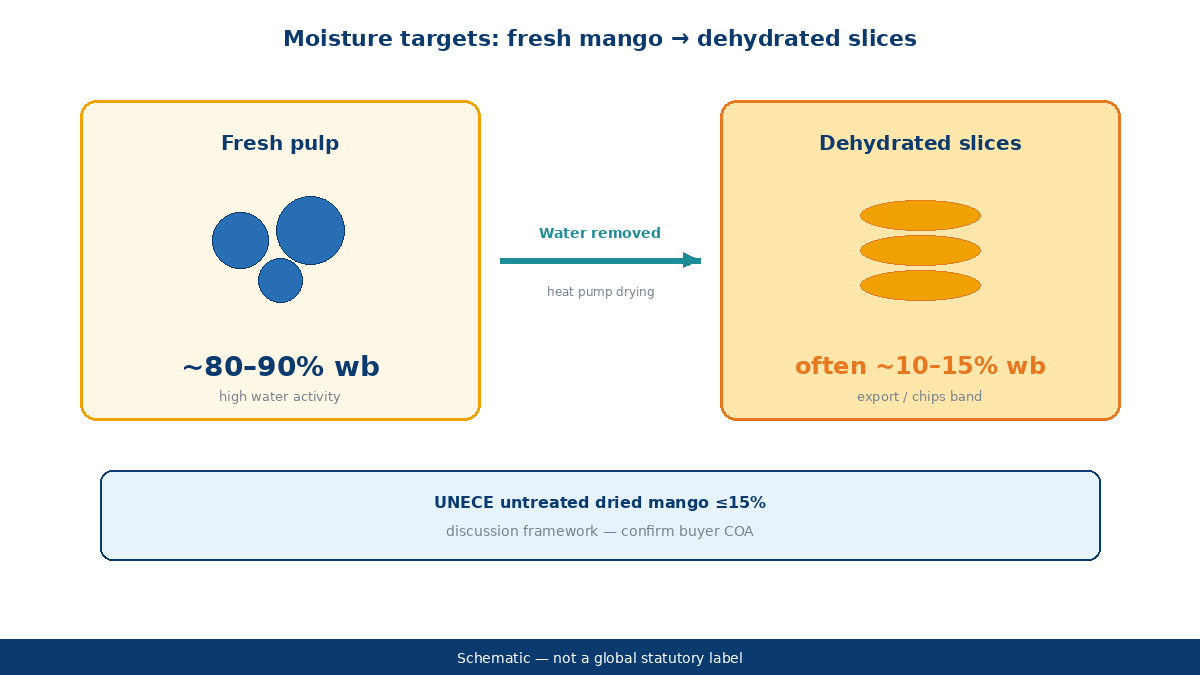
Export / standards framing (discussion aids—not universal law)
Public standards and buyer guides useful for RFQ conversations include:
- UNECE standard for dried mangoes: untreated dried mangoes not exceeding 15.0% moisture; preservative-treated product may sit 15.1–35.0%, with 30–35% labeled soft fruit / high moisture.
- Philippine PNS/BFAD 15 (dried mango products): moisture not more than 15%, and water activity Aw ≤ 0.70 at 25 °C (as written in that specification).
- Trade / CBI-style product notes: residual moisture bands around ~10–15% for many sweetened dried mango pieces, and rough ~14–18% discussion for some conventional dried styles used in cereals and bars.
Exact legal caps and buyer COAs still vary by destination (EU retail, US snack brands, Middle East, Japan, etc.). Use UNECE / national standards as conversation frameworks. Do not treat one number as a global mandatory limit—and never apply fried-chip moisture language to heat-pump dehydrated slices.
For microbial stability, many snack buyers also care about water activity and moisture-barrier packaging after cool-down—not moisture percentage alone.
Pretreatment and Slice Thickness for Color Retention
Mango browns and softens easily once cut. Polyphenol oxidase (PPO) plus oxygen drives enzymatic browning; sugar + heat later adds non-enzymatic darkening. Color is often the first thing an export buyer rejects.
Pretreatment options processors actually use
| Approach | What it does | Commercial note |
|---|---|---|
| Hot-water / steam blanching | Helps inactivate PPO; used in pilot mango heat-pump process development | Balance enzyme kill vs color/texture damage; over-blanching softens slices |
| Citric acid / ascorbic acid dips | Cleaner-label browning control; common in tray and fluidized-bed mango studies | Typical research dips are on the order of ~0.5–1% acid solutions for finite minutes—validate on your cultivar |
| Sulfite / KMS dips | Strong anti-browning history for dried fruit | Residue and labeling limits apply in many markets—check buyer rules before scaling |
| Osmotic syrup soak (optional) | Partial water removal before drying; sweetness and softer texture | Common for “dried mango candy / soft slice” styles; changes mass balance and final sugar claim |
| No pretreatment | Possible for some SKUs | Higher risk of uneven color and longer color QA fight |
A Vietnamese pilot-scale heat pump drying study on Tu Quy mango combined ~10 mm slices, blanching near 90 °C / ~4 min, optional syrup osmosis, then mild heat-pump drying toward ~14–16% moisture—useful as process research context, not as an Airtek recipe card.
Slice thickness: chips vs export slices
Geometry sets diffusion path, tray utilization, and how “chip-like” vs “chewy slice” the SKU feels.
| Form | Typical thickness discussion | Time & uniformity | Commercial fit |
|---|---|---|---|
| Thin snack chips | Often ~2–5 mm (trade listings for dehydrated slices sometimes cite 3–5 mm) | Fastest; best batch uniformity if thickness is controlled | High-turn snack packs; remill feedstock if over-dried carefully |
| Standard export slices / pieces | Often ~6–10 mm in process R&D; some osmotic soft products study ~8–12 mm | Medium; core stays moist longer | Mainstream dried-mango bags, cereal inclusions |
| Thick pieces / halves | >10–12 mm or irregular chunks | Slowest; wet centers and case-hardening risk rise | Specialty soft fruit; needs patient staging |
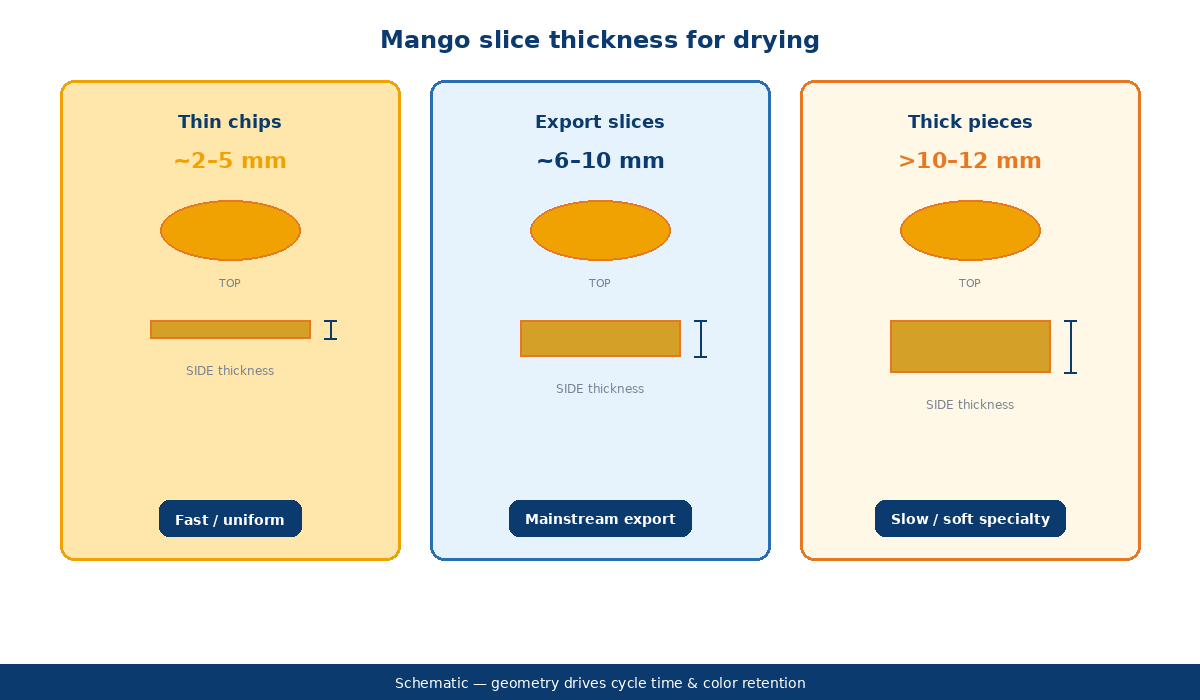
Selection logic: export snack chips → thinner, uniform slices on tray heat-pump lines. Soft osmotic dried mango → thicker pieces plus syrup pretreatment, with longer cycles. Uneven knives mean the thickest piece sets the stop time—thin pieces then over-dry and shatter.
Tray loading (qualitative only)
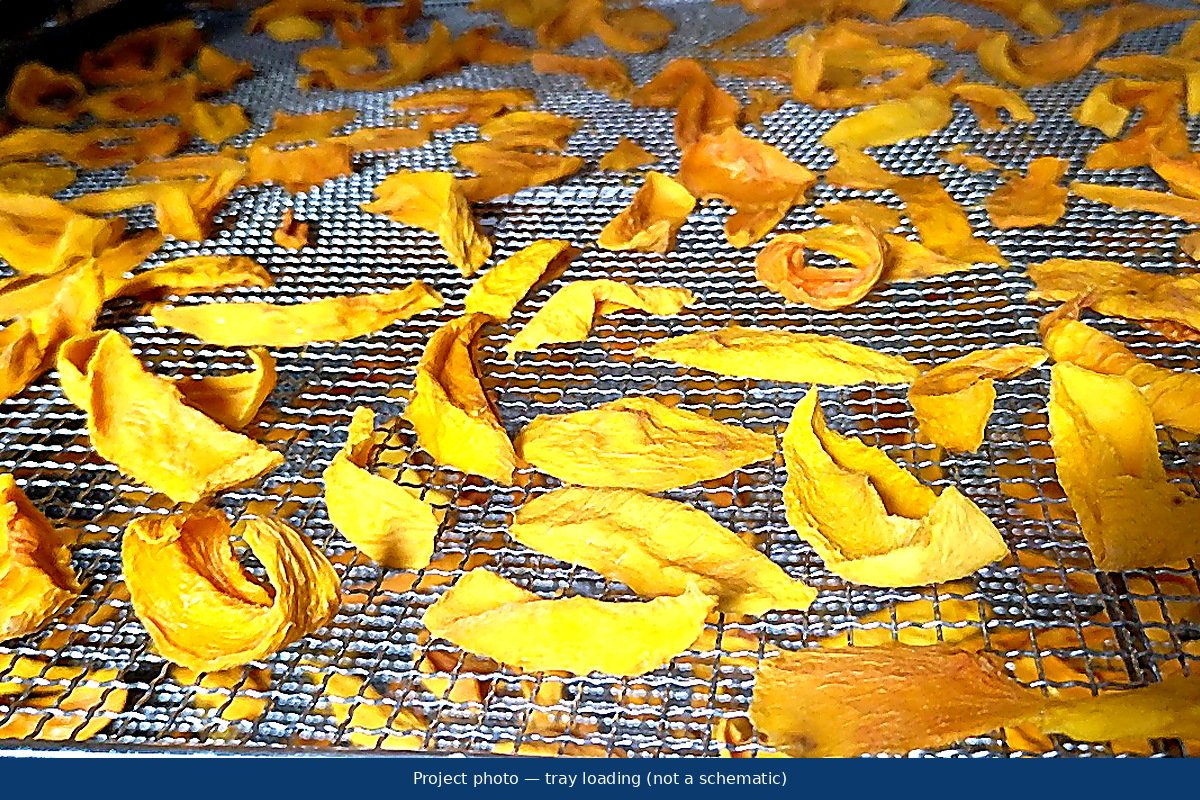
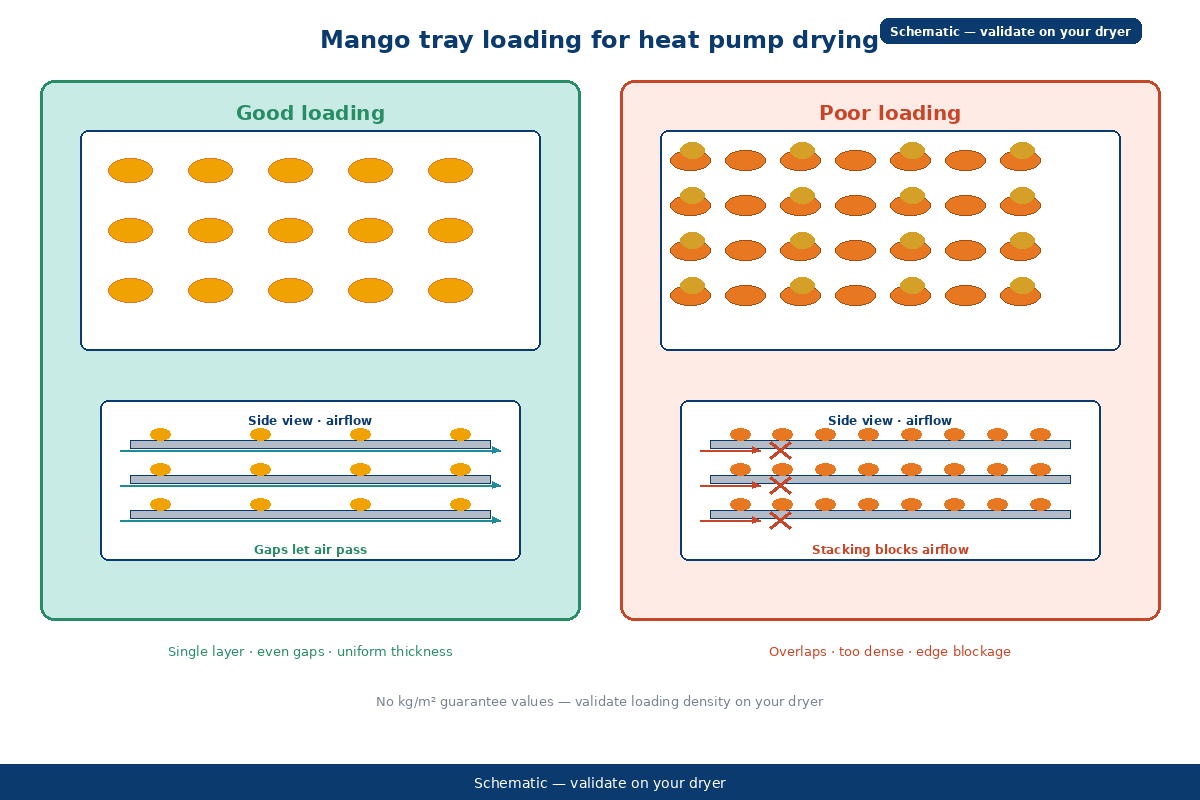
Leave gaps; stacking creates wet pockets and pale or brown spots. Industry pages sometimes quote loading densities and air speeds for fruit trays in general.
Any specific kg/m² or m/s figure is a generic reference band at best—not an Airtek guaranteed setpoint. Validate loading and airflow on the machine and cultivar.
Temperature and Humidity Staging (Qualitative Bands)
Closed-loop heat pump dryers matter for mango because temperature and relative humidity can be programmed with more independence than a simple open exhaust hot-air oven. That helps protect carotenoid color and avoid aggressive surface crusting.
Use the bands below as planning language for trials—not as factory setpoints copied into a purchase contract.
Stage thinking (no invented plant hours)
| Stage | Goal | Qualitative process band |
|---|---|---|
| 1 · Surface free water | Remove unbound moisture quickly without scorching sugar | Mild-to-moderate chamber air; keep RH from collapsing so hard that surfaces case-harden |
| 2 · Falling-rate drying | Pull moisture from the slice core while holding color | Often the longest stage for mango; literature heat-pump mango work frequently explores roughly ~30–50 °C air for quality-focused runs |
| 3 · Finish / equilibration | Hit target moisture / Aw without darkening edges | Slightly gentler finish; avoid “cooking” high-sugar surfaces |
Research anchors (soft language):
- Pilot heat-pump mango drying has been demonstrated from roughly ~20–50 °C, with lower temperatures preserving polyphenols better but taking longer (e.g. one pilot report: on the order of ~12–18+ hours depending on temperature and endpoint—site-specific, not a quote).
- Conventional cabinet / tunnel fruit drying for mango slices often sits nearer ~50–65 °C in older process studies—faster, but color and vitamin C trade-offs rise if profiles are blunt.
- Combined heat-pump + dehumidification research continues to push low-temperature mango slice drying for better rehydration and ascorbic-acid retention versus basic closed HPD at the same load class.
Exact °C / %RH / hour curves for your cultivar, thickness, and SKU must come from trial logs—never from a blog table as a contractual guarantee.
Case hardening and stickiness
If inlet air is too hot and too dry too early, mango surfaces can crust while cores stay wet (case hardening). Late-stage sugar surfaces also stick to trays—use food-grade tray finishes, light release aids where allowed, or a brief surface set before denser loading. Cool product before sealing moisture-barrier packs.
Dehydrated Mango Slices vs Fried Mango Chips (Do Not Confuse Them)
| Fried mango chips | Dehydrated / dried mango slices | |
|---|---|---|
| Process | Thin pieces fried in hot oil | Moisture removed by sun, hot air, solar, vacuum, or heat pump |
| Composition | Absorbs oil | Little or no oil unless coated later |
| Texture story | Crispy, savory/sweet snack | Chewy to semi-crisp fruit-forward snack / ingredient |
| Moisture language | Often written for oil snacks | Follow dried fruit standards / buyer COAs |
| Equipment story | Fryer lines | Fruit drying machine / heat pump dehydrator territory |
Always specify which product you are quoting capacity, moisture, and yield for.
Can You Dry Mango in a Heat Pump Dryer?
Yes. Peer-reviewed pilot work and industry practice both support heat pump drying of mango slices and related dried-mango products.
How it works (briefly): In a closed or semi-closed heat pump dryer, moist chamber air passes over an evaporator that condenses moisture and recovers latent heat; the refrigerant then rejects heat at the condenser to rewarm the air before it returns to the trays. For high-moisture, sugar-rich fruit like mango, that means useful drying force at relatively mild air temperatures, with less heat and humidity dumped straight outdoors—helpful in humid tropics during harvest peaks.
For export-oriented processors who care about color, batch repeatability, and energy per kilogram of water removed, a commercial heat pump tray dryer sized to wet infeed is a strong technological fit—especially when you already run banana, pineapple, or other fruit on the same plant calendar.
Yield Thinking: How Much Dried Mango from 1 Tonne?
Never treat a single kilogram number as a law of nature. First confirm whether the buyer’s “1 tonne” means whole fruit with peel and stone or already peeled, destoned pulp, then lock initial and final moisture assumptions.
Mass-balance idea
W_f = W_{\text{in dryer}} \times \frac{100 - MC_i}{100 - MC_f}where MC_i and MC_f are moisture % wet basis, and W_{\text{in dryer}} is the mass that actually enters the dryer (usually pulp pieces—not whole mangos with stones).
Dry matter is approximately conserved during drying; water removal \Delta W = W_i - W_f is the engineering load that drives dryer sizing conversations.
Transparent assumptions (dehydrated slice route)
Mango has a large stone. Processing literature often places edible pulp roughly in the ~45–65% band of whole fruit weight (peel commonly ~15–20%, stone ~10–20%, with variety extremes wider). One Langra pulping example reported about ~62% pulp recovery—useful as an illustration, not a universal constant.
| Parameter | Conservative | Mid | Optimistic |
|---|---|---|---|
| Whole fruit in | 1000 kg | 1000 kg | 1000 kg |
| Edible pulp after peel + stone | 45% | 55% | 65% |
Initial moisture MC_i | 85% | 82% | 80% |
Final moisture MC_f | 15% | 12% | 10% |
Scenario A — 1 tonne = whole fresh mangos (common inquiry wording)
Moisture removal only (no factory scrap yet):
| Case | Pulp into dryer (kg) | Approx. dried slices (kg) |
|---|---|---|
| Conservative | 450 | ~79 |
| Mid | 550 | ~113 |
| Optimistic | 650 | ~144 |
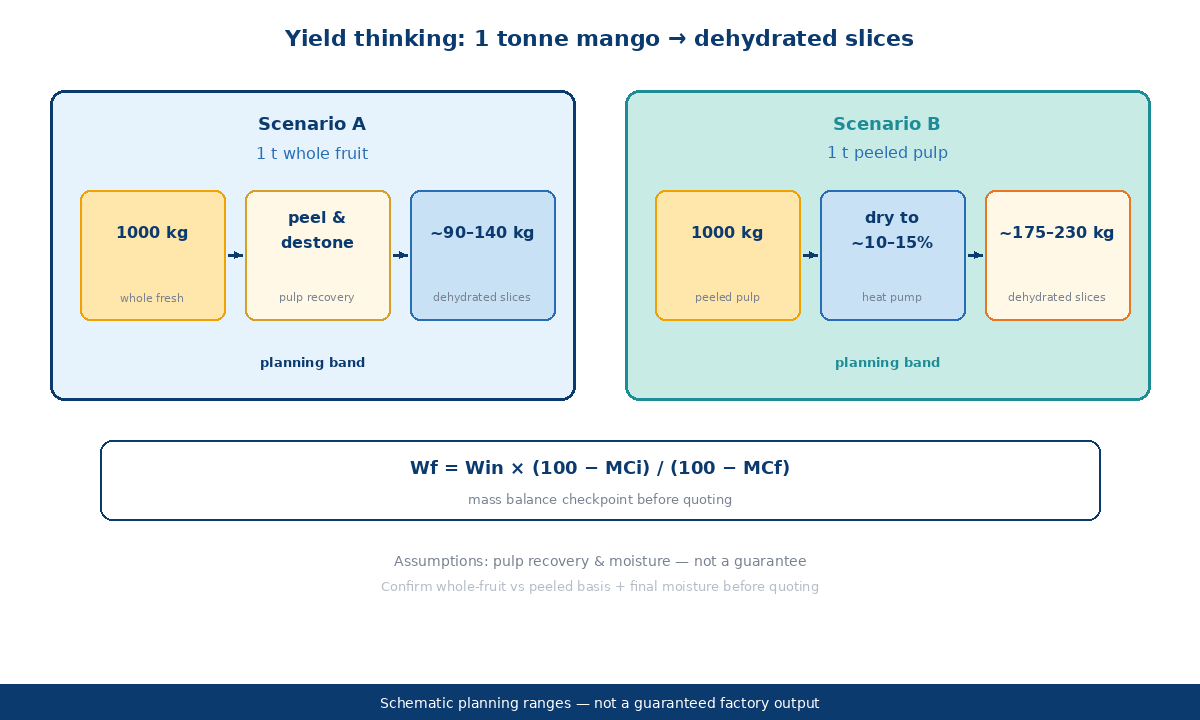
After a few percent for crumbs, stickiness, and sorting rejects (plant loss % is site-specific—validate on trials), a mid planning band often lands near ~100–120 kg.
Writer-safe summary: From 1 tonne of whole fresh mangos, after peeling and destoning and drying to about 10–15% moisture, processors typically obtain on the order of ~90–140 kg of dehydrated mango slices, depending on pulp recovery, ripeness (initial moisture), and final moisture target.
Scenario B — 1 tonne = already peeled, destoned pulp
MC_i → MC_f | Approx. dried product (kg) |
|---|---|
| 85% → 15% | ~176 |
| 82% → 12% | ~205 |
| 80% → 10% | ~222 |
Writer-safe summary: If the 1 tonne is already peeled and destoned pulp, expect roughly ~175–230 kg of dried product under similar moisture assumptions.
Osmotic / sweetened routes change the mass balance
Syrup uptake adds solids; water also leaves during osmosis before the dryer. Do not reuse plain dehydrated-slice yield numbers for sugar-infused soft dried mango without a separate solids balance.
Factory loss percentages and destination-market moisture caps vary—use the ranges above as planning bands, not a fixed “guaranteed kg/tonne” claim.
Heat Pump Benefits for Mango Processors
| Dimension | vs traditional sun drying | vs simple hot-air / open exhaust drying |
|---|---|---|
| Energy | Continuous production regardless of rain or dust season | Recovers condensation latent heat; ask suppliers for kWh per kg water removed under comparable loads—not vague “saves X%” slogans |
| Quality | Less dust, insects, rain rewetting, and uneven sun bleach | Milder T + controllable RH → better color / carotenoid story when profiles are tuned |
| Hygiene / compliance story | Enclosed chamber supports cleaner GMP narratives | No combustion flue contact with food; condensate can be managed |
| Control | Weather-driven batch scatter | Programmable temperature, humidity, and airflow → repeatable batches for export COAs |
| Climate independence | Rainy-season schedules still run | Closed-loop dehumidification maintains drying force even in humid tropics |
| Operations | Delivery dates less hostage to weather | Exact ROI depends on local electricity tariffs and should be calculated case by case—site numbers must be calculated case by case |
One-line takeaway: A mango heat pump dryer helps processors run cleaner, more controllable, weather-independent dehydration with a stronger color-retention story than sun drying or blunt hot-air systems—when tray loading and staging are validated on the fruit you actually buy.
For how closed-loop recovery differs from hot-air exhaust loss—and what to ask about SMER—see How heat pump dryers cut energy use vs conventional hot-air dryers.
Airtek’s industrial fruit drying machines are built around heat pump technology for fruits and other foods—useful when you need tray-based capacity from small batches up to larger chamber solutions.
Practical Checklist Before You Scale Mango Drying
- Define the SKU: dehydrated chips / export slices, soft osmotic dried mango, powder pathway—or fried chips (different line).
- Lock ripeness, peel+stone vs pulp basis, and target moisture (and Aw if your buyer asks).
- Choose slice thickness for the cycle time and chew you can sell.
- Plan pretreatment (acid, blanch, sulfite, or osmosis) against your market’s additive rules.
- Validate tray loading and airflow on your dryer—do not treat generic industry ranges as guarantees.
- Size the heat pump chamber to your wet infeed per batch and water-removal load, not only to a hoped-for dry-out tonnage. If you are still choosing tray chambers versus a continuous belt line for fruit, see Batch vs continuous heat pump dryer.
- Package for moisture barrier after product cool-down; confirm labeling for untreated vs preserved styles.
FAQ — Mango heat pump dryer
Q1. Can you dry mango commercially in a heat pump dryer?
A. Yes. Closed-loop heat pump dryers remove moisture by condensation and heat recovery at relatively mild air temperatures, which suits high-moisture, sugar-rich mango when slice thickness, pretreatment, and tray loading are validated. This guide covers dehydrated chips and export slices—not fried mango chips.
Q2. What moisture should dehydrated mango slices target?
A. Many commercial and lab discussions for dehydrated snack / export slices sit around ~10–15% wb (lab finishes sometimes below ~10%). Public frameworks such as UNECE (untreated dried mango ≤15.0%; preserved soft/high-moisture styles differ) and some national specs (e.g. Philippine dried-mango moisture / Aw notes) are useful RFQ conversation aids—not a single global legal cap. Confirm your buyer COA and never reuse fried-chip moisture language. Confirm destination-market rules with your buyer.
Q3. How much dried mango from 1 tonne of fresh fruit?
A. First lock whether “1 tonne” means whole fruit (peel + stone) or already peeled, destoned pulp, then set MC_i / MC_f. Under transparent planning assumptions, whole fruit often lands on the order of ~90–140 kg dehydrated slices after peeling/destoning and drying to about 10–15% moisture; peeled pulp often lands roughly ~175–230 kg. These are planning bands, not guaranteed kg/tonne. Osmotic / sweetened routes need a separate solids balance.
Q4. How do I protect color when drying mango?
A. Control enzymatic browning (PPO) and later sugar darkening: choose ripeness carefully; use validated pretreatments (acid dips, blanching, or market-allowed sulfites); keep slice thickness uniform; avoid early case hardening with blunt hot-dry air; stage temperature and RH on a closed-loop heat pump rather than “heat harder.” Research dips and pilot curves are context—validate on your cultivar.
Q5. What should I send Airtek for a mango heat pump dryer RFQ?
A. Send: whole fruit vs peeled pulp basis, wet kg per batch or day, chip vs export-slice thickness, pretreatment plan, target moisture (and Aw if asked), destination market, and whether you need batch tray chambers or are comparing continuous options. Use the product inquiry form. For energy metrics, see heat pump dryer energy saving vs hot air; for architecture choice, see batch vs continuous.
Talk to Airtek About a Mango Heat Pump Dryer
If you are scoping a commercial dehydrated mango chips or export-slice line, share your wet batch size, product form (thin chips vs thicker slices), pretreatment plan, target moisture, and destination market. The Airtek team can help match a heat pump dehydrator capacity and drying program to your fruit—not a one-size brochure promise.
Next step: send a product inquiry with your raw-material basis (whole fruit or peeled pulp) and daily throughput goal. We will respond with a practical equipment discussion for your plant.