
Choosing between a batch (tray / chamber) heat pump dryer and a continuous (mesh-belt or tunnel-style) heat pump dryer is one of the highest-leverage equipment decisions a fruit plant makes. Get it right and you protect product quality, labor rhythm, and the ability to run more than one crop. Get it wrong and you fight either idle capacity or endless changeovers.
This guide is written for commercial buyers and plant engineers who already understand that a heat pump food dryer recovers heat while dehumidifying in a controlled loop—and now need a clear batch vs continuous heat pump dryer decision framework. It stays educational: no invented “must buy continuous above X tons/day” cutoffs, and no competitor brand names.
Airtek supplies both heat pump chamber dryers and conveyor belt type dryers as portfolio options for fruit and food plants. Exact sizing always follows your wet infeed, target moisture, and crop mix—not a brochure slogan.
Soft note for buyers: throughput bands and changeover times below are decision language, not guaranteed plant outputs. Marked items are until validated on your product and site.
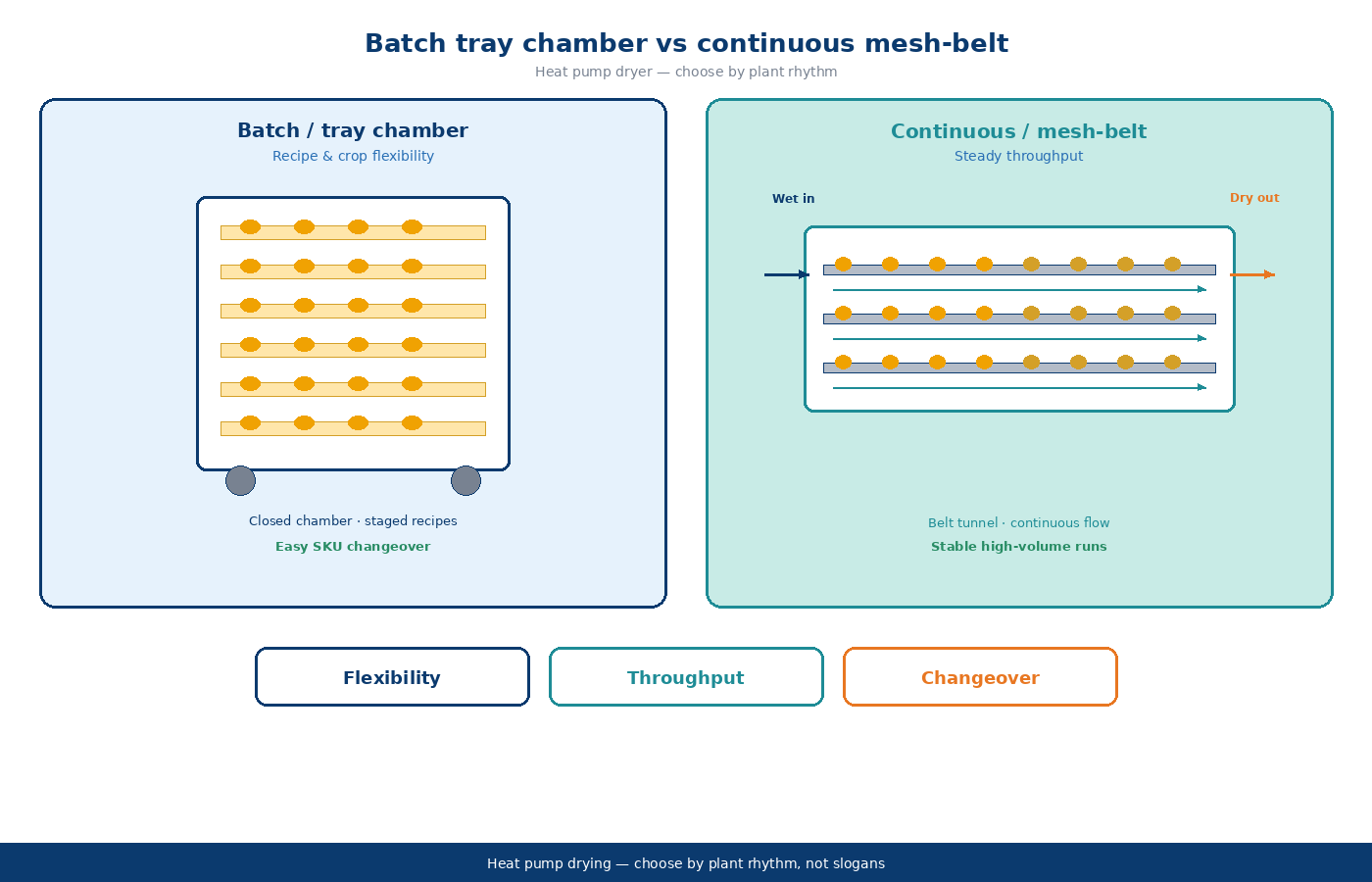
What “batch vs continuous heat pump dryer” means (buyer definition)
A batch vs continuous heat pump dryer decision is about how product moves and how you schedule crops—not about whether heat-pump physics apply. Both architectures can use a closed-loop heat pump to dehumidify by condensation and reheat circulating air.
In a batch / tray chamber heat pump dryer, fruit stays on trays (often on trolleys) inside a chamber while a programmed temperature/humidity profile runs; operators load, dry, unload, and clean between recipes. In a continuous / mesh-belt or tunnel heat pump dryer, product moves on belt(s) through drying zones: wet infeed at one end, dried outfeed at the other, with belt speed, bed depth, and zone settings as the main levers.
Choose batch when SKU variety, seasonal peaks, trials, and frequent changeovers dominate. Choose continuous when stable high volume of similar thin geometry and rare changeovers dominate. Many plants use a hybrid: belt for the flagship SKU, chambers for side crops and R&D. Exact sizing follows wet infeed, target moisture, and crop mix—not a brochure “tons/day” switchover law.
Airtek (airtekdehydrator.com) supplies heat pump chamber dryers and conveyor belt type dryers for fruit and food plants. Share wet daily tonnage, crop list, and changeover frequency for a project discussion.
Related: Heat pump food dryer machine · Fruit drying machine · How belt conveyor drying works · Heat pump dryer energy saving vs hot air · Product inquiry
What “Batch” and “Continuous” Mean in Heat Pump Fruit Drying
Batch / tray chamber heat pump dryer
Fruit sits on trays (often loaded on trolleys) inside a drying chamber. A closed-loop heat pump system conditions the circulating air—heating and dehumidifying—while the load stays put until the recipe ends. Operators load → run a programmed temperature/humidity profile → unload → clean as needed → next batch.
Strengths in one line: recipe flexibility, SKU variety, and controlled trials on the same footprint.
Continuous / belt or tunnel heat pump drying
Fruit moves on one or more mesh belts (or through a tunnel path) while conditioned air removes moisture. Wet product enters at one end; dried product exits at the other. Belt speed, layer count, zone temperatures, and airflow are the main levers. Airtek documents belt conveyor drying characteristics for this continuous style of line.
Strengths in one line: steady throughput, fewer open/close cycles per kilogram, and a production rhythm that matches continuous peeling/slicing upstream.
Both can use heat pump heat and dehumidification. The difference is how product travels and how you schedule crops—not whether heat pump physics apply.
Side-by-Side Comparison: Batch Tray Chamber vs Continuous Belt / Tunnel
Use this table in RFQs and internal design reviews. It is a selection aid, not a capacity law.
| Dimension | Batch / tray chamber heat pump dryer | Continuous / mesh-belt or tunnel heat pump dryer |
|---|---|---|
| Product motion | Static on trays for the full cycle | Moves on belt(s) through drying zones |
| Typical plant fit | Multi-SKU fruit plants, R&D + production shared lines, seasonal crops, export trial lots | High, stable daily volume of similar geometry (slices, shreds, leaves, pellets with good airflow) |
| Flexibility | High—change recipe, thickness, or crop between batches | Lower per run—optimized for long campaigns of one (or few) products |
| Throughput style | Discrete batches; daily output = batch size × cycles/day | Continuous kg/h once bed depth and speed are set |
| Labor pattern | Peaks at load / unload / trolley handling | More steady infeed/outfeed; still needs monitoring and sanitation |
| Changeover | Relatively natural between batches if trays and chamber are cleaned | Longer when belts, zones, and infeed must be cleared and validated |
| Multi-crop / multi-flavor | Often preferred when crops rotate weekly or daily | Wins when one crop dominates weeks or months |
| Process control story | Full-chamber T/RH programs; easy A/B trials | Zone control + belt speed; strong for uniform thin pieces at scale |
| Footprint & utilities | Chamber + trolleys + heat pump module | Longer line, more mechanical parts (belts, drives), still needs heat pump / dehumidification capacity |
| CapEx direction | Often lower entry for versatile plants | Often higher mechanical investment; justified by labor/throughput |
| Quality risks to watch | Overloading trays → wet cores; uneven tray stacking | Uneven bed depth; bridging; belt speed too fast for thick pieces |
| Airtek portfolio angle | Chamber heat pump dehydrators for fruit and multi-product use | Conveyor belt type dryers for continuous industrial runs |
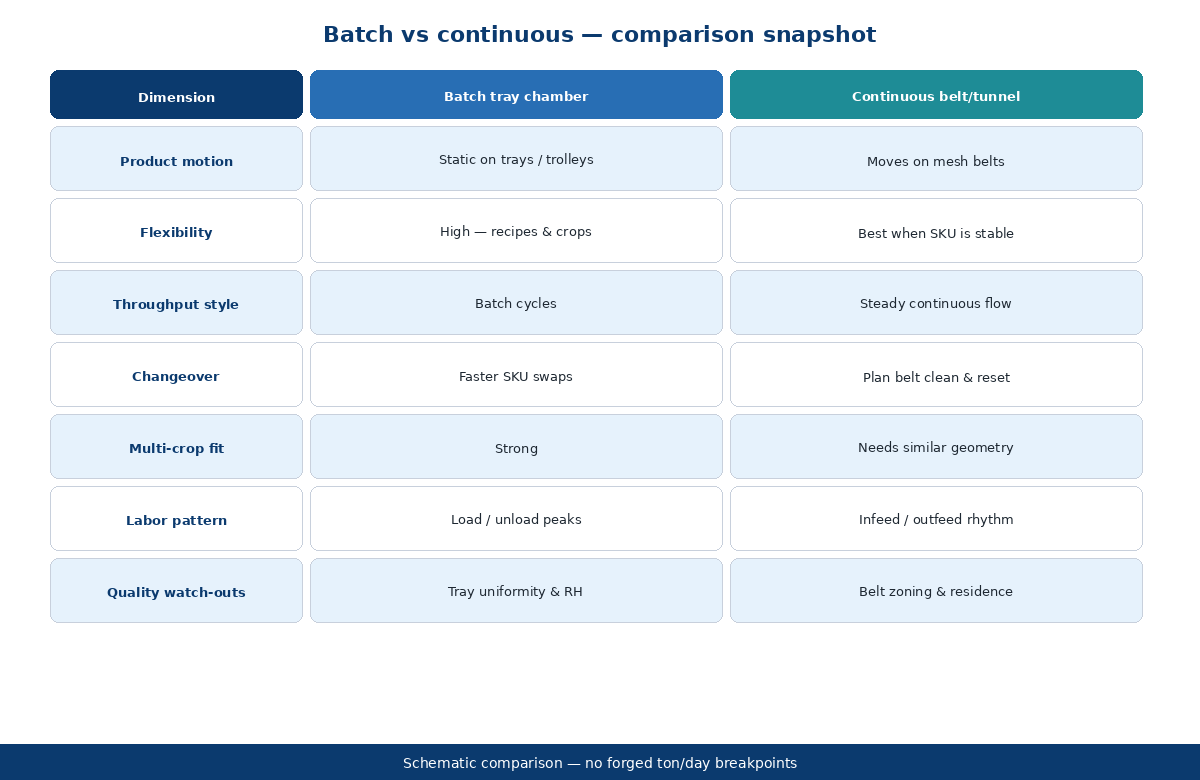
Decision rule of thumb (qualitative only): choose batch when crop and SKU variety dominate your year; choose continuous when stable geometry + high daily wet tons of similar product dominate. Do not treat any public “tons/day” number as a universal switchover law — plant-by-plant.
When Batch Flexibility Wins
Batch heat pump drying is usually the better fit when your fruit plant looks like this:
1. Many SKUs, short campaigns
You dry mango chips one week, pineapple rings the next, then a smaller herb or chili lot for a contract buyer. Each product wants its own temperature–humidity curve, slice thickness, and packing moisture. A tray chamber lets you finish one recipe cleanly, then start another without redesigning a belt line.
2. Seasonal and surplus-driven infeed
Tropical fruit plants often chase harvest peaks and local surplus. Wet tons per day swing. Batch chambers scale by adding cycles or trolleys, and you can leave a chamber idle without keeping a long belt “warm for nothing.” Continuous lines prefer predictable, high utilization.
3. Export buyers who demand trial lots and recipe proof
New markets often start with sample cartons and small purchase orders. Batch dryers support pilot → validation → scaled batches on the same machine family. You can document chamber programs (time, T, RH) for buyer audits more easily than explaining a one-off belt campaign.
4. Fragile or irregular pieces
Whole pieces, thick halves, sticky high-sugar fruit, or mixed sizes are harder to keep uniform on a moving belt. Trays give operators visual control: rearrange, thin out dense areas, or pull a trolley early for a moisture check.
5. Shared chamber for fruit + adjacent foods (with hygiene discipline)
Some plants use one heat pump platform for fruit today and a compatible dry snack tomorrow. That only works with documented cleaning and allergen/flavor segregation. Batch changeovers are still work—but they are often easier to schedule than clearing an entire multi-layer belt line. See the multi-crop section below.
Batch does not mean “small forever.” Commercial tray systems can be large. Airtek positions custom capacity across a wide wet-load range (public site language spans roughly 100 kg to larger industrial scales). What batch really buys you is scheduling and recipe freedom, not a permanent small-plant identity.
When Continuous Throughput Wins
Continuous belt or tunnel heat pump drying starts to make sense when the plant economics shift from variety to flow:
1. High daily volume of similar geometry
If your peeling and slicing lines already run many hours with a narrow product family—thin fruit slices, vegetable shreds, leaf strips, or pellets that ventilate well—a mesh-belt dryer can keep pace without waiting for a full chamber unload. Throughput is expressed as kg/h wet in or kg/h dry out once bed depth and belt speed are locked— for your crop.
2. Labor cost of load/unload dominates
Manual trolley handling is manageable at moderate volumes. At high volumes, teams spend the day pushing carts. Continuous infeed/outfeed (often with feed and discharge conveyors) can reduce per-kilogram handling—if upstream and downstream are also continuous. A belt dryer alone does not fix a manual peeling bottleneck.
3. Long campaigns of one crop
Contract drying for a single export chip SKU lasting weeks favors belt utilization. Changeovers are rare, so the mechanical complexity pays for itself through steady output and fewer open-door heat losses between batches.
4. Process already designed around zones
Some fruit and vegetable plants specify multi-layer belts with 1–5 mesh layers (common industrial design language on continuous food dryers). Hot air passes through the bed; residence time is belt length × layers ÷ speed. This suits thin, free-flowing pieces. Thick, sticky, or very irregular fruit may still belong on trays even at high volume—or may need a hybrid plant.
5. You are building a dedicated high-volume line
Greenfield plants that know their flagship dried fruit SKU for the next several years often specify continuous drying from day one, with batch chambers kept for R&D, premium SKUs, or overflow. That hybrid layout is common and often wiser than forcing everything onto one architecture.
Caution: continuous is not automatically “more efficient.” Heat pump energy performance still depends on moisture removed, ambient conditions, and how well air contacts the product. A poorly loaded belt can waste as much energy as an overloaded tray. Ask suppliers for kWh per kg water removed under stated assumptions—not a single magic percentage.
For the energy metric buyers should request—and how closed-loop recovery differs from hot-air exhaust loss—see How heat pump dryers cut energy use vs conventional hot-air dryers.
Changeover and Multi-Crop Implications
For many Airtek-relevant fruit plants, the real question is not “batch or continuous?” but “how often do we switch crops?”
What changes between crops
- Residue and aroma: chili, garlic, onion, and strongly flavored fruits leave volatiles that can taint the next sweet fruit run.
- Allergens / labeling (where applicable): shared equipment needs a written sanitation SOP even if local rules are light.
- Sugar and fines: sticky fruit leaves films on trays, mesh, and walls; under-cleaning causes scorching and microbiology risk.
- Recipe library: PLC or controller recipes should be named, versioned, and locked after validation—not overwritten casually.
Why batch often wins on changeover frequency
Between batches you already stop the process. That stop is a natural window to:
- Remove trays/trolleys
- Dry-clean crumbs and wash food-contact surfaces
- Inspect seals, drains, and condensate paths
- Load the next crop with a different T/RH program
Continuous lines can be cleaned thoroughly too—but clearing multiple belt layers, guides, and dead zones typically takes more planned downtime. If you change crops daily or several times per week, batch flexibility usually protects quality better. If you change crops monthly, continuous campaign drying can still work with a documented CIP/manual clean protocol— time and labor for your line layout.
Hybrid plant pattern (often the practical answer)
| Role | Typical equipment | Use |
|---|---|---|
| Flagship SKU | Continuous belt heat pump dryer | Long runs, high kg/day |
| Secondary SKUs / seasons | Batch tray heat pump chamber(s) | Variety, trials, overflow |
| Process development | Small batch chamber | Recipe and moisture validation |
Many growing processors start all-batch, then add a belt line when one SKU earns enough volume. That path reduces stranded CapEx compared with buying continuous before demand is proven.
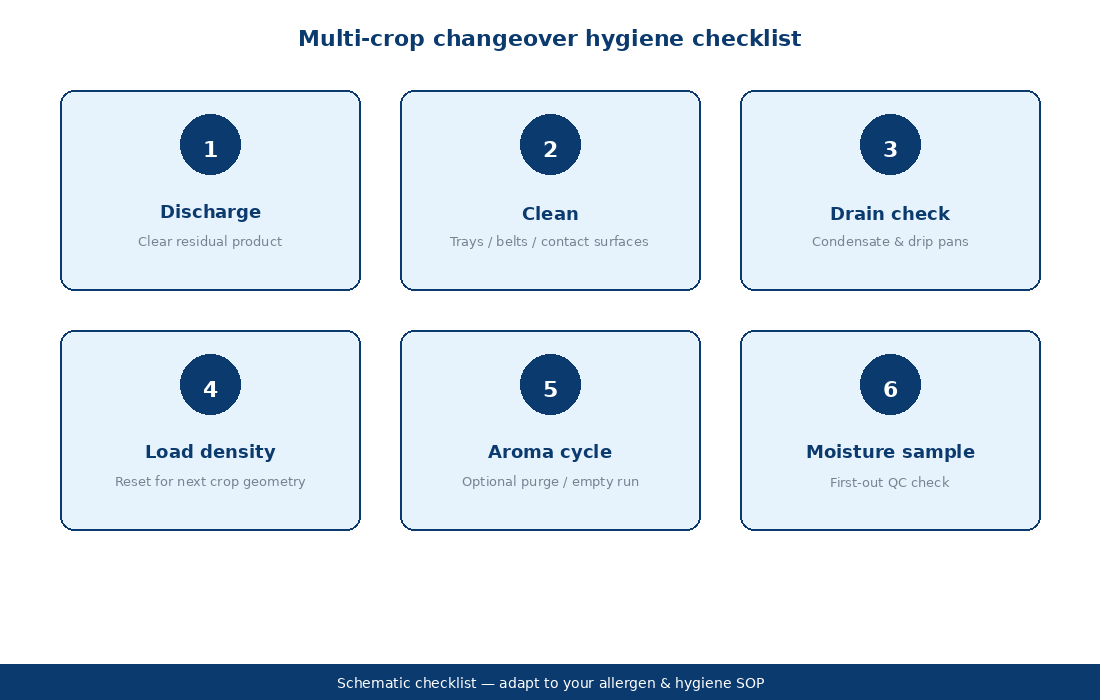
Operator checklist for multi-crop changeover (either architecture)
- Confirm previous product is fully discharged.
- Clean food-contact surfaces; verify no visible residue on mesh/trays.
- Check condensate drains and water trays.
- Load next crop at validated bed depth / tray density—do not invent density from a blog.
- Run a short empty or low-load warm/dry cycle if aroma carryover is a known risk— whether your SOP requires it.
- Pull early moisture samples before declaring the first full production lot “buyer ready.”
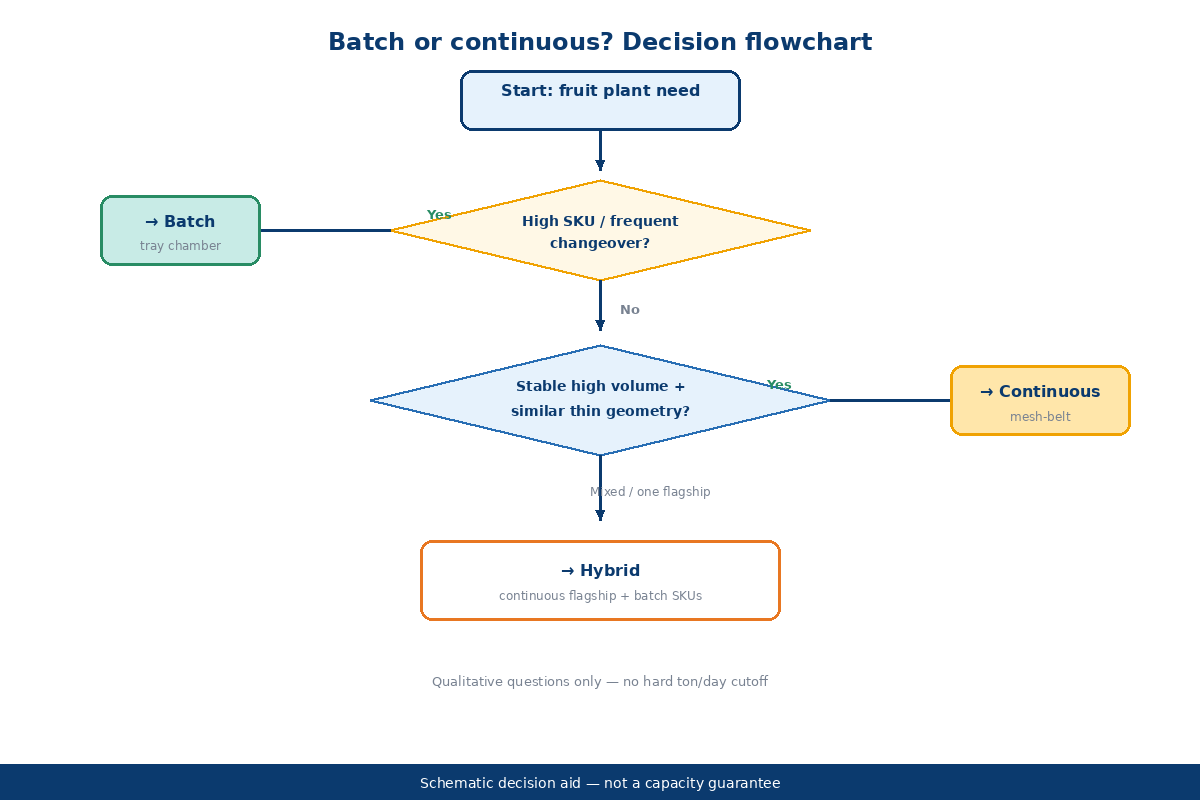
Decision Framework for Fruit Plant Buyers (No Fake Cutoffs)
Answer these questions in writing before you lock CapEx:
- Wet infeed pattern: How many wet tonnes per day in peak month vs off-season?
- SKU count: How many dried fruit (or adjacent food) SKUs share this dryer in a typical month?
- Geometry: Mostly thin slices/shreds, or mixed thick pieces and whole fruit?
- Changeover frequency: Daily / weekly / monthly?
- Labor model: Available for trolley handling, or pushing toward continuous infeed?
- Quality story: Need frequent buyer trials and recipe proof, or one long export contract?
- Utilities & footprint: Chamber height vs long belt hall—what does the building allow?
- Growth path: Will one SKU likely dominate in 12–24 months?
Qualitative mapping (not capacity law)
| If your answers lean toward… | Prefer… |
|---|---|
| High SKU count, seasonal peaks, frequent changeover, trials | Batch / tray heat pump dryer |
| Stable high volume, similar thin geometry, rare changeover, continuous upstream | Continuous / belt heat pump dryer |
| One growing flagship + several side SKUs | Hybrid (belt + batch) |
Refuse any supplier who insists on a universal tonnage switchover without asking about crop mix and changeover. Sizing still starts from wet mass, initial/final moisture, and hours available—see future calendar topics on capacity sizing. Exact Airtek chamber or belt dimensions remain project-specific per inquiry.
How Heat Pump Technology Fits Both Architectures
Regardless of batch or continuous hardware, the heat pump value proposition for fruit drying stays the same at mechanism level:
- Closed-loop air can be dehumidified by condensation and reheated, recovering much of the latent heat that open exhaust systems throw away.
- Temperature and humidity can be managed more deliberately than “heat harder and dump moist air.”
- Indoor, weather-independent operation supports export hygiene narratives versus sun drying.
What changes with architecture is air path and residence time control—chamber volume and tray stacking versus belt zones and bed depth—not the basic refrigerant + air-loop idea.
For fruit-specific process context (chips, slices, moisture thinking), pair this selection guide with Airtek’s fruit drying machine pages and product-application content. For continuous mechanical layout language, see how belt conveyor drying works.
Practical RFQ Notes (So Quotes Compare Fairly)
When you request quotations for a batch vs continuous heat pump dryer, send the same packet to every supplier:
- Product list and share of annual wet tonnage by crop
- Slice/piece geometry and target moisture (wet basis)
- Peak and average wet kg/day and operating hours
- Preferred architecture (batch / continuous / hybrid) and why
- Voltage, available power, and approximate hall dimensions
- Hygiene expectations (stainless contact parts, washdown, etc.—confirm grades on the quote)
- Whether you need installation guidance and training scope
Ask for:
- Assumed kg water removed and indicative energy discussion (not a guaranteed magic multiple)
- Control capability (programs, zones, logging)
- Spare parts list for belts/trays/fans
- Cleaning access design
Avoid comparing a “batch kg per cycle” quote to a “belt kg/h” quote without converting both to daily wet infeed under your hour calendar.
FAQ — Batch vs continuous heat pump dryer
Q1. What is the difference between a batch and a continuous heat pump dryer?
A. Both can use heat pump dehumidification and reheat. In batch / tray chamber systems, product stays put for a full recipe cycle. In continuous / belt or tunnel systems, product moves through zones while drying. The buyer decision is flexibility and changeover versus steady throughput—not “which one has a heat pump.”
Q2. When should a fruit plant choose batch tray chambers?
A. When you run many SKUs, seasonal or surplus-driven infeed, frequent crop switches, export trial lots, or irregular/thick pieces that need visual tray control. Batch buys scheduling and recipe freedom; commercial chambers can still be large. Do not equate “batch” with “forever small.”
Q3. When does a continuous belt heat pump dryer make sense?
A. When you have high daily volume of similar geometry (thin slices, shreds, well-ventilating pieces), long campaigns of one crop, continuous upstream peeling/slicing, and labor cost dominated by load/unload. Express capacity as kg/h under stated bed depth and speed— for your crop—not a universal plant law.
Q4. Is continuous always more energy-efficient than batch?
A. No. Heat pump energy performance still depends on water removed, ambient conditions, and air–product contact. A poorly loaded belt can waste as much energy as an overloaded tray. Ask for kWh per kg of water removed under stated assumptions. See Airtek’s guide: Heat pump dryer energy saving vs hot-air dryers.
Q5. What should I send Airtek to decide batch, belt, or hybrid?
A. Send: crop list and share of annual wet tonnage, piece geometry and target moisture, peak vs average wet kg/day and hours, changeover frequency, hall footprint limits, power supply, and whether upstream is batch or continuous. Prefer stating a preferred architecture and why. Use the product inquiry form. Many growing plants start all-batch, then add a belt when one SKU earns the volume.
Talk to Airtek About Batch, Belt, or Hybrid Fruit Drying
If you are designing or upgrading a fruit dehydration plant, share your wet daily tonnage, crop list, changeover frequency, and whether your upstream line is batch or continuous. The Airtek team can discuss chamber heat pump dryers, conveyor belt type dryers, or a hybrid layout matched to your fruit—not a one-size slogan.
Next step: send a product inquiry with wet infeed, target moisture, and multi-crop notes. We will help you frame the batch vs continuous decision with project-specific assumptions—and mark what still needs plant trials.